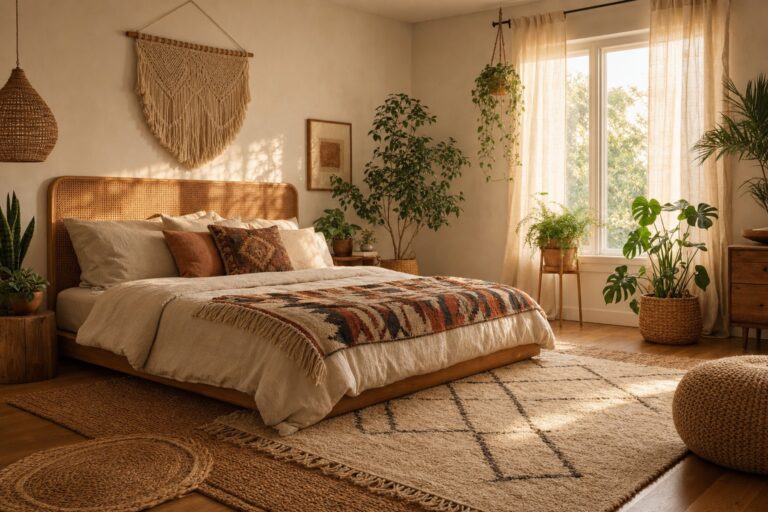
Bedroom Wall Decor Above the Bed: Weight First, Then Style

Every list of bedroom wall decor above the bed jumps straight to the pretty part — canvas or tapestry, gallery or mirror — and skips the two questions that actually decide the wall. First: this is the only wall in your home you sleep directly under, so weight comes before style.
Second: the zone above a headboard is wide and short, which quietly disqualifies half the art formats in the store. Answer those two, and the pretty part gets easy — this guide sorts the looks by weight class, gives you the sizing recipe as a drawing, and ends with a fifteen-minute tape mockup so the first nail hole is the right one.
Jump to a section
- The zone is wide and short — so think horizontal
- The proportion recipe: two-thirds wide, a hand above
- Sort every idea by weight, because you sleep under it
- Featherweight looks: fabric, paper, and air
- Middleweight: the framed pair and the long horizontal
- Heavyweight honesty: mirrors and shelves belong on other walls
- The headboard handshake
- Color: pull it from the bedding, not the wall paint
- Renting? The no-drill weight ceiling
- Light the zone and the decor works nights
- The fifteen-minute tape mockup
- FAQ
The zone is wide and short — so think horizontal

Measure the space you're decorating and it's a surprise: a queen bed is 60 inches wide, but between the top of a typical headboard and an 8-foot ceiling there's often only two to three feet of usable height. That's a banner, not a wall — a wide, short band that wants wide, short things.
This one observation explains most above-bed failures. A tall portrait-format canvas floats in the band like a postage stamp. A small square print gets swallowed. What thrives up there: one long horizontal piece, a landscape-format pair, a row of three, a wide tapestry, or a horizontal gallery cluster that reads as one wide shape. Retailers have noticed — "above bed" is one of the only searches where stores sell art by the location — and nearly everything they stock for it is horizontal. Shop your own candidates with the band's shape in mind and the options shrink to the ones that will actually work.
The proportion recipe: two-thirds wide, a hand above

Here's our sizing recipe, and the reasoning, so you can bend it knowingly. Width: about two-thirds of the bed. On a 60-inch queen that's roughly 40 inches of art (or a grouping that totals 40 inches including gaps). Full bed width reads crowded, like a second headboard stacked on the first; half width reads skimpy, like the art shrank in the wash. Two-thirds leaves visible breathing room on both sides while still clearly belonging to the bed.
Height: a hand's width above the headboard — six to ten inches. Lower, and the frame gets knocked every time pillows get stacked; higher, and the art divorces the bed and starts belonging to the ceiling. If you have no headboard, drop the decor lower so it takes the headboard's job — that trick and the rest of the headboard-free playbook live in our apartment bedroom guide.
The diagram above puts all of it in one picture. When you break the recipe, break it on purpose: an oversized statement piece can run nearly full width — but then it must be featherweight or properly anchored, which is the next section's whole subject.
Sort every idea by weight, because you sleep under it

Before choosing between the tapestry and the mirror, notice what they weigh, because gravity treats them very differently over a pillow. FEMA's earthquake-readiness guidance is blunt about walls in general — secure heavy items, including "objects that hang on walls" — and while most of us don't plan around earthquakes, the above-bed wall is the one place where "how is this attached, and what if it isn't enough?" is a fair nightly question.
So this guide sorts the looks into three classes. Featherweight — fabric, paper, dried botanicals — weighs ounces, hangs from pins or adhesive, and can't meaningfully hurt anyone. Middleweight — framed prints and canvas — weighs real pounds and earns real hardware. Heavyweight — mirrors, loaded shelves, massive framed glass — deserves either serious anchoring into studs or, our honest advice, a different wall. Pick your class first; every idea below is filed under one.
Featherweight looks: fabric, paper, and air

The featherweight class is bigger and better-looking than people expect, and it's the class where the above-bed wall becomes worry-free. A woven tapestry or quilt hung from a light wooden dowel adds more square footage of texture per ounce than anything else in decor. Macrame brings dimension and shadow. Dried botanicals — a row of bundled stems, a palm frond, a wide eucalyptus swag — give the wall a soft organic line. Paper works too: an oversized unframed print mounted on foam board, hung with adhesive strips, reads from across the room exactly like a framed piece at a tenth of the weight.
The styling rule that keeps featherweight from reading flimsy: go bigger than you would with a frame. Fabric and paper cost little per square foot, so hit the full two-thirds width confidently. This class is also the whole answer for anyone nervous about the wall — a bed under a quilt hung on a dowel has nothing above it but cloth and wood the weight of a coat hanger.
Middleweight: the framed pair and the long horizontal

Framed prints and stretched canvas are the classic answer, and they're fine over a bed — installed like you mean it. Two moves dominate this class. The landscape pair: two matched horizontal frames hung side by side with a couple of inches between them, which fills the band, survives the two-thirds math easily, and lets couples split the subject (two halves of one landscape is the quiet favorite). And the single long horizontal — one wide canvas or framed print that treats the whole band as one gesture.
Installation is the class rule: hang on two hooks, not one (it keeps long frames level and doubles the support), use real picture hooks or anchors rated beyond the frame's weight, and skip the single bare nail at an angle. Canvas beats glass over a bed at equal size — a stretched canvas is mostly air on a wood frame, while glazed frames concentrate weight in the one material you least want overhead. If a piece needs glass, keep it modest and hang it heavy-duty.
Heavyweight honesty: mirrors and shelves belong on other walls

Every above-bed roundup includes the round mirror and the styled picture-ledge shelf, so let's be the one guide that's honest: these are the two heaviest, most-likely-to-be-bumped options in the room, positioned over your head for six to eight unconscious hours a night. A mirror is dense glass; a ledge invites you to keep adding objects to it; both get knocked by headboards, pillow fights, and enthusiastic bed-making.
Our advice: give them the opposite wall. A mirror across from the bed doubles the room's light and lets you actually use it; a picture ledge over the dresser holds the rotating photo collection at a height where rearranging it is easy. If you're set on heavy art above the bed anyway, the standard rises: anchors into wall studs, hardware rated well beyond the object's weight, and nothing merely hooked over a nail. "It hasn't fallen yet" is not a mounting system.
The headboard handshake

Art and headboard share one small band, so they have to agree. A tall, ornate headboard is already the wall's statement — decor above it should shrink toward a single small piece or nothing at all, and that's a legitimate finished look. A low, plain platform headboard hands the job upward: the art can grow toward the full two-thirds and carry the wall alone. The mistake is two statements: a carved cane headboard and a bold gallery six inches above it read like two people talking over each other.
One glance test settles it: stand at the foot of the bed and squint. You should see one vertical focal moment — headboard and art reading as a single stacked composition — not two rivals. If your eye bounces between them, quiet one of the two.
Color: pull it from the bedding, not the wall paint

The fastest way to make above-bed decor look intentional is to let it repeat something the bed is already wearing. Pull the art's dominant color from the duvet, the accent pillows, or the throw — not from the wall paint. Matching the paint makes the piece dissolve; echoing the bedding ties art and bed into one furniture-scale object, which is exactly what the two-thirds rule is doing geometrically.
This is also the cheapest refresh lever in the room: keep a neutral bed and a featherweight art format, and swapping one pillow cover plus one inexpensive print re-themes the entire wall for a season. If your bedding is patterned and busy, run the logic in reverse — calm, tonal art above, so the bed keeps the microphone.
Renting? The no-drill weight ceiling

Every class above has a no-drill translation, but the weight sort matters even more when adhesive is doing the holding. Featherweight is the renter's home field: pins leave pinholes (usually a non-issue), and adhesive strips carry fabric, foam-mounted prints, and light dowels without drama. Middleweight works on the large-size adhesive hangers — but respect the package's stated limit as a ceiling, not a suggestion, press-and-wait exactly as directed, and remember our rule from the command hook guide: the object's REAL weight, frame and glass included, decides the hardware.
Heavyweight has no honest no-drill version — no adhesive product wants a mirror over a bed, and neither do we. If you rent and love heavy pieces, this is the class that leans against the dresser or hangs on the one wall where your lease allows a proper anchor. The deposit-safe wall above the bed is a featherweight-to-light-middleweight zone, and it can still look like the best wall in the apartment.
Light the zone and the decor works nights

Above-bed decor spends half its life in a dark room. One warm, low-wattage light aimed at the zone — a plug-in picture light on the frame, or a pair of plug-in sconces flanking the art — turns the wall into the room's evening focal point and doubles as reading light that frees up the nightstands. Cord covers run the wire down to the outlet cleanly, no rewiring involved.
Keep the bulb warm and dim; this is glow, not gallery lighting. The pairing rules stay in force: sconces are middleweight objects, so they follow middleweight hardware rules, and their light flatters texture most — one more argument for the tapestry.
The fifteen-minute tape mockup

Before any hardware, build the wall in paper. Cut kraft paper or newspaper to your candidate's exact size, tape it up centered over the bed at headboard-plus-a-hand height, and live with it through one evening and one morning. Check it from the foot of the bed, from the doorway, and lying down. The two-thirds math gets you close; the mockup catches what math can't — a light switch that clips the composition, a ceiling slope that wants the piece shifted, a size that felt right online and feels timid on the wall.
Adjust the paper, not the nail holes. When the paper's been right for a full day, mark its top corners lightly in pencil, and hang once. The blank wall above a bed is the most-photographed spot in most bedrooms — fifteen minutes of paper is what makes the version you commit to the version you meant.
FAQ
How high above the headboard exactly?
Six to ten inches — close enough that bed and art read as one composition. With no headboard, center the art so its midpoint sits roughly at standing eye level, then nudge it lower until it visually connects to the bed.
Is a mirror above the bed ever okay?
We file it under heavyweight and recommend the opposite wall, where a mirror is also more useful. If you're committed, mount it into studs with hardware rated well past its weight — and never on adhesive or a single nail.
What about a TV above the bed?
A TV is a heavyweight object with a cord problem, and above the bed it forces a neck angle you'll regret. FEMA's securing guidance applies doubly. If the bedroom needs a TV, the wall or dresser opposite the bed is both safer and more watchable.
I have no headboard — what changes?
The decor drops lower and takes the headboard's job: a wide tapestry, a row of frames, or a painted-rectangle effect starting just above the pillow line. It anchors the bed visually the way a headboard would.
Does any of this change in an earthquake area?
The weight sort becomes policy instead of preference: featherweight over the bed, everything heavy secured per FEMA's guidance or moved off sleeping-area walls entirely. Local codes and common sense outrank decor in those zip codes.