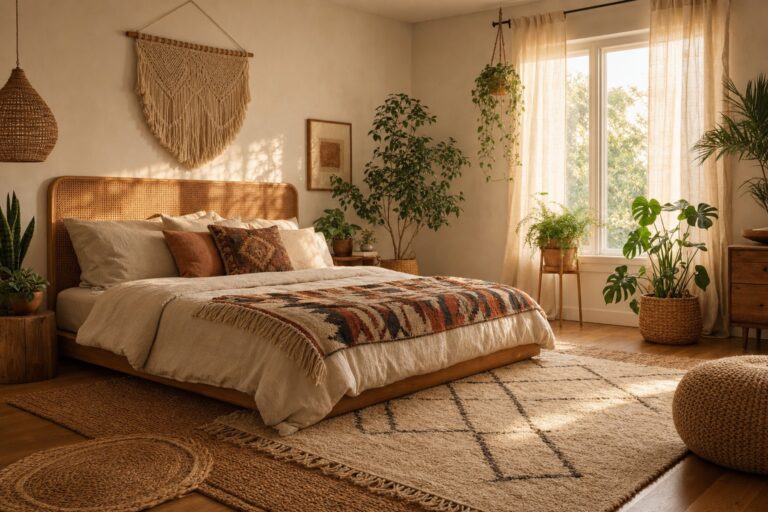
Bedroom Wall Decor: Four Walls, Four Different Jobs

Bedroom wall decor ideas usually arrive as a pile — thirty looks, zero placement logic — which is how bedrooms end up with a beautiful print on the wrong wall and three walls of nothing. Here's the sort that makes every purchase place itself: a bedroom's four walls have four different jobs. The bed wall anchors the room.
The wall you wake up facing sets the morning's tone. The window wall already has its decor — the curtains. And the working wall, usually behind the door or over the dresser, carries the mirror, the photos, and everything too heavy or busy for the others. Assign the jobs first, and the shopping list writes itself.
Jump to a section
- Four walls, four jobs: the map
- The bed wall: the anchor (the short version)
- The wake-up wall: decorate for 7 a.m.
- The window wall: the curtains are the decor
- The working wall: mirror, photos, and the heavy stuff
- One statement per room, everything else supports
- Texture speaks quieter than print
- Awkward walls: slopes, corners, and half walls
- Renting? Same jobs, no holes
- The 30-minute walk: assign before you shop
- The finish line: when to stop
- FAQ
Four walls, four jobs: the map

Stand in the doorway and read the room clockwise. Wall one, the bed wall, is the room's stage — whatever hangs there frames the headboard and photographs as "the bedroom." Wall two, the wake-up wall, is the one your eyes open to; it's seen more minutes per year than any art you own, all of them half-asleep. Wall three, the window wall, is mostly glass, radiator, and curtain hardware — hanging space is an illusion there. Wall four, the working wall, holds the door, the dresser, or the closet; it's seen in passing, at full alertness, which makes it the room's only honest home for busy, heavy, or interactive decor.
Most bedroom decorating mistakes are job mix-ups: the bold gallery on the wake-up wall (too loud for 7 a.m.), the mirror over the bed (a weight problem), art crammed beside a window (fighting the curtains). The diagram above is the map; the next four sections take the walls one at a time.
The bed wall: the anchor (the short version)

The bed wall's job is to make bed and wall read as one furniture-scale composition — one statement at roughly two-thirds of the bed's width, hung close above the headboard, weight chosen with a healthy respect for the fact that you sleep under it. That last idea matters enough that we gave this wall its own full guide, with the sizing math, the weight classes, and a paper-mockup method.
For the whole-room decision this article is making, you only need the bed wall's one rule: it goes first. Choose its statement before buying anything for the other three walls, because its colors and mood set the palette everything else supports. A room decorated outward from the bed wall coheres; a room decorated wall-by-wall in shopping order collects.
The wake-up wall: decorate for 7 a.m.

The wall opposite your pillow is the most-viewed surface in your home and the least considered. Its audience is always horizontal, half-awake, and unwilling to be shouted at — so its job is calm with something to look at: one large, quiet piece (a muted landscape, a soft abstract, a textile), low contrast, no busy grids. A single oversized calm piece beats six small frames here, because a grid asks your waking eyes to count.
Two placement notes tune it. Hang slightly lower than you would elsewhere: the standing gallery convention centers art at about 57 inches, but this wall's real audience views it from bed, and a touch lower meets that sightline. And check it at night — it catches the streetlight-and-shadow show, so glass frames that glare are wrong here; canvas or fabric wins again. If the TV lives on this wall, let it: mount it at the same considered height, flank it with calm, and skip pretending a screen is a gallery.
The window wall: the curtains are the decor

The window wall almost never has real hanging space — glass, trim, a radiator, and awkward slivers of plaster. Stop trying to decorate the slivers. On this wall, the curtains are the artwork: hang the rod close to the ceiling and let the panels run to the floor, extend it wide so the fabric stacks on wall rather than glass, and the window reads taller, the wall reads dressed, and the room gets its biggest textile moment for the price of a longer rod.
Fabric choice is the design decision: linen-look for airy rooms, a warm color or subtle stripe when walls are plain white. The slivers beside the window stay empty on purpose — breathing room is part of the composition. The one exception that works: a slim vertical piece (a narrow botanical, a hanging fern) on a wide-enough flank, hung to align with the curtain rod so it joins the window's architecture instead of competing.
The working wall: mirror, photos, and the heavy stuff

Whatever the other three walls rejected, the working wall welcomes — because it's viewed standing, in passing, at full attention. This is the mirror's home (bounce the window's light from here and skip the over-bed weight debate entirely), the photo wall's home, the picture ledge's home, and the right spot for anything interactive: the jewelry organizer, the hat display, the calendar.
Over the dresser, treat furniture and decor as one stacked unit — mirror or art starting 6 to 8 inches above the dresser top, no wider than the dresser. For family photos, one archival note worth obeying: the Library of Congress's care guidance says to limit light exposure and keep photographs away from vents and heat sources — which conveniently argues for exactly this wall, usually the room's dimmest, and against the sunny window flank. Print spares of anything irreplaceable; walls fade photos, full stop.
One statement per room, everything else supports

Four walls with jobs still need a hierarchy, and the rule is the same one that governs a good outfit: one statement, everything else supporting. Pick the room's single loudest moment — usually the bed wall's piece, sometimes a dramatic wake-up wall canvas — and let the other walls speak at half volume: smaller pieces, quieter colors, more texture than image.
The failure mode is three statements: a bold bed wall, a bold gallery, and bold curtains, each excellent, together exhausting. If you love it all, rotate seasonally instead of hanging simultaneously — the closet is a legitimate gallery archive. And if you're building a true gallery grouping anywhere, the craft of making many frames read as one shape lives in our gallery wall guide; in a bedroom, that one shape counts as your statement.
Texture speaks quieter than print

A sleep room rewards decor you read with your skin as much as your eyes. Woven hangings, quilts on dowels, baskets, wood, plaster relief — texture gives a wall presence without an image demanding interpretation, which is why textural walls feel expensive and restful at once. The practical bonus: textiles are the lightest weight class, which reopens doors the framed-glass world closes — including most rental rules and every anxiety about hardware.
Use texture where print would shout: the wake-up wall, the slivers a small print would clutter, above a dresser that already holds visual noise. A good test when torn between a print and a woven piece: imagine both at dusk with one lamp on. The print goes dark; the texture keeps its shadows. Bedrooms live at dusk.
Awkward walls: slopes, corners, and half walls

Real bedrooms have walls the idea lists ignore: the knee wall under a slope, the sliver behind the door, the corner the closet chopped. The jobs framework handles these too — an awkward wall is a supporting wall by definition, so it gets modest, flexible decor. Slope walls take art leaned on the floor-side ledge or a low row hung to follow the angle (align frame centers along the slope, not the level). Slivers take one slim vertical or a single hook with something beautiful on it. Deep corners take a plant tall enough to claim them.
The freeing rule: an awkward wall is allowed to be empty. Every room needs quiet square footage, and the odd wall is the natural donor — emptiness there reads intentional the moment the four main walls clearly have jobs.
Renting? Same jobs, no holes

The framework survives a lease untouched; only the hardware changes. The bed wall runs featherweight — fabric on dowels, foam-mounted prints on adhesive strips (limits and technique in the command hook guide). The wake-up wall's one large calm piece can lean on a dresser or console instead of hanging — oversized leaning art is a legitimate look, not a compromise. The window wall needs one act of courage: a proper rod, mounted with the right anchors, because tension rods can't run wide — this is the single hole-set most landlords happily allow when asked. The working wall's mirror leans; the photo ledge becomes an adhesive ledge rated for its real load.
What renters should skip: heavy framed glass anywhere adhesive is doing the holding, and wallpapering every wall. One peel-and-stick accent wall — behind the bed, where the anchor job wants it — delivers the whole apartment-transformation photo with one afternoon of removal at the end.
The 30-minute walk: assign before you shop

Do the assignment before the browsing, or the browsing will do the assigning. Stand in the doorway with your phone and photograph each wall straight-on. Label the four photos with their jobs. Then audit what's already hanging against the job list — you'll usually find a mix-up or two (the busy gallery on the wake-up wall is the classic) and realize the fix is a swap, not a purchase.
Only then make the list, in order: the bed wall's statement first, the wake-up wall's calm piece, the curtain upgrade, the working wall's function. Most bedrooms need to buy two things and move two things. That's the quiet advantage of walls with jobs — the room stops being a gallery with vacancies and starts being a system with two openings.
The finish line: when to stop

A bedroom's walls are done earlier than the idea lists want you to believe. The test isn't "is every wall full?" — it's "does the room have one statement, three supporting players, and somewhere for the eye to rest?" If yes, stop. The impulse to fill the remaining gaps is how calm rooms drift busy, one reasonable purchase at a time.
Live with "done" for a month before adding anything. Bedrooms are the one room where restraint pays compound interest: every empty stretch of wall is doing quiet work each night, and the four jobs — anchor, calm, dress, serve — were never about filling walls. They were about letting a small set of good decisions run the whole room.
FAQ
How many pieces should a bedroom wall have?
Count moments, not pieces: one statement in the room, one supporting moment per remaining wall, and at least one wall stretch that's deliberately quiet. A gallery grouping counts as a single moment if it reads as one shape from the door.
Should the walls above both nightstands match?
They're part of the bed wall's composition, so symmetry helps but twin-matching isn't required — two frames from the same family, or one piece balanced by a sconce, both read as intentional. Keep whatever hangs there featherweight and modest; the bed wall's statement lives above the headboard, not the nightstands.
Is a wallpaper accent wall bedroom wall decor?
Yes — it's the bed wall's anchor job done in one move, and it usually replaces the need for art above the headboard. Keep the other three walls in supporting mode, or the room tips loud.
Is it bad to have a mirror facing the bed?
Practically, a mirror facing the bed reflects streetlight and motion, which some sleepers genuinely find disruptive — and some traditions dislike it outright. The working wall usually offers an angle that bounces window light without facing the pillows; that placement satisfies everyone.
How high should I hang bedroom art?
Start from the gallery convention — center around 57 inches — then adjust for the audience: a touch lower on the wake-up wall (viewed from bed), stacked to the furniture on the working wall (6–8 inches above the dresser), and by the two-thirds-plus-a-hand recipe on the bed wall, which has its own guide on the site.