
Kitchen Decor Ideas: Upgrade What Is Already There

Most kitchen decor ideas start with a shopping list. That is the wrong end of the problem, because a kitchen is the one room where nearly every decorative object is also a working object — and where counter space is too scarce to give away to things that do not earn it.
The better approach: your kitchen is already decorated. Every surface in it already has a color, a texture and a finish that somebody chose, usually not you. Decorating it means upgrading what is already there before adding anything new.
Jump to a section
- Your kitchen is already decorated — count what shows first
- Rank every change by visible area per dollar
- Textiles are the fastest change and the only one you can undo in an afternoon
- The towel problem: buy two sets, not one nice one
- A kitchen rug has a job a living room rug does not
- The window is usually the only soft thing missing
- Everything within arm's reach of the range has to be wipeable
- Change the shade and the bulb before you change the fixture
- Hardware is the cheapest change that reads as renovation
- The coherence rule: three things share one color
- The short list of things actually worth adding
- FAQ
Your kitchen is already decorated — count what shows first
Before you buy a single thing, work out what you are actually looking at. Stand in the doorway and rank the surfaces by how much of the view they occupy.
In almost every kitchen the order goes: cabinet fronts, then the floor, then the walls and backsplash, then the counter surface, then the window, then the hardware, and only then the objects sitting out.

That order is uncomfortable, because decor advice spends nearly all its attention on the last item — the objects — which is the smallest thing in the room. A canister set changes perhaps two percent of what you see. The floor is closer to a quarter of it.
You cannot always change the big things, especially renting. But knowing the order tells you where a fixed budget does the most work, and it stops you buying a fourth ceramic thing for a counter that already has three.
Rank every change by visible area per dollar
Divide what a change costs by how much of the room it covers, and do the cheap large ones first. This single calculation reorders most people's kitchen plans.
Roughly, from best to worst value in an average kitchen:
- A floor runner — covers a large share of the visible floor for the price of a couple of takeaways. Best ratio in the room.
- A café curtain — the window is small in area but high in attention, because it is the brightest thing in the room and the eye goes there first.
- Cabinet hardware — tiny individually, but there are usually twelve to twenty of them, evenly distributed across the largest surface in the room. That repetition is what makes it read as a renovation.
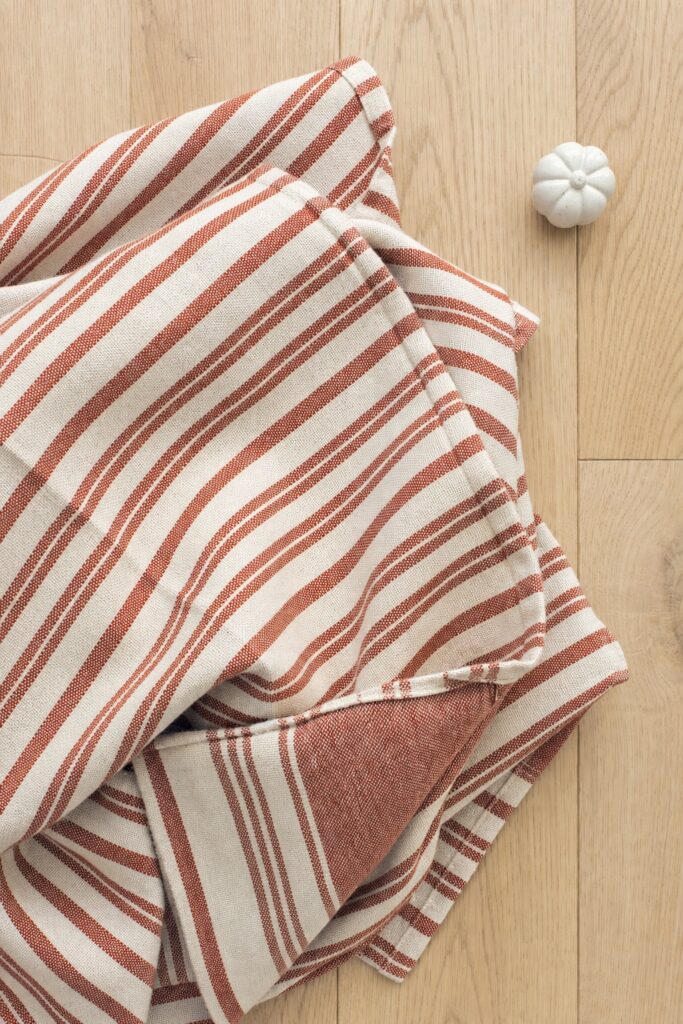
- Towels and seat pads — small area, but they sit at eye level in the busiest part of the room.
- A bulb and a shade — changes the color of everything in the room for a few dollars, which is the best ratio of all if your light is currently cold.
- One or two counter objects — smallest area, and each one costs you prep space. These come last, not first.
If you own the place and can repaint cabinet fronts or replace a floor, those beat everything on the list. This ranking is for the far more common situation where you cannot.
Textiles are the fastest change and the only one you can undo in an afternoon
The soft layer is where a kitchen gets its personality, and it is completely reversible. Runner, towels, café curtain, seat pads. Four items, one palette, no tools, and nothing that affects a deposit.
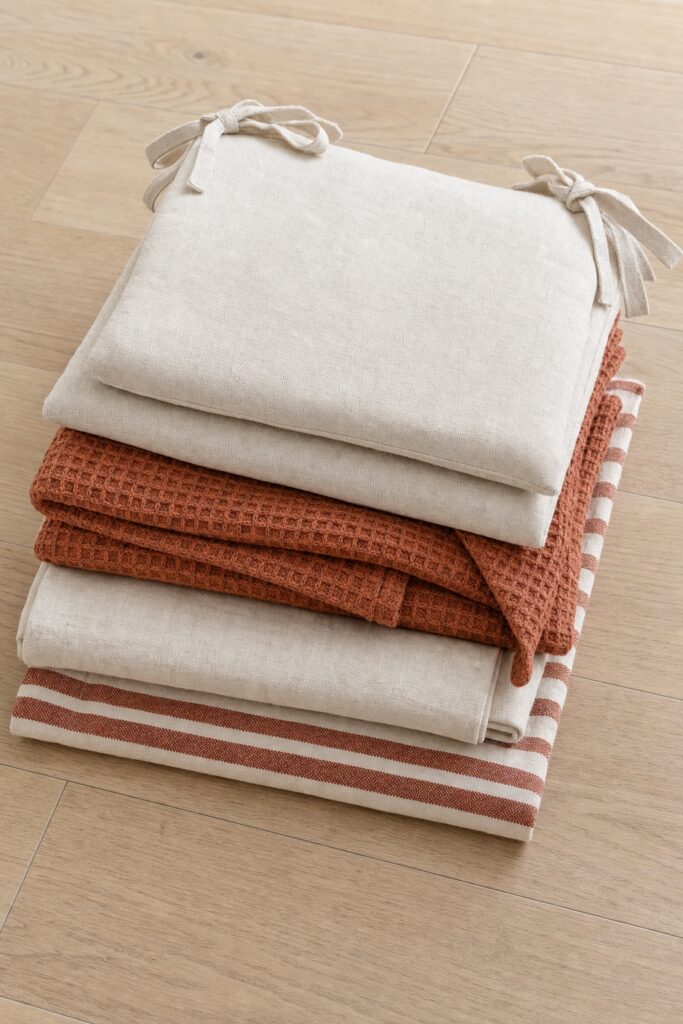
Buy them together rather than one at a time. Textiles bought over six months in six shops rarely land in the same color family, and a kitchen is small enough that a near-miss reads as a mistake rather than as a mix.
Keep the pattern simple. In a room already full of hard lines — cabinet doors, tile grid, appliance edges — a busy print competes with the architecture. Stripes, a plain weave with texture, or a simple check all sit better than a floral in a kitchen.
Cotton and linen only. Everything in this layer gets washed constantly, and the whole point of the soft layer is that it can be.
The towel problem: buy two sets, not one nice one
Kitchen towels need washing every two days, so one beautiful set cannot possibly do the job. This is the specific, boring reason most kitchens look tired: the towel on display is the towel that has been drying hands and wiping spills since Sunday.

Utah State University Extension's laundry guidance is blunt about the cadence: wash "every two days: hand towels and dish towels." For comparison, the same guidance puts bath towels at every three to four uses. Kitchen towels work harder than bath towels do, because they touch raw food, wet hands and counters.
So the working system is:
- Buy four to six identical towels in one color, not two "nice" ones. Identical means the rotation never looks patchy.
- Keep two out at a time — one for hands, one for dishes — and swap both into the wash every second day.
- Waffle weave or flat-weave cotton, not terry. They dry faster between uses and hang flat rather than bunching.
- Skip the decorative towel entirely. A towel that is too nice to use is not decor, it is a small piece of fabric taking up a rail.
If you want the display effect, hang the clean one and keep the working one on a hook inside a cabinet door. That is a real solution rather than a compromise.
A kitchen rug has a job a living room rug does not
It has to lie completely flat and it has to survive water. Those two requirements rule out most of what is sold as a runner, and they matter more than the pattern.
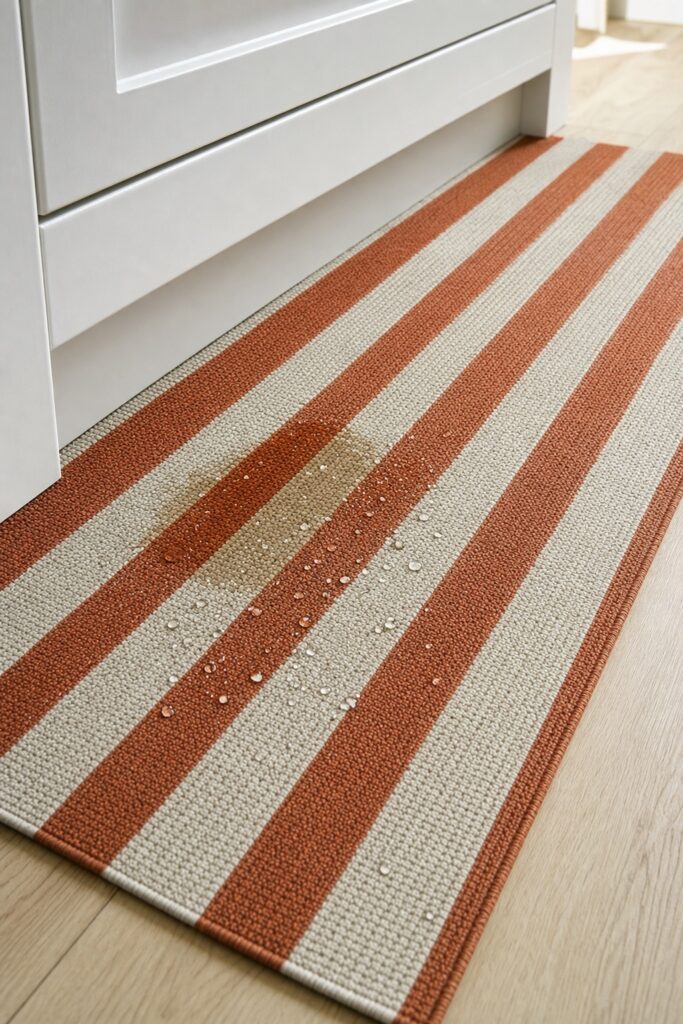
Flat, because of the traffic. A kitchen runner sits where people pivot with hot pans and full plates. Any curl at the edge is a trip point in the worst possible room for one. Buy low-pile and flat-woven, and if an edge lifts, a few strips of rug tape solve it permanently.
Washable, because of the water. The area in front of a sink gets splashed every single day. A rug that cannot go in a machine will be dingy within a season, and a thick pile will hold the damp.
That combination points at cotton flat-weaves and the newer machine-washable low-pile runners, and away from jute, sisal, and anything shaggy. Natural fiber rugs absorb water and stain rather than releasing it, which is exactly the wrong behavior in front of a sink.
Length matters more than width. A runner should span the working stretch — sink to range if you can — rather than sitting as a small mat in front of one appliance. A short mat cuts the floor into pieces and makes a galley kitchen look shorter.
The window is usually the only soft thing missing
A kitchen window with nothing on it is why the room feels hard. Kitchens are full of tile, laminate, steel and glass, and the window is often the last chance to introduce fabric at eye level.

The move that works in almost every kitchen is a café curtain: a single panel on a slim rod fitted across the middle of the window, covering the lower half only.
- You keep the light. The top half stays completely open, so a small kitchen loses nothing.
- You gain the privacy that actually matters — the half where someone can see you at the sink.
- It fits a rental. A tension rod inside the window frame needs no holes at all.
Keep it unlined and pale so light passes through. Cream, oatmeal, or a fine stripe in your accent color. A heavy floor-length drape in a kitchen collects cooking smells and blocks light for no benefit.
If the window is above the sink and you would rather not have fabric near the tap, the alternative is a plain roller blind mounted high and left rolled up most of the time, which still softens the top edge of the opening.
Everything within arm's reach of the range has to be wipeable
Cooking throws a fine film of airborne oil onto everything nearby, and anything porous in that zone will hold it. This is invisible for weeks and then obvious all at once — the surface stops reflecting light properly and starts looking dull and slightly yellow.

That single fact decides materials near the range:
- Fine near the range: glazed ceramic, glass, stainless, sealed stone, powder-coated metal, and anything you would happily wipe with a damp cloth every week.
- Not fine near the range: unsealed wood, paper, unframed prints, dried stems and grasses, raw plaster objects, and any fabric that is not going in the wash.
There is a safety layer on top of the practical one, and it is worth stating exactly rather than approximately. Fire-safety guidance from the NFPA, as published by state emergency agencies, is to "move flammable items, such as oven mitts, cooking utensils and food packaging, away from the stovetop," and separately to "keep children and pets at least three feet away from the stove." The three-foot figure is about people, not objects — but "away from the stovetop" is unambiguous for anything that can burn.
In practice: treat the counter either side of the range as working surface, not display surface. Put the pretty things at the far end of the run, on the wall opposite, or on a shelf away from the heat. A dried-grass arrangement beside a gas burner is both a grease magnet and a genuinely bad idea.
Change the shade and the bulb before you change the fixture
A cold bulb makes every other decision in the room look worse, and it costs a few dollars to fix. Kitchens are the room most likely to have been fitted with harsh, blue-white lighting, because it was sold as "bright" and bright was the only thing anyone optimized for.

Bulb color is measured in kelvin, and the number is printed on every box. Lower numbers are warmer and more amber; higher numbers are colder and bluer. Around 2700K reads as warm and domestic, roughly like the old incandescent bulbs. Somewhere near 4000K and above starts reading as clinical — fine over a chopping board, unpleasant for the room as a whole.
The practical fix, in order:
- Swap the bulbs first. Match every bulb in the room to the same warm temperature. Mixed bulb temperatures in one small room look worse than any single wrong choice.
- Then look at the shade. A bare bulb or a plain glass diffuser gives you flat, unflattering light. A simple dome shade in metal or ceramic directs it down onto the counter and takes the glare out of your eye line.
- Only then consider a new fixture, which usually means an electrician and, in a rental, a landlord conversation.
One exception worth keeping: under-cabinet task lighting can be cooler and brighter than the room light, because that is a working light aimed at a chopping board rather than a light you look at.
Hardware is the cheapest change that reads as renovation
Twenty handles change the largest surface in the room for the price of a takeaway each. Cabinet fronts are most of what you see, and hardware is the only part of them a renter is usually allowed to touch — and can put back.

The one thing to check before ordering anything: measure the hole spacing, called the center-to-center distance. Existing pulls are usually 3 inches (76 mm), 96 mm, or 128 mm on older cabinets. If you match the spacing, the swap is a screwdriver job with no new holes.
If your cabinets currently have knobs (one hole) and you want pulls (two holes), you will be drilling, which is fine if you own and a problem if you rent. Going the other way — pulls to knobs — leaves a visible spare hole.
Choosing:
- Matte black is the safe modern default and works with white, wood and most colors.
- Unlacquered brass warms up a cool kitchen and ages visibly, which some people love and some do not.
- Match the finish to the faucet if you can see them both at once, and ignore the appliances — nobody expects a stainless range to match a handle.
- Buy one first and live with it for a week before ordering nineteen more.
Renters: keep the original handles in a labelled bag. The swap is fully reversible and that bag is what makes it so.
The coherence rule: three things share one color
A kitchen reads as decorated when one accent color appears exactly three times, at three different heights. Not once, which reads as accidental. Not seven times, which reads as a theme.

Pick one warm accent — rust, olive, mustard, a deep green, a muted blue — and place it in three separated spots: something low (the runner), something at hand height (a towel or seat pads), and something high (a jug on a shelf, a pendant shade). The eye connects them across the room and reads the whole thing as deliberate.
Everything else stays neutral: white, warm grey, stainless, wood. In a small room, one accent plus neutrals is enough. Two accents is possible if one of them appears only once.
This is the rule that makes a cheap kitchen look considered, and it costs nothing, because it is a rule about placement rather than about buying.
The short list of things actually worth adding
After the swaps, almost nothing needs buying. Here is the honest list of objects that earn a permanent spot on a counter.

- A wooden board you actually use, left leaning against the backsplash. It is warm, it is the right kind of texture for a room full of hard surfaces, and it is in reach when you cook.
- One bowl of real fruit. Lemons, apples, whatever you eat. It is the only decor in the house that improves the room and gets consumed, and it is the cheapest color you will ever buy.
- One living herb in a small pot, if you have any daylight. Basil, mint or rosemary on a sill. It earns its footprint twice.
- A utensil crock with the tools you reach for daily. Not a display of twelve; the four you use.
That is it. Everything else — the sign, the decorative canister set, the second vase, the ceramic thing shaped like a lemon — costs you counter space you will want back within a month.
If you want more, put it on the wall or the shelf, not the counter. Our guide to kitchen wall art covers what survives the heat and grease up there, and the counter-specific guide works through where the safe zones are on a working counter.
FAQ
What is the cheapest way to make a kitchen look better?
Change the bulbs to a warm temperature and add a floor runner. Together those two cost very little and change the color of the entire room and about a quarter of what you see. Do them before you buy any objects.
How do I decorate a rental kitchen without losing my deposit?
Stay in the reversible layer: textiles, hardware (keep the originals in a bag), bulbs, a tension-rod café curtain, and free-standing objects. Nothing there needs a hole or a permanent adhesive. Our rental kitchen makeover guide goes further into the fixed surfaces.
Should kitchen decor match the rest of the house?
The palette should, the style need not. Carrying one or two colors through from the adjoining room is what makes an open-plan space feel like one home. Beyond that, kitchens tolerate being a little more practical and a little plainer than the rooms around them.
What kitchen decor should I avoid?
Anything porous or paper near the range, decorative towels you will not use, word signs, and any object whose only job is to sit on a counter. Counter space is the scarcest thing in the room; make each object earn its footprint.
Where should I put plants in a kitchen?
On a windowsill or a shelf away from the range, and keep them to one or two. Herbs earn their place because you cook with them. Avoid anything trailing near a burner, and skip fake plants — they collect grease film and cannot be washed properly.
How many things should be out on the counter?
As few as you can stand, and never so many that you lose your working stretch. A useful test: you should be able to unpack a full grocery bag onto the counter without moving anything first. If you cannot, the counter has too much on it. Our small kitchen guide covers what to do when the counter was never big enough to begin with.


