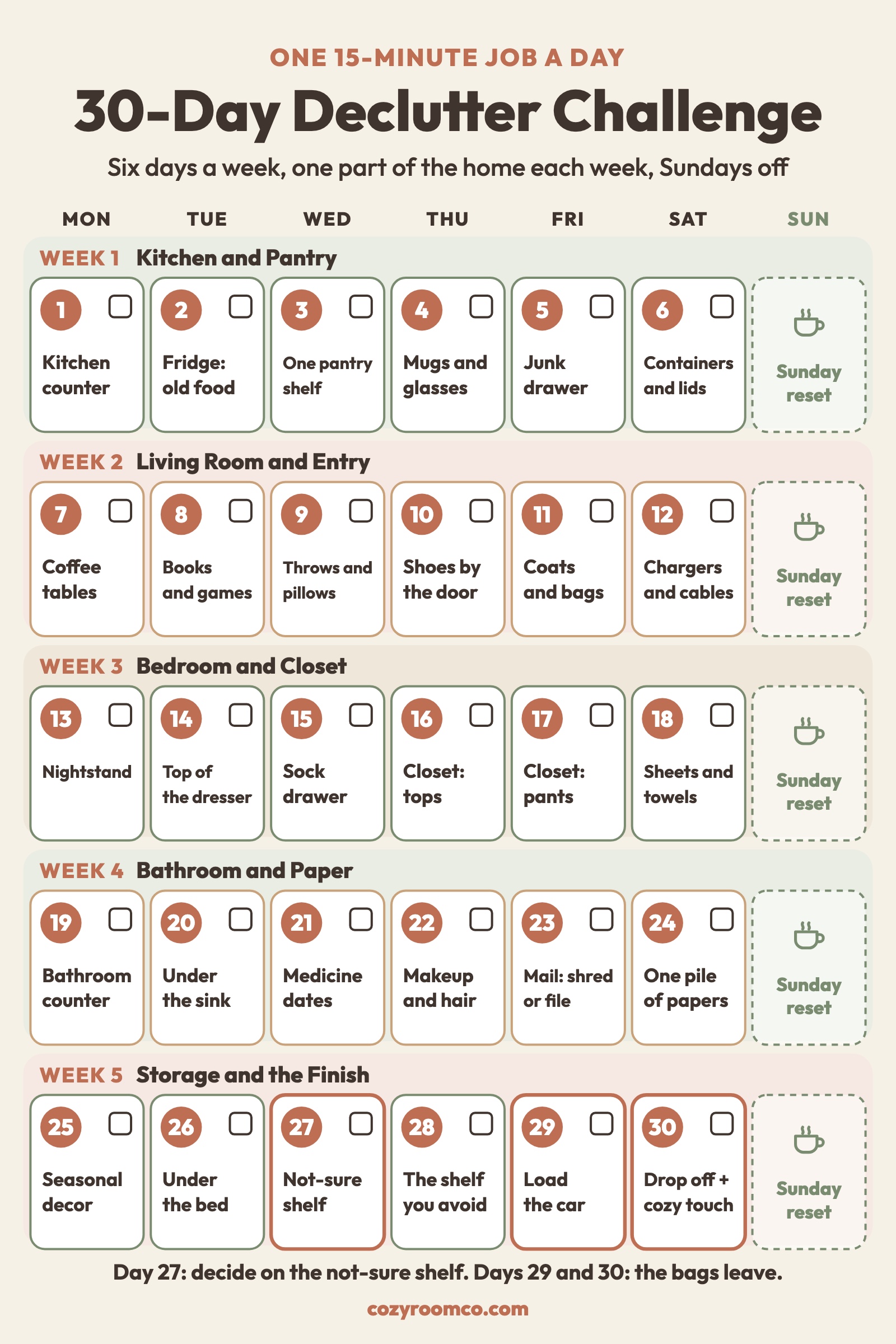
30-Day Declutter Challenge: 15 Minutes a Day, Room by Room

This 30-day declutter challenge gives you one small job a day. Set a timer for 15 minutes, clear one spot, and stop when it rings. Sundays are a day off, so the challenge never swallows a whole weekend.
By Day 30 the counters are clear, the closet holds clothes you actually wear, and the bags are gone from the house, not riding around in your trunk.
The order matters: quick decisions first, storage last, once you know what you're keeping. Below you'll find all 30 days in one free chart, what to let go of in each spot, and the two days that make it stick: the day you decide on the maybes and the day the bags leave.
Jump to a section
- The 30-Day Declutter Checklist at a Glance
- How the 30-Day Declutter Challenge Works
- Week 1: Kitchen and Pantry
- Week 2: Living Room and Entry
- Week 3: Bedroom and Closet
- Week 4: Bathroom and Paper
- Week 5: Storage and the Finish
- The Not-Sure Shelf: Why Day 27 Matters
- Getting the Bags Out of the House
- After Day 30: Keep It From Coming Back
- FAQ

The 30-Day Declutter Checklist at a Glance
Thirty jobs over five weeks: six a week with Sundays off, and one part of the home each week.

Open the free 30-day chart full size →
Save it to your phone or print it, then check off each day as you go.
Start on a Monday and Day 30 falls on the Saturday of week five. Start the first Monday of November and you're done in early December, before the busiest weeks of the year. Start the first Monday of January and you're done in early February.

How the 30-Day Declutter Challenge Works

Five rules keep it small enough to finish.
Fifteen minutes, then stop. Set a timer and stop when it rings, even halfway through a drawer. Tomorrow or Sunday picks up the rest. Knowing the job will end is what gets you to start it.
Set up once, before Day 1. Put out three bags (donate, sell and trash) and a basket for things that belong in another room. Find out where you'll donate and what they accept. Then clear one shelf for the things you can't decide on yet.
Ask one question. Would I buy this again today, for this home? Yes: it stays and gets a real spot. No: it goes in a bag. Not sure: it goes on the shelf until Day 27.
Sundays have no new job. Rest, or spend half an hour on a short Sunday reset that keeps the cleared spots clear and finishes anything the timer cut short.
Missed a day? Don't double up. Do today's job and let the missed one wait for Sunday's reset or your next round. A challenge you finish beats a perfect one you drop in week two.
Week 1: Kitchen and Pantry

The kitchen goes first because it's the easiest room to judge. Food has a date, a lid fits or it doesn't, and a clear counter shows up every time you walk past.
- Day 1: Clear one kitchen counter. Put away everything you don't use every day. What stays is what you'd miss tomorrow morning.
- Day 2: Fridge: toss old food. Cooked leftovers keep 3 to 4 days (USDA), so anything older goes, then the jars in the door you'll never finish.
- Day 3: One pantry shelf. One shelf, not the whole pantry. Unopened food you won't eat can go to a food pantry; call first to ask what they take.
- Day 4: Mugs and glasses. Keep the ones you reach for. Chipped mugs and the ones that never leave the cabinet go.
- Day 5: The junk drawer. Dead pens, mystery keys, old menus. Rechargeable batteries never go in the trash or the recycling bin (EPA): tape the ends and take them to a battery drop-off.
- Day 6: Food containers and lids. Match every lid to a container. Anything without a partner goes.
Everything that stayed now needs a home, and our cabinet-by-cabinet kitchen plan gives it one.
Week 2: Living Room and Entry

Week two moves to the rooms everyone sees. Clear surfaces here make the whole home feel calmer, even before you open a closet.
- Day 7: Coffee and side tables. Clear them down to what you use every day: a lamp, a coaster, one book.
- Day 8: Books, games and toys. Books you won't reread, games with missing pieces, toys nobody has asked for in months.
- Day 9: Throws and pillows. Keep the ones people actually use. Flat pillows and scratchy throws go.
- Day 10: Shoes by the door. One or two pairs per person stay out. The rest go back to the closet or into a bag.
- Day 11: Coats and bags. Out-of-season coats go to the closet. A coat nobody wore last winter goes in the donate bag.
- Day 12: Chargers and cables. Match every cable to something you still own. Check your town's website for an electronics recycling drop-off for the rest.
Want the door area to stay this way? Our entryway ideas end with a 60-second nightly reset.
Week 3: Bedroom and Closet

Clothes take longer to judge than mugs, so the closet gets two days instead of one. Two weeks of quick decisions in the kitchen and living room make this week easier to start.
- Day 13: Nightstand. Keep what you use in bed: a lamp, a book, a glass of water, a small dish for rings.
- Day 14: Top of the dresser. Clear it completely, then put back one tray for the things you use daily.
- Day 15: Sock and underwear drawer. Holes, stretched bands and socks without a partner go.
- Day 16: Closet: tops you don't wear. Pull every top you haven't worn in a year, and be honest about the ones that don't fit.
- Day 17: Closet: pants and skirts. Same rule. Not sure? Try it on. Still not sure? The shelf.
- Day 18: Sheets and towels. Two sets of sheets per bed covers you: one on the bed, one in the wash. Thin towels can become cleaning rags or go to an animal shelter that accepts them.
Our closet organization ideas show how to put a cleared closet back so it stays tidy.
Week 4: Bathroom and Paper

Week four is the small stuff that piles up quietly: bottles, samples, envelopes. Most of it is easy to judge once you actually look at it.
- Day 19: Bathroom counter. Clear it down to daily things: soap, a toothbrush cup, one hand cream.
- Day 20: Under the sink. Empty bottles, hotel samples, products you tried once, cleaners you never use.
- Day 21: Medicine: check the dates. The FDA's first choice for old medicine is a drug take-back site, such as a pharmacy or police station, or a prepaid mail-back envelope. With no take-back nearby, most medicines can be mixed with coffee grounds or cat litter, sealed in a bag and thrown away, and the few on the FDA's flush list are flushed instead. The FDA's disposal page has both lists, and says to scratch your details off the empty bottle.
- Day 22: Makeup and hair tools. The FDA advises throwing out mascara three months after you buy it, and any that has dried up. A hair tool with a damaged cord goes too.
- Day 23: Mail: shred, file or recycle. Anything with an account number or your signature goes through the shredder.
- Day 24: One pile of papers. One pile, not the whole desk. The IRS's basic rule is to keep tax records for three years, with some longer exceptions, so check those before you shred anything older.
The papers you keep need one place to live, and our home organization binders use three small ones instead of one huge one.
Week 5: Storage and the Finish

The last week opens the places you don't see every day, then finishes properly: the maybes get decided and the bags leave.
- Day 25: Seasonal decor into bins. Keep what you put out last season. What stayed in the bin can go.
- Day 26: Under the bed. Pull everything out. Anything you'd forgotten you owned is probably a bag item.
- Day 27: Decide on the not-sure things. The one decision day of the month (more on the shelf below).
- Day 28: The shelf you always avoid. You know the one. It gets 15 minutes, like any other day.
- Day 29: Load the car with donations. Every bag and box from the month, in one trip.
- Day 30: Drop them off, then a cozy touch. After the drop-off, put one thing out on purpose: a plant on the clear counter, a throw on the chair, flowers on the table.
The Not-Sure Shelf: Why Day 27 Matters

The maybes are where decluttering stalls. You pick up the waffle maker, can't decide, and put it back where it was. The not-sure shelf breaks that loop: the item goes on one shelf with a sticky note and today's date, and you stop deciding for now.
On Day 27 you go through the shelf once. Anything you went and got while it sat there has earned its place, so give it a real spot. Anything you didn't reach for goes in the donate bag. It's an easier call than the first one, because now you're not guessing.
Keep jewelry, keepsakes and documents off the shelf. Things with real money or family meaning deserve their own decision, on a day when you have more than 15 minutes.
Getting the Bags Out of the House

A bag only counts once it leaves. Until then it's the same clutter in a different spot, which is why the challenge ends with two days you can plan around: Day 29 to load the car, Day 30 to drop off.
- Donate: check what your nearest donation center takes before you load up; not every center takes everything.
- Sell: only what's worth the time to list it and meet a buyer. Not sold in two weeks? Donate it.
- Trash and recycling: know your pickup days, and look up your town's bulky pickup for anything large.
- Special items: old medicine to a take-back site, rechargeable batteries to a battery drop-off, papers with account numbers to the shredder.
Count the bags as they go. By week four, that number is the best reason to keep going.
After Day 30: Keep It From Coming Back

The challenge clears the home; a weekly habit keeps it that way. That second part is the one people lose: in a Talker Research survey of 2,000 Americans for The Container Store, people planning a New Year clean-out expected the fresh feeling to last just 38 days.
Your Sundays are already free for it. One short reset a week catches the counters, the laundry and the mail before they turn back into piles, and our cleaning schedule for a small home gives every other day one main job.
Keep one donate bag in a closet from now on. When you decide something has to go, it goes straight in the bag, and the bag leaves when it's full.
Want a faster version for January? The New Year home reset covers the same rooms in seven evenings.
FAQ
What Is a 30-Day Declutter Challenge?
A plan that spreads decluttering across a month: one small job a day instead of one exhausting weekend. This version uses 15-minute jobs, six days a week with Sundays off, so it runs five weeks and moves room by room from the kitchen to storage.
How Long Should You Declutter Each Day?
Fifteen minutes is enough when each job is small: one counter, one drawer, one shelf. Stopping when the timer rings makes it easier to start again tomorrow, and showing up tomorrow matters more than any single day.
What Should You Declutter First?
The kitchen counter and the fridge. Food has a date and a clear counter shows results right away, so the first days are quick wins before the harder decisions in the closet.
What If You Miss a Day?
Skip it and do today's job; don't double up. The missed spot can wait for Sunday's reset or your next round. The challenge works because each day stays small.
What Do You Do With Things You're Not Sure About?
Put them on one not-sure shelf with a dated sticky note. On Day 27, keep what you needed while it sat there and donate the rest.
Is There a Printable 30-Day Declutter Challenge?
The chart at the top of this page has all 30 days, free: open it full size to save or print it. If you'd rather check the days off in a planner, on paper or on your phone, with a page for each room and a donate and sell list, that's what our Cozy Home Reset Planner is for.