
Small Bathroom Ideas on a Budget: Spend Where the Room Actually Shows

A small bathroom is the cheapest room in the house to change, and most people spend the money in the wrong order.
The reason is that a small bathroom is mostly made of a few large surfaces. Five or six things — the shower curtain, the walls, the floor, the mirror, the light, the metal — are almost everything your eye lands on. Fix the biggest surfaces first and a $150 weekend reads as a renovation. Buy the small stuff first and $400 later the room still looks the same, just with nicer soap.
This guide puts the moves in spending order: the most visible square footage per dollar, first.
Jump to a section
- Count the surfaces, not the ideas
- Start with the curtain — it's 36 square feet of decision
- One gallon of paint covers the entire room
- Fix the grout and caulk before you buy anything
- The floor: 40 square feet is small enough to redo
- A bigger mirror is the closest thing to a bigger room
- Change the bulb before you change the fixture
- Make the metals agree
- Paint the vanity instead of replacing it
- Renting? Here's the reversible version of every move
- Where budget bathroom money gets wasted
- FAQ
Count the surfaces, not the ideas
Measure your bathroom once and the whole plan writes itself.
Take the standard American full bath, 5 by 8 feet. That's 40 square feet of floor — genuinely tiny. But stand in it and look around: with 8-foot ceilings you're surrounded by roughly 180 square feet of wall, and hanging in front of you is a standard 72-by-72-inch shower curtain, which is 36 square feet of fabric — an area almost as big as the entire floor, in one flat plane, at eye level.
Now put prices next to those numbers:
| What you change | Roughly how big | Typical cost | |—|—|—| | Shower curtain | 36 sq ft | $20–40 | | Walls (paint) | ~180 sq ft | one gallon, $30–60 | | Floor | 40 sq ft | $40–80 in peel-and-stick vinyl | | Mirror | 6–12 sq ft | $30–120 | | Metal fittings | tiny, but everywhere | $15–90 |
Two things sit at the top of that list, for different reasons. Paint changes the most area per dollar — roughly four square feet of wall for every dollar spent, three times better than anything else here. The curtain changes the most per hour — 36 square feet swapped in five minutes, with no prep, no drying time and nothing to move out of the room.
So the order is: curtain tonight, paint this weekend, then work down the list and stop whenever the room looks right.

Start with the curtain — it's 36 square feet of decision
If you do one thing tonight, do this one. Nothing else changes so much of the room in so little time.
Two rules make a cheap curtain look expensive:
Buy a fabric curtain and a separate liner. The all-in-one vinyl curtain is what makes a bathroom look like a motel — it creases, it clings, and it never hangs straight. A cotton or linen-blend outer curtain hangs with real weight, and a plain plastic liner behind it does the wet work and costs a few dollars to replace when it gets cloudy. Standard sizes are 72 by 72 inches for both; the liner should sit an inch or two shorter so it tucks into the tub.
Hang the rod high and wide. Move it up close to the ceiling and let the curtain run nearly to the floor. The eye reads the whole vertical line, and the ceiling feels higher for the price of nothing. It's the same trick that works for windows, and it works even better here because the curtain is the biggest thing in the room.
On pattern: in a small bathroom, one bold curtain plus quiet everything-else looks deliberate. Two patterns plus a busy floor looks like a clearance bin. If you want color anywhere, this is the place to put it.

One gallon of paint covers the entire room
Paint is the best value per square foot in the house, and a small bathroom is where that math gets absurd.
Premium interior paints publish coverage of 350 to 400 square feet per gallon on smooth, primed walls. A 5-by-8 bathroom has roughly 180 square feet of wall before you subtract the door, the window and the tile. One gallon does the room twice — two full coats, from a $30 to $60 can.
Three specifics that matter in a bathroom:
- Sheen. Use satin or semi-gloss, or a bathroom-specific paint. Flat paint in a damp, small room stains where hands and steam touch it and can't be wiped clean.
- Ventilation first. Paint won't survive a room that stays wet. The Home Ventilating Institute recommends 1 CFM of fan capacity per square foot for bathrooms under 100 square feet — 50 CFM minimum, whatever the size — and running the fan for 20 minutes after a shower. A $20 timer switch protects a $50 paint job and every dollar you spend after it.
- Dark is allowed. A small bathroom is the one room where a deep color reliably works. There's no long sightline to shorten, the room is usually windowless anyway, and a dark wall behind a white sink and a white tub makes both look crisp instead of dingy. Test a sample the size of a sheet of paper next to the tub before you commit.
Paint the ceiling too while the roller is out. In a room this size it's fifteen extra minutes, and a fresh ceiling is what stops the walls looking new against something grey.

Fix the grout and caulk before you buy anything
This costs under $15 and does more for how clean the room reads than any purchase on the list. Do it before the paint, not after.
Know the difference, because people fix the wrong one:
- Grout is the hard, sandy filler between tiles. When it's grey and patchy, the whole wall looks dirty even after scrubbing. A grout pen re-whitens it for a few dollars; regrouting a small area is a $10 bag of grout and an afternoon.
- Caulk is the soft, flexible bead where two different things meet — tub to tile, sink to counter, floor to baseboard. Caulk is the part that goes black. You cannot clean black caulk back to white; the mold is inside it. Cut it out with a utility knife, dry the joint completely, and run a new bead of mildew-resistant bathroom silicone from a $6 tube.
New caulk is the single most convincing "this bathroom has been redone" signal there is, because a crisp white line where the tub meets the tile is exactly what people register as new. It's also the fix most likely to be skipped in a rushed flip, which is why fixing it puts your bathroom ahead of rooms that cost thousands more.
One warning: silicone needs a genuinely dry, oil-free joint or it peels within a month. Give it the full day the tube asks for before anyone showers.

The floor: 40 square feet is small enough to redo
Floors feel expensive because most rooms are big. Yours isn't. At 40 square feet, materials that would cost a fortune in a kitchen become a weekend line item.
Peel-and-stick vinyl tile is the usual answer, and big-box stores carry plenty of it in the $1 to $2 per square foot range — so $40 to $80 covers the room, plus a craft knife and an afternoon. Modern patterns are convincing; the giveaway on cheap ones is a repeat you can spot, so buy a sample tile first and look at it on your own floor in your own light.
Where it goes wrong, honestly:
- Seams and water. Around a tub or a toilet base, water finds edges. Seal the perimeter with a thin bead of caulk and dry the floor rather than letting puddles sit.
- The subfloor. These tiles copy whatever is beneath them. Over old, deeply-textured sheet vinyl the ridges telegraph through within a month.
- Removing the toilet. Cutting neatly around the base is fine and it's what most people do. Lifting the toilet gives a much better result and turns a two-hour job into a half-day one with a new wax ring involved. Decide which of those you're actually up for before you start.
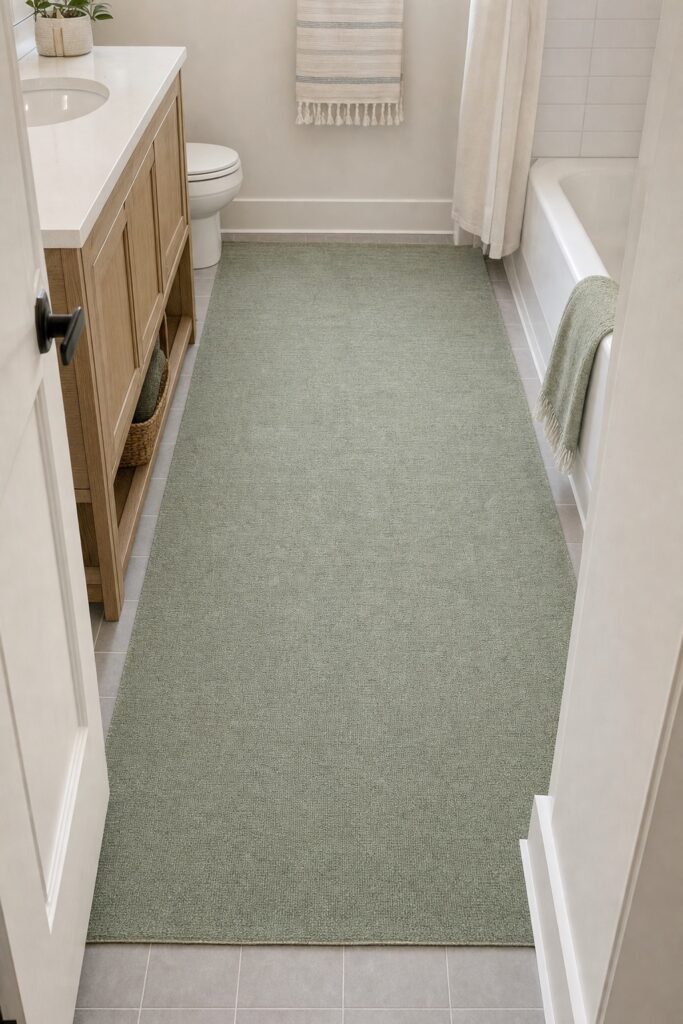
If a whole new floor is more than you want, paint the floor tile with a floor-rated enamel, or lay one good washable rug that covers most of the visible area. Both are honest fixes, not compromises.

A bigger mirror is the closest thing to a bigger room
A small bathroom usually came with a small mirror, and that's the cheapest visual mistake in the room.
Go as wide as the vanity itself, or wider. A mirror that spans the full counter reflects the opposite wall, doubles the apparent depth and bounces every bit of light you have. A round mirror 18 inches across over a 36-inch vanity does none of that — it reads as a porthole in a beige wall.
Three price points, in order of value:
- Frame the builder mirror in place — $20 to $40 of mirror-edge trim glued around the existing glass. It costs the least, wastes nothing and instantly stops the sheet-of-glass look.
- Replace it with a wide frameless mirror — $40 to $100 for something double the size, hung on mirror clips.
- Add a second mirror on the opposite wall if the room is truly dark. Two mirrors facing each other can feel like a funhouse, so angle one over a towel wall instead of directly opposite.
Then clean it properly and check what it reflects. A large mirror pointed at a cluttered shelf just gives you twice the clutter.

Change the bulb before you change the fixture
Bad light makes a clean bathroom look grubby, and almost nobody's first fix should be a new fixture.
Start with a $10 to $15 bulb. Two numbers on the box do the work:
- Color temperature. Warm white, 2700K to 3000K, for a bathroom you relax in; step up toward 3500K if the same mirror is where you do makeup and you want more accurate color. Anything at 5000K or above is the blue-white hospital light that makes everyone look tired.
- CRI, the color rendering index. Look for 90 or above. High-CRI bulbs render skin and towel colors accurately, and it's the difference between "warm" and "yellow." It's printed on the box and most cheap bulbs quietly skip it.
Match every bulb in the room. One warm and one cool bulb in the same fixture is worse than two of either.
If the fixture itself is the problem — the flat plastic dome, the three-bulb chrome bar from 1998 — a replacement is around $40 to $80 and one of the few jobs in this guide that involves the electrical panel. Turn the breaker off and check whether it's a job you want; a plug-in sconce or a battery puck light beside the mirror is a real alternative that costs less and needs no wiring.

Make the metals agree
Here's the change nobody notices you made, and everybody notices the result of: pick one metal finish and make every piece of hardware match it.
Count what's in there — faucet, towel bar, towel ring, robe hooks, toilet paper holder, shower rod, cabinet knobs, the little lever on the toilet tank. In most bathrooms that's four different finishes fighting each other: builder chrome, an oil-rubbed bronze hook someone added, brushed nickel knobs, a white plastic rod.
Choose the finish you already have most of, then replace the strays. Towel bars, hooks, rings, rods and knobs are $8 to $20 each and take a screwdriver. Total spend is often under $60, and the room stops looking accidental.
The faucet is the exception: budget $60 to $150 and about two hours, plus a basin wrench and the discovery that the shutoff valves under your sink may not have been turned in twenty years. It's the single biggest hardware upgrade in a small bathroom because the faucet sits at eye level in the mirror — but do the cheap matching pieces first and see whether you still want it.
Skip mixing metals on purpose unless you're confident. It works in big rooms with lots of separation. In 40 square feet everything is within one glance of everything else.

Paint the vanity instead of replacing it
A new vanity is $300 to $800 plus plumbing. Painting the one you have is a $40 to $60 job, and on a laminate or oak cabinet the result is genuinely good — if you do the boring parts.
The order that makes it last:
- Take the doors off and pull the hinges and knobs. Painting around hardware is what makes a job look homemade.
- Degrease. Bathroom cabinets carry hairspray, lotion and soap film. Wash with a degreasing cleaner and rinse.
- Scuff-sand with 220-grit until the shine is gone. You're not removing the finish, just giving the primer something to hold.
- Bonding primer — the specific kind sold for laminate and glossy surfaces. This is the step that decides whether the paint chips in a month.
- Two thin coats of cabinet or trim enamel, sanding lightly between them. Thin coats. Thick ones stay soft and print fingerprints for weeks.
- New knobs, and leave the doors off for a full day before rehanging.
Deep colors work especially well here because the vanity is a small, contained block of color against a light wall. If the countertop is what you actually hate, that's a different budget: countertop paint kits exist and reviews are mixed, so treat that as an experiment rather than a plan.

Renting? Here's the reversible version of every move
Everything above assumes you can paint and drill. If you can't, most of the list still works — you just swap the permanent version for a removable one.
| The move | The reversible version | |—|—| | New shower curtain | Identical. Nothing here is permanent, and it's still the biggest change available. | | Paint the walls | Removable wallpaper or large framed art on adhesive hooks; ask about paint first, since many landlords say yes to neutral colors. | | New floor | A large washable cotton rug that covers most of the visible floor; peel-and-stick over vinyl only with written permission. | | Bigger mirror | A leaning mirror on the floor beside the vanity, or a frame kit that comes off with the glass intact. | | Bulbs and fixture | Swap the bulbs freely — keep the originals in a labelled bag. Add a battery or plug-in light instead of rewiring. | | Matching metals | Replace towel bars and hooks with adhesive versions in one finish; keep every original screw and bracket in that same bag. | | Paint the vanity | Adhesive contact paper on the doors, plus new knobs (keep the old ones). | | Grout and caulk | Do it anyway. Fresh caulk is a repair, not an alteration, and it's the one thing on this list your landlord will thank you for. |
For the full reversible version, we have a whole guide to making over a rented bathroom and a room-by-room plan for apartment bathrooms.

Where budget bathroom money gets wasted
Cheap can be smart. These are the places where cheap just costs you twice.
- A tiny accent rug. A 20-by-30-inch mat in front of the sink covers almost none of the floor and makes the room look smaller by chopping it up. One large washable rug or none.
- Replacing a working vanity to get storage. Most small bathrooms lose to clutter, not to cabinet size. Sort the cabinet first; you may find you're storing three shampoos and a hairdryer you don't use.
- Vessel sinks in a small bathroom. They eat counter space, splash more, and the tall faucet they need costs extra. They photograph well in rooms four times this size.
- Novelty "space-saving" gadgets. Over-the-door racks, suction shelves and cascading hooks are cheap to buy and cheap-looking on the wall. One good shelf beats five plastic solutions.
- Painting over dirty or wet surfaces. Every hour you skip in prep comes back as peeling in month two. This is the only place on this list where doing it slower saves money.
- Buying the fixture before the bulb. Half the "my bathroom lighting is awful" problem is a 5000K bulb in a fine fixture.
Do the list in order, stop when you're happy, and put whatever's left toward the faucet.
FAQ
What's the cheapest way to make a small bathroom look better?
Change the shower curtain and recaulk the tub. Together that's about $40 and one evening, and it's the biggest visible change per dollar in the room — the curtain is roughly 36 square feet of new surface, and fresh white caulk is what reads as "recently redone."
Can I redo a small bathroom for under $200?
Yes, if you spend it in order. A fabric curtain and liner ($30), a gallon of paint ($45), caulk and a grout pen ($15), a high-CRI warm bulb ($12), matching towel bar and hooks ($40) and a large washable rug ($45) comes to roughly $190 and changes every surface you look at. The faucet and the floor are the next tier up.
Should a small bathroom be painted a light color?
Not necessarily. Light colors keep a small bathroom bright, but a deep color is one of the few reliable wins in a tiny windowless room: it hides the room's edges and makes white fixtures look crisp. What matters more than the shade is the sheen — satin or semi-gloss, so steam wipes off.
Is peel-and-stick flooring a good idea in a bathroom?
It works well over a smooth, clean, dry subfloor, and at $1 to $2 per square foot a 40-square-foot bathroom is an affordable place to try it. It fails over deeply textured old vinyl, and it needs a caulked perimeter around the tub and toilet so water can't get under the seams.
How do I make a small bathroom feel bigger without renovating?
Three moves, in order: hang the shower rod high and wide so the eye reads a full-height line, put in the widest mirror the wall allows, and get the floor to read as one continuous surface rather than several small mats. Nothing here changes the square footage — they change how much of the room you take in at once.
What should I fix first if the bathroom just feels dirty rather than dated?
Caulk, grout and light, in that order — and check the fan. Black caulk and grey grout read as dirt no matter how much you scrub, and a cool-white bulb exaggerates every stain. If the fan is under 50 CFM or nobody runs it, the mold comes straight back.


