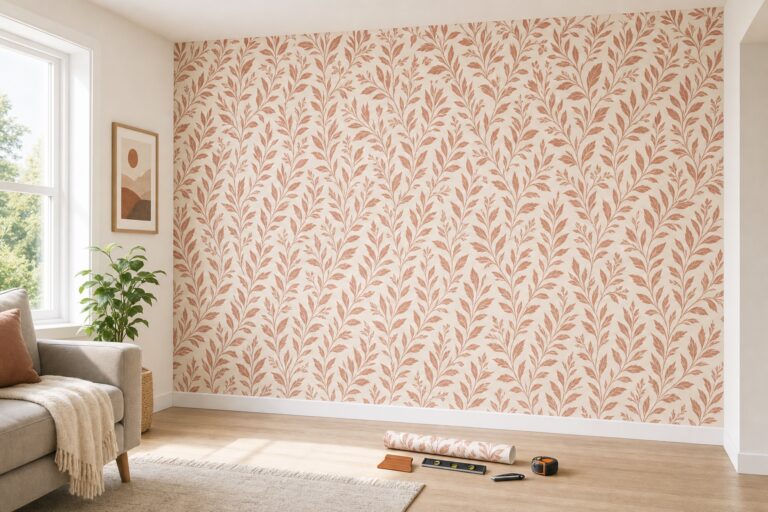
Rental Apartment Decorating Hacks, Sorted by What They Cost You at Move-Out

Every rental apartment decorating hack is described as reversible. Most of them are. The trouble is that the ones that aren't get described exactly the same way, and you don't find out which is which until the walk-through.
So here they are sorted honestly — by what each one costs you if it goes wrong, along with the specific technique that keeps it in the safe tier. Same hacks everyone else lists. Different order, and a better idea of what you're risking.
Jump to a section
- Sort every hack by what it costs you at move-out
- The ten-minute move-in record that protects everything after it
- Zero-risk: the changes that touch nothing at all
- The one-square-foot test before any adhesive touches a wall
- Peel-and-stick: where it works, and the walls it will damage
- Tension rods: the renter's structural system
- Swap what's already there, and keep the originals in a bag
- The moves that quietly cost you money
- The reversal, in the order that saves the most time
- FAQ
Sort every hack by what it costs you at move-out
Three tiers. Every decorating decision in a rental belongs to one of them, and knowing which is most of the skill.
- Touches nothing. Freestanding, laid down, or plugged in. Rugs, lamps, furniture, textiles, plants. There is no version of these that costs you money at move-out. Start here and get further than you'd think.
- Touches a surface, comes off if you do it right. Adhesive hooks and strips, peel-and-stick, tension rods, fixture and hardware swaps. These are safe conditional on technique — the technique is the whole difference between a clean wall and a deduction.
- Usually costs you money. Anchors and screws beyond a small nail, painting without written permission, anything with real glue, drilling into tile, and adhesive on a surface it was never made for.
Most people treat all three as one bucket labeled "renter hacks." That's how a $9 pack of strips turns into a $200 patch-and-paint charge.
Worth knowing before you start: US landlord-tenant law generally does not let a landlord deduct for normal wear and tear — small nail holes from hanging pictures, scuffs from furniture, paint fading with age are commonly treated as normal. What counts, how much deposit can be held and how quickly an itemized list of deductions must reach you all vary by state, so check your own before you rely on it. HUD keeps state-by-state housing resources if you don't know where to look.

The ten-minute move-in record that protects everything after it
Do this before you hang anything, and preferably on the day you get the keys.
Photograph everything, with dates. Every wall, every corner, both sides of every door, the floor in each room, inside the oven and fridge, every window sill, and a close-up of anything already damaged. Your phone stamps the date, which is the entire point. Ten minutes now is the difference between "that mark was there when I moved in" and "prove it."
Video the walk-through narrating what you see. Faster than photos for the small stuff and much harder to argue with.
Email the photos to yourself and to the landlord. A dated email with attachments creates a record that lives outside your phone. Keep it factual: "Attached are move-in photos from today, including the scratch on the bedroom door and the stain under the kitchen window."
Start a hardware bag on day one. Every original doorknob, shower head, cabinet pull, switch plate and light fixture you take down goes in one labeled bag or box that stays in a closet for the whole lease. This single habit is what makes the entire swap tier safe — a swap you can't reverse isn't a swap, it's a modification.

Zero-risk: the changes that touch nothing at all
This tier is bigger than most people realize, and it's where the actual transformation happens.
- The rug is the biggest single change available to you. Bad carpet, scratched vinyl, cold tile — a large rug covers the floor's whole personality. Go bigger than feels sensible; a rug that only fits under the coffee table makes the room look smaller.
- Lamps instead of the ceiling light. Two or three lamps at different heights, warm bulbs, and the builder-grade fixture overhead just stops being switched on. Nothing else changes the mood of a rental this cheaply.
- Furniture as walls. A bookcase back-out as a room divider, a sofa floated to define a living zone, an open shelf unit splitting a studio. Zero fixings, and it does what a wall would do.
- Textiles carry the color. Curtains, cushions, throws, a bed cover, a table runner. In a beige rental, the fabric is your palette — the walls are just the background you were given.
- Plants for the corners furniture can't fix. One tall plant in an empty corner does more than another piece of furniture would.
- Leaning, not hanging. A large mirror or a big framed print leaned against the wall behind a console reads deliberate, costs nothing in wall damage, and moves whenever you want.
If you did only this tier and nothing else, the apartment would already look like someone lives there on purpose.

The one-square-foot test before any adhesive touches a wall
Here is the step almost nobody takes, and it costs one square foot and three days.
Before you commit adhesive hooks, strips or peel-and-stick to a wall, apply a single small piece somewhere hidden — behind a door, inside a closet, low behind where the sofa goes. Leave it for 72 hours. Then remove it the way the instructions say, slowly and straight down, and look hard at what's underneath.
You are checking for three things:
- Does the paint lift? Rental walls are often painted with cheap flat paint over old paint over older paint. When the top layer comes away with the tape, it comes away in a sheet.
- Does the paper tear? Drywall has a paper face. If the paper fuzzes or peels, that's not paint damage, that's a patch-and-sand job.
- Does it leave residue? Some walls hold a shadow of adhesive that won't wipe off, which reads as damage even though nothing's torn.
If the test square fails, you've learned it for the price of one hidden square foot instead of a whole gallery wall. If it passes, you can commit with confidence.
Two rules from the manufacturer that make the test more likely to pass: Command's own guidance is that paint must be fully cured before their products go on it — a week is the general recommendation on fresh paint — and their strips are not recommended for wallpaper, heavily textured walls, brick or unpainted concrete. If your landlord painted the week before you moved in, wait. Our guide to decorating with removable hooks covers what weight each type will actually hold once you're past the surface question.

Peel-and-stick: where it works, and the walls it will damage
Peel-and-stick tile and wallpaper are the loudest promises in rental decorating, and they're genuinely good — in the right places.
Where it works well: a smooth, sealed, non-porous surface. Existing ceramic tile, a laminate backsplash, a flat cabinet door, a smooth painted wall in good condition, a bathroom wall that isn't in the shower spray. Small areas are also better than large ones — a backsplash strip or one closet interior is far more forgiving than a whole room.
Where it fails: textured walls (the classic orange-peel or knockdown finish common in US apartments), fresh paint, flat matte paint that hasn't cured for years, anything porous like unsealed grout, and any surface that gets steam directly.
The removal risk is the whole story. Peel-and-stick comes off the surface it was applied to — but on a wall painted with cheap flat paint it takes the top coat with it in strips. That's the failure mode that costs a deposit, and it's exactly what the one-square-foot test above is for.
Two practical rules if you go ahead: work in small sections so a bad piece is a small loss, and warm the corner with a hair dryer on low when you remove it — warm adhesive releases; cold adhesive pulls. Take it off slowly, at a shallow angle, straight back on itself rather than out from the wall.

Tension rods: the renter's structural system
Tension rods are the single most underused thing in rental decorating, because most people think of them as a shower-curtain part.
They're a structural system that installs with zero fixings anywhere you have two facing surfaces:
- Windows. A rod inside a recessed window frame hangs curtains with no brackets at all. In a window that isn't recessed you're back to brackets, so this depends on your building.
- Closets. A second rod below the existing one doubles your hanging space for shirts and folded trousers.
- Under the sink. One rod across the cabinet, spray bottles hung from it by their triggers, and the floor of the cupboard is usable again.
- As a room divider. A ceiling-height rod between two walls with a curtain on it separates a sleeping area in a studio.
- In a laundry closet. A rod between the two side walls holds everything that can't go in the dryer.
The honest limit, and it matters: a tension rod holds by pressing outward on two surfaces. Overload it and one of two things happens — it slips, or it dents the drywall where the end caps press. Both are on you. Use the shortest rod that spans the gap (a rod extended near its maximum is much weaker), buy the heavier gauge for anything beyond light curtains, and put a small rubber pad under each end cap if the wall is soft.

Swap what's already there, and keep the originals in a bag
The fastest visual upgrade in a rental is replacing the cheapest-looking parts with better versions of the exact same thing. It's reversible by definition — as long as you keep the originals.
- Cabinet and drawer hardware. Unscrew the builder pulls, screw in yours. Ten minutes, no new holes if you match the screw spacing, and it changes an entire kitchen. Measure the existing hole centers before you buy: 3 inches and 96 mm are common and are not the same.
- The shower head. Unscrews by hand or with a wrench and a cloth. It is genuinely the best-value upgrade in a rental bathroom.
- Switch plates and outlet covers. A few dollars each and they're everywhere in your eyeline. Cut the power at the breaker first.
- The toilet seat. Not glamorous, and it makes a rental bathroom feel like yours.
- Light fixtures, with a real caveat: swapping a hardwired fixture means working with wiring. If you're not confident and competent, this is the one to leave alone, or the one to ask the landlord about in writing — some will do it if you supply the fixture.
Everything you remove goes in the bag. Label it with the room. Put it in the back of a closet on the day you do the swap, not later. Reinstalling the originals at move-out is a one-hour job when you have the parts and an expensive problem when you don't.

The moves that quietly cost you money
These get listed as "renter hacks" all over the internet. They're not; they're modifications, and they belong in the third tier.
- Wall anchors and heavy screws. A small nail hole is often normal wear and tear. A drywall anchor is a hole you can put your finger in, and it needs filling, sanding and touching up in a paint you'll never match exactly.
- Painting without written permission. Even painting a wall back to white can be charged if the lease says no painting, and "I improved it" is not a defense. Ask, and get the yes in an email.
- Adhesive on unpainted or unsealed surfaces. Bare wood, unsealed brick, raw concrete, wallpaper. The adhesive bonds into the surface rather than sitting on it.
- Drilling into tile. A hole in tile is a replaced tile, and the replacement won't match a discontinued 1990s tile.
- Contact paper left for years. Adhesive cures with time and heat. The removable thing you put on a sunny window sill three summers ago is no longer removable.
- Semi-permanent hooks on the back of a door where the door is a hollow-core rental door. Over-door hooks that hang from the top edge do the same job with no fixings.
None of this is a rule against ever doing them. It's a rule about doing them knowingly, with the landlord's written yes where it matters, rather than because a listicle said it was renter-friendly.

The reversal, in the order that saves the most time
Move-out goes faster if you undo in the reverse order of risk — hardest first, while you still have time and energy.
- Reinstall the originals from the bag. Hardware, shower head, switch plates, seat, fixtures. Do this first because it's the part that needs the parts, and finding out the bag is missing on the last day is the worst version of this.
- Remove adhesives warm and slow. Hair dryer on low, then pull straight down and along the wall, not out from it. Rushing this is where damage happens, and it always happens on the final afternoon.
- Take down peel-and-stick in the same way, working a corner up first and keeping the angle shallow.
- Fill the small nail holes with a dab of lightweight spackle on a fingertip, let it dry, sand it flat with a fingernail. Even where nail holes count as normal wear and tear, filling them takes ten minutes and removes the argument.
- Photograph the empty apartment the way you photographed it on day one, from the same positions. Dated, emailed to yourself.
- Then move the furniture and rugs out. They were never a risk, so they go last.
Done in that order, the whole reversal is an afternoon. Done in the panic order — furniture first, walls at midnight — it's how deposits get lost.

FAQ
What is the safest way to decorate a rental apartment?
Start with everything that touches nothing at all: a large rug, lamps instead of the ceiling light, furniture used to define zones, textiles for color, and large mirrors or art leaned rather than hung. That tier carries no move-out risk whatsoever, and it changes a rental more than the wall-mounted ideas people reach for first.
Do Command strips damage rental walls?
They can, and it depends almost entirely on the wall rather than the strip. The manufacturer says paint must be fully cured — around a week on fresh paint — and doesn't recommend them for wallpaper, heavily textured walls, brick or unpainted concrete. Test one strip in a hidden square foot for 72 hours and remove it before you commit to anything visible.
Will peel-and-stick wallpaper ruin the paint?
On a smooth, well-cured, good-condition painted wall, usually not. On cheap flat paint, fresh paint or a textured wall it can lift the top coat in strips when you remove it. Test a hidden square first, apply in small sections, and warm each corner with a hair dryer before pulling it off slowly at a shallow angle.
Can my landlord charge me for nail holes?
In most US jurisdictions small nail holes from hanging pictures are treated as normal wear and tear, which landlords generally can't deduct for — but anchors, large holes and unapproved paint are a different matter, and the specifics vary by state. Fill small holes anyway before you leave; it takes ten minutes and removes the discussion.
What should I photograph when I move into a rental?
Every wall and corner, both sides of every door, the floor of each room, window sills, inside the oven and fridge, and close-ups of anything already damaged. Then email the set to yourself and to the landlord the same day, so there's a dated record that doesn't live only on your phone.
What are the best reversible upgrades in a rental?
Swapping parts that already exist for better versions: cabinet pulls, the shower head, switch plates and the toilet seat. All four are cheap, take minutes, and are fully reversible — provided every original part goes into one labeled bag on the day you remove it and stays there until move-out.