
Moving Checklist: What to Buy, How Much, and What to Skip

Most moving checklists tell you when to do things. This one tells you what to buy and how much of it, because that's the half that costs money — and the half people get wrong twice: once by under-buying and making a second trip on a Saturday night, once by buying a boxed moving kit full of things they never open.
Below is the whole supply list with real counts behind every line, and the single physical rule that decides which box everything goes in. If you want the week-by-week task order instead, that's a separate article: the moving checklist timeline.
Jump to a section
- The supply list at a glance
- The rule that picks every box: a size is a weight limit
- Read the stamp on the bottom flap before you trust a free box
- How many boxes: count shelves, not bedrooms
- Tape: how much you actually need, by arithmetic
- Padding: buy paper, use your linens
- Labeling: two markers, one rule
- The four specialty items worth the money
- What not to buy
- If you rent: four supplies that protect your deposit
- The order to buy it in
- FAQ
The supply list at a glance
Here's the full list for a self-packed one-bedroom home. Scale it up by roughly half again for each extra bedroom.
- Boxes: 12–18 small, 10–14 medium, 6–8 large, 1–2 wardrobe
- Tape: 3 rolls of 2-inch carton sealing tape, plus a hand dispenser
- Paper: 1 bundle (about 10 lb) of unprinted newsprint
- Bubble wrap: one small roll — for screens, glass fronts and framed art only
- Markers: 2 chisel-tip permanent markers
- Color coding: 1 pack of dot stickers or 4 rolls of colored tape, one color per room
- Blades: 1 utility knife or box cutter, plus a spare blade
- Furniture: 1 mattress bag, 4 furniture sliders, moving straps or a rented dolly
- Deposit kit if you rent: spackle, a putty knife, a sanding sponge, a screwdriver, zip bags
That's it. Everything else in a store's moving aisle is a variation on those nine lines, and the rest of this article is the reasoning — how the counts were reached, and where you can substitute something you already own.

The rule that picks every box: a size is a weight limit
A box size is not a storage size. It's a weight limit. Small, medium and large cartons are usually built to about the same maximum gross weight — the figure printed on the box itself — so the size you choose is really you deciding how heavy that box will be when it's full.
That's why "books go in small boxes" is not a folk saying. A large box filled with books passes the box's limit and yours. The same box filled with pillows weighs almost nothing.
There are two ceilings, and the lower one is you. Most moving cartons state a maximum of around 65 pounds of contents. The human number is lower: OSHA's guidance on manual lifting explains that the NIOSH lifting equation "establishes a maximum load of 51 pounds, which is then adjusted to account for how often you are lifting, twisting of your back during lifting, the vertical distance the load is lifted, the distance of the load from your body, the distance you move while lifting the load, and how easy it is to hold onto the load." OSHA also notes plainly that it "does not have a standard which sets limits on how much a person may lift or carry" — so 51 pounds isn't a law, it's a starting point for ideal conditions.
A move has no ideal conditions. You twist to get through a doorway, you carry the box thirty feet to the truck, you take stairs, and you do it seventy times in a day. Every one of those factors pulls the real number below 51.
So use the size as the limiter it is:
- Small (about 1.5 cubic feet): books, dishes, canned food, tools, records — anything dense
- Medium (about 3 cubic feet): the everyday middle — kitchen gear, shoes, toys, small electronics
- Large (about 4.5 cubic feet): bedding, pillows, comforters, lampshades, winter coats — bulk without weight
The field test takes two seconds: before you tape a box shut, lift it to your waist. If you have to lean back to hold it, take something out. You'll repack four or five boxes on your first day doing this, and none on your second.

Read the stamp on the bottom flap before you trust a free box
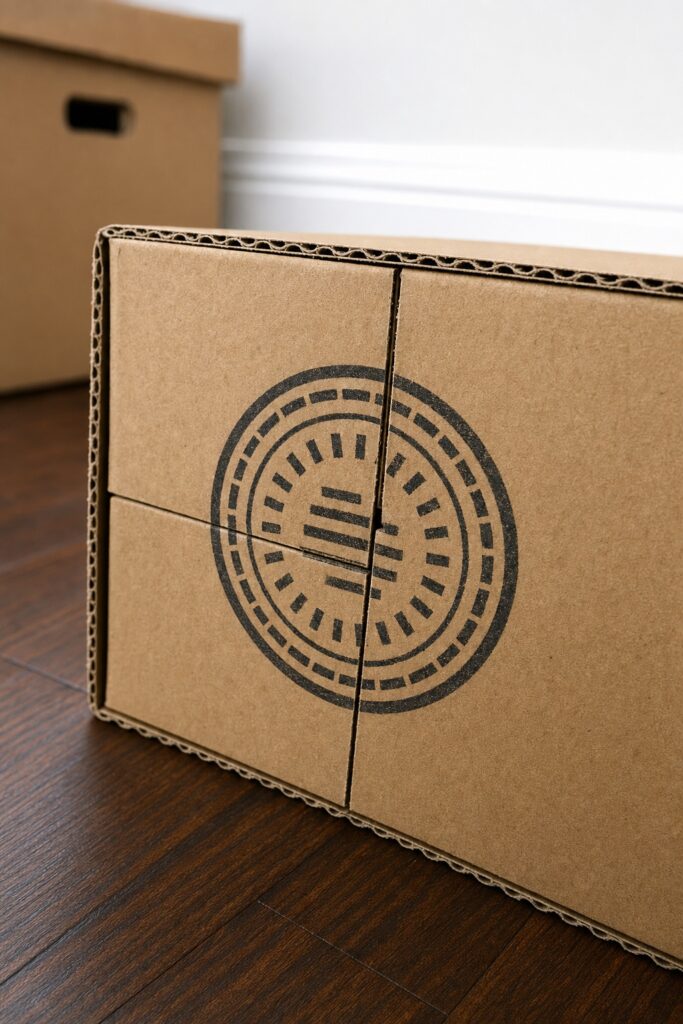
Free boxes are the biggest saving available on a move, and the check that tells you whether one is worth taking is printed on it. Turn any carton over and look at a bottom flap for a round stamp, the Box Maker's Certificate. Rand-Whitney's guide to that stamp explains it plainly: a line reading "Gross WT LT 65 Lbs" means "the maximum weight of the contents that you can place in the box."
The same circle usually shows a strength test — "Bursting Test 200 Lbs per Sq in" — and a size limit given as length plus width plus depth.
Where good free boxes come from: liquor stores (small, thick-walled, often with built-in dividers that are perfect for glasses), bookstores, pharmacies, and office supply stock rooms. Ask the day before a delivery, not after.
What to refuse: produce boxes with open tops and no lids, anything that feels soft or cool at the corners (that's absorbed moisture, and it fails at the worst moment), and any box that held food and still smells like it.
One more thing worth knowing about used boxes: corrugated board loses stiffness the first time it's loaded and unloaded. Give single-use boxes to the heavy jobs — books, dishes, tools — and let the veterans carry linens, cushions, and lampshades.
How many boxes: count shelves, not bedrooms
Moving companies quote 20 to 45 boxes for a one-bedroom home, which is a range wide enough to be useless when you're standing in a store. Count your own storage instead. It takes ten minutes and it's accurate.
Walk the home with your phone and tally:
- Every 3 feet of packed shelf — books, pantry, media — is one small box
- Every 2 drawers is one medium box
- Every closet shelf of soft goods — bedding, spare pillows, off-season clothes — is one large box
- Every 2 feet of hanging clothes you don't want to fold is one wardrobe box
- Each kitchen cabinet is one small box for the heavy contents plus one medium for the light
Add three spares. There is always a cupboard nobody counted.
Then buy in two rounds: get about 60% of the total now, pack for one evening, and see how fast they fill. Nobody predicts their own fill rate correctly the first time, and the second round costs you one trip while the wrong first order costs you storage space and money.
The number also isn't fixed — it's the direct output of how much you're moving. Every bag that goes to donation before you pack is a box you don't buy, don't fill, don't carry twice and don't unpack.

Tape: how much you actually need, by arithmetic
Three rolls for a one-bedroom move, and here's the math so you can adjust it.
A standard medium box measures about 18 by 18 by 16 inches. Sealing one end properly — the H-seal, meaning the center seam plus a strip along each side edge — takes roughly 22 inches down the middle and 22 inches on each edge. That's 66 inches, or 5½ feet, per end. Both ends: about 11 feet of tape per box.
Carton tape is commonly sold in 55-yard (165-foot) and 110-yard (330-foot) rolls; Uline's best-selling carton sealing tape is a 2-inch, 2.0-mil, 110-yard roll. So:
- H-sealed both ends: a 55-yard roll does about 15 boxes; a 110-yard roll about 30
- Center seam only: roughly 3¾ feet per box — a 55-yard roll stretches to about 40
Those are our numbers from the box dimensions above, not a manufacturer's claim, and you can check them with a tape measure.
Two opinions worth the money. Buy the hand dispenser — the plastic gun with a metal blade. It takes a box from forty seconds to ten, and by box thirty you will have earned back what it cost several times over. And buy carton sealing tape specifically: duct tape and masking tape are sold for other jobs, and the aisle labels tell you which is which.

Padding: buy paper, use your linens
Buy one bundle of unprinted newsprint and stop there. Paper is the cheapest padding per cubic foot, it wraps around irregular shapes, and unlike newspaper it doesn't leave ink on your white dishes.
Then use what you already own for the bulky stuff. Towels around a lamp base. Sheets over a mirror before it goes between two mattresses. Socks inside drinking glasses. T-shirts between plates. It's free, it has to travel anyway, and it saves you boxes in both directions.
The honest limitation: those linens come out of the truck creased, sometimes grubby, and you'll unwrap a bath towel to find a plate inside it at 11pm. Mark those boxes clearly so you know the towels in them aren't ready for the bathroom shelf.
Keep bubble wrap for what actually needs a cushion of air — TV and monitor screens, glass cabinet fronts, framed art, and anything ceramic with a thin protruding handle. One small roll covers a one-bedroom home. A giant roll is the single most over-bought item in the moving aisle.
One packing habit that's worth adopting: stand plates on their edges in the box like records rather than stacking them flat. Weight travels down through the rims, which are the strongest part of the plate, instead of pressing on the flat faces.

Labeling: two markers, one rule
Write the room the box is going TO, not the room it came from. That single change is the difference between a first morning where boxes get carried once, and one where you shuttle them room to room while somebody holds a door.
The system needs three things and nothing more:
- Two chisel-tip markers — one lives in your pocket, one gets lost. This is not pessimism, it's day two.
- One color per room — dot stickers or colored tape. Put a matching strip on each doorframe in the new place, and helpers stop asking where things go.
- A priority word: OPEN FIRST, WEEK ONE, or STORAGE. Three tiers is enough; more and nobody follows it.
Write on the sides, not the top. Boxes arrive stacked, and you can only read the sides of a stack. Write on two adjacent sides if you have the energy, because you don't get to choose which way a box lands.
For what goes into the box you open first, and when in the countdown to pack it, the moving timeline covers the essentials box in detail.

The four specialty items worth the money
Most of the moving aisle is optional. These four earn their place, and each has a situation where it doesn't.
Wardrobe boxes. A tall carton with a metal bar across the top: you move hangers straight from the closet rod into the box and straight back out. They suit anyone with clothes that crease — suits, dresses, coats — and they save an hour of ironing at the other end. The limit is bulk: they eat truck space, so buy one or two for the things that matter and fold the rest.
A mattress bag. A mattress travels against a truck wall and collects everything that wall has. The bag is thin plastic and cheap, and it earns its place on any move where it might rain. Choose the heavier gauge if your route includes stairs or a narrow hallway — the thin ones tear on a corner and then do nothing.
Furniture sliders. Four hard plastic or felt discs under a loaded dresser turn a two-person lift into a one-person push, and they protect the floor you're trying to get a deposit back on. Buy the type that matches your floor — hard plastic for carpet, felt for wood and tile.
Straps or a dolly. Rent the dolly with the truck; it's usually a few dollars and it saves your back on anything with a footprint bigger than a nightstand. Forearm straps are cheaper and work well on wide, flat items like a mattress or a table top, but they take a couple of practice runs — try them on something light before you carry a dresser down a staircase.

What not to buy
Six things that leave the store and come back unopened.
- Pre-boxed "moving kits." You pay for a fixed ratio of sizes that has nothing to do with what's in your cupboards. Buy the counts from your own tally instead.
- Bubble wrap by the giant roll. One small roll covers a one-bedroom home. The big roll is bought in a panic and stored for years.
- Foam pouches for dishes. Paper does the same job for less, and you already need the paper.
- Duct tape as packing tape. It's sold for a different job. Carton sealing tape costs less and is designed to close a carton.
- Wardrobe boxes for the whole closet. Two at most. Everything else folds flat into a large box for free.
- New plastic bins bought only for the move. Bins are excellent if you'll use them afterwards for holiday decorations or under-bed storage. If they're going straight to the curb, they're an expensive box.

If you rent: four supplies that protect your deposit
This is the one part of the list that's specific to a lease, and it's four small purchases you make at the same time as the boxes — because on move-out day, a store is the last place you want to be.
- A small tub of spackle, a putty knife, and a fine sanding sponge. Filling nail holes takes about a minute each and needs an hour to dry before you paint over it.
- An adhesive remover or a citrus-based solvent for hook residue and sticker gum on doors and tile.
- A melamine foam sponge for scuffs on painted walls and baseboards — used gently, because it's a mild abrasive and it will take paint sheen off if you scrub.
- A screwdriver and a handful of zip bags. Every bracket, shelf pin and blind fitting you remove goes into a labeled bag, and the bag goes into the box with the item it belongs to. This is also what makes reassembly on the other end take twenty minutes instead of an evening.
What counts as normal wear versus damage, and which of your existing decor decisions cost you at move-out, is a longer subject — our guide to renter-friendly decorating sorts those by what each one costs when you leave.

The order to buy it in
Buy in two rounds and nothing on moving day.
Round one, as soon as you have a date: about 60% of your box tally, all three tape rolls, the dispenser, the markers, the color coding, the paper. These are the things you need in order to start, and starting early is the entire difference between packing calmly and packing at midnight.
Round two, about ten days out: the remaining boxes once you know your fill rate, the wardrobe boxes, the mattress bag, the sliders, the deposit kit.
Moving day: nothing. Anything you're still buying that morning gets bought at whatever price the nearest open store charges, by someone who is already tired. Keep the utility knife, one marker and a spare roll of tape in your pocket and you'll never need the trip.
If the new place is your first, the supply list ends here but the shopping doesn't — the first apartment checklist covers what you need once the boxes are inside, and if you're combining two households, moving in together covers who keeps which sofa before either of you packs it.

FAQ
How many moving boxes do I need for a one-bedroom apartment?
Moving companies commonly quote 20 to 45, and where you land depends entirely on how much you own. Counting your own storage is more accurate and takes ten minutes: one small box per 3 feet of packed shelf, one medium per two drawers, one large per closet shelf of bedding, plus three spares.
What size box should heavy things go in?
The smallest one that fits them. Boxes of every size carry roughly the same maximum weight — commonly about 65 pounds, printed on the bottom flap — so a large box full of books passes that limit and yours. Books, dishes, tools and canned food go in small boxes; bedding and pillows go in large ones.
Are free boxes from stores safe to use?
Usually yes, with two checks. Look for the round stamp on a bottom flap to see the weight it's rated for, and press the corners — if the cardboard feels soft or cool, it has absorbed moisture and will fail when you lift it. Skip open-top produce boxes, and give used boxes the lighter loads.
How much packing tape do I need?
About 11 feet per box if you seal both ends the H-way, which works out to roughly 15 boxes per 55-yard roll or 30 per 110-yard roll. Three rolls covers a typical one-bedroom move with a margin, and a hand dispenser makes each box about four times faster to close.
What's the cheapest way to pad dishes and glasses?
One bundle of unprinted newsprint plus the linens you already own. Paper wraps the fragile pieces, towels and t-shirts fill the gaps, and socks go inside glasses. Keep bubble wrap for screens, glass fronts and framed art, where a cushion of air is doing something paper can't.


