
Bathroom Essentials for Your First Apartment: The Worst-Moment List

The smartest way to shop for bathroom essentials for a first apartment is not a longer list — it's a sorted one. Every checklist out there names the same fifteen items in aisle order, as if a soap dish and a plunger were equally urgent. They are not.
Below, the whole list is ranked by one question: how bad is the moment when you discover it's missing? Some items announce their absence mid-crisis, some just make week one annoying, and a few can't be bought correctly until you've lived with the room. Shop in that order and you'll spend less, forget nothing that matters, and skip the stuff that only exists to pad a registry.
Jump to a section
- Sort by the worst moment, not by the aisle
- Before the first flush: the plunger rule
- Before the first shower: curtain, liner, and rings
- Towels: three per person, and why
- The day-one consumables shelf
- The bath mat is safety equipment dressed as decor
- The cleaning trio nobody registers for
- No towel bar? Hooks were the better answer anyway
- Wait a week before buying storage
- The one upgrade that pays you back: the showerhead
- The whole first-apartment list in buy order
- FAQ
Sort by the worst moment, not by the aisle

Every bathroom purchase falls into one of three tiers, and the tier tells you when to buy it.
Crisis items are the ones whose absence you discover at the worst possible second — a clogged toilet, a first shower with no curtain, a wet body and no towel. There is no graceful recovery, so these get bought before the first night, even if everything else waits.
Friction items don't cause emergencies; they cause a low hum of annoyance — drips on the floor, nowhere to hang anything, a bathroom that's slowly getting grimy. You have about a week of grace. Buy them on the first normal shopping trip.
Earned items — storage, organizers, decor, upgrades — punish you for buying them early. You don't yet know what lands on your counter, what fits over your toilet, or what your daily routine actually needs. These are bought after the room has taught you, usually in week two or three.
The rest of this article walks the list in exactly that order.
Before the first flush: the plunger rule

A plunger is the only item in the house you must own before the day you need it. When a toilet clogs, there is no calm trip to the store — there is a rising bowl and a closing window. Buy it on move-in day, stand it in its holder beside the toilet, and with any luck never think about it again.
One detail almost every first-apartment list skips: toilet plungers and sink plungers are different tools. The one for toilets has a rounded, beehive-shaped head with a narrowed lip that seals into the curved drain opening; the flat rubber cup you probably picture is made for flat surfaces — sinks, tubs, shower drains. Manufacturers like Korky sell them as two separate products for exactly this reason. If you only buy one, buy the toilet shape; a flat cup on a toilet mostly splashes.
The honest limitation: a plunger clears a blockage. It does nothing for a drain that has always run slow — in a rental, that's a maintenance request to your landlord, not a you-problem to solve with force.
Before the first shower: curtain, liner, and rings

The shower kit is three purchases, and the cheap one does all the real work. The liner hangs inside the tub and keeps water off the floor. The curtain hangs outside and does the decorating. The rings hold both. A plain liner with magnets or weights in the hem costs a few dollars and is replaceable — when it mildews, you swap it, not the curtain.
Sizing is nearly automatic: curtain makers cut the US standard at 72 by 72 inches, and it fits the standard tub alcove. The one check worth doing is rod height — if a previous tenant mounted the rod unusually high, a standard liner can hang short and end above the tub rim, which sends spray straight to the floor. Hold a tape to the rod before you shop; anything around 76 inches or lower from the floor and the standard size works.
Since the curtain is pure decor, it's also the single biggest pattern decision in the room — roughly 36 square feet of fabric facing the door. We've written a whole argument about spending your style budget there first in our budget bathroom guide.
Towels: three per person, and why

Buy three bath towels per person, and the number stops being arbitrary the moment you look at wash cadence. Utah State University Extension's laundry guidance says to wash bath towels every three to four uses. With one towel, that means mid-week laundry runs forever. With three, the rotation runs itself: one in use, one in the wash, one dry and waiting. Add two hand towels for the sink so your bath towels aren't doing double duty, and one washcloth per person if you use them.
Pick one color family for all of them — towels bought over time in random colors read as chaos on the hook, while mismatched towels in the same family (say, three different creams) just read as layered.
The rule has one dependency: it only works if towels fully dry between uses. A damp towel is a bacteria farm, which is why health guidance keeps repeating the drying part. If your bathroom has no window and towels stay damp, hang them spread out — or outside the bathroom door — rather than adding a fourth towel to the pile.
The day-one consumables shelf

Toilet paper is the true first purchase — before furniture, before the shower kit, before anything with a plug. Move-in day needs a small consumables run: toilet paper (a real multi-pack, not a single roll), hand soap for the sink, and whatever your shower routine uses — shampoo, conditioner, body wash. That's it. Skip the matching dispensers for now; the pump bottles they come in work fine until the room tells you otherwise.
Then set one rule that outlasts move-in: the day you open the last roll or pump the last inch of soap, it goes on the shopping list. Give backups one dedicated spot — a basket or one shelf corner — so a glance tells you the state of things. Running out of toilet paper is a crisis-tier event that a fifty-cent habit prevents forever.
The bath mat is safety equipment dressed as decor
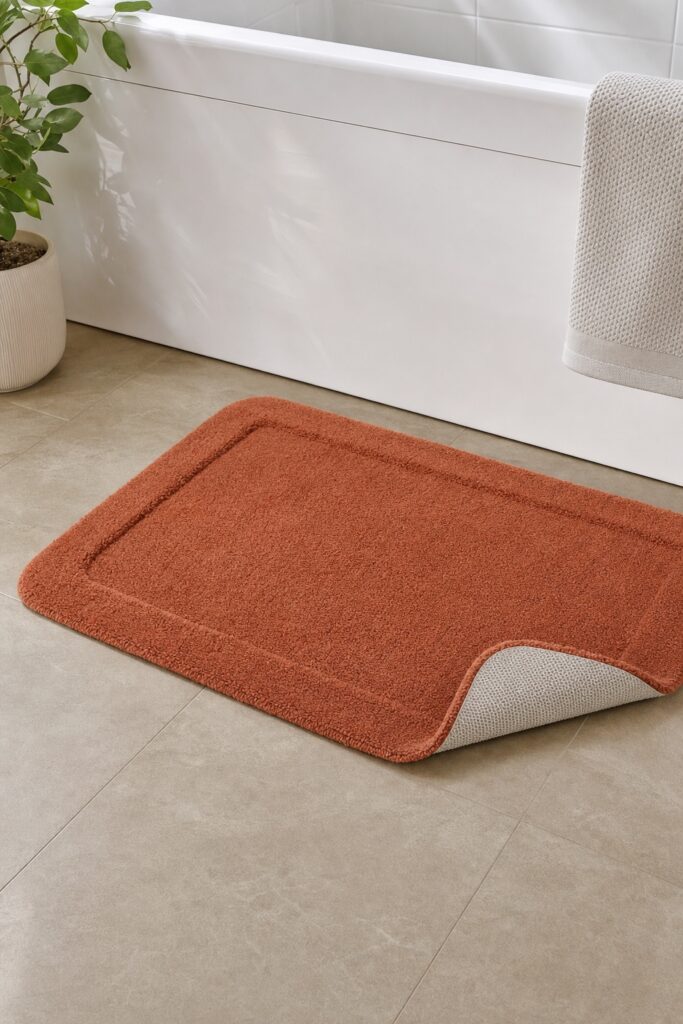
A bath mat looks like a style choice, but its actual job is catching a dripping person stepping onto smooth tile. Buy one with a non-slip backing (or add a rug pad underneath), and put it directly where you exit the tub — not centered in the room where it looks symmetrical.
Know the difference between the two rug-shaped things a bathroom can hold: a bath mat is absorbent, rubber-backed, and machine-washable — it's laundry, and it joins the towel wash cycle. A bathroom rug is decor that happens to live in a bathroom. A first apartment needs the mat; the rug is an earned item for later, if ever.
One habit makes the mat last: drape it over the tub edge after showering instead of leaving it flat. A mat that stays damp against the floor gets musty fast, and in a windowless bathroom it never really dries at all.
The cleaning trio nobody registers for

Three unglamorous purchases keep the room from sliding into grime: a toilet brush in its own holder, an all-purpose bathroom spray, and a small trash can. They're friction-tier — nothing explodes without them, but every day they're missing, the eventual cleanup gets longer.
The brush must come with a holder; a wet brush with nowhere to stand is worse than no brush. The spray should be one bottle that handles sink, counter, and tub — a first apartment does not need six specialized products under the sink, and most of those six exist to sell you the seventh. The trash can should be small and, ideally, lidded; a bathroom bin collects things you'd rather not look at, and a lid also keeps a curious pet out of it.
Add one microfiber cloth kept in the bathroom, and Sunday maintenance drops to five minutes: spray, wipe, brush, done.
No towel bar? Hooks were the better answer anyway

Plenty of apartment bathrooms come with one towel bar, badly placed, or none at all — and you can't drill. The fix is adhesive hooks, and it's barely a compromise: hooks hold more towels per foot of wall than a bar, a hook takes one second to use (a bar demands folding), and adhesive versions come off cleanly at move-out.
Two rules make hooks work. One towel per hook — a towel hung over a towel stays damp in the middle, which breaks the drying rule from the towel section. And space them out: a hook per person on the wall near the tub, one on the back of the door for a robe or tomorrow's clothes. Weight matters too — a soaked bath towel is heavier than it looks, so buy the larger hook size and press the adhesive on properly. We've mapped which adhesive hardware holds what in the command hook guide.
Wait a week before buying storage

Storage is where first-apartment money gets wasted, because it's bought on day one for an imagined routine instead of a real one. Live in the bathroom for a week first. Watch what actually accumulates on the counter, what you reach for wet, what has no home. Then buy exactly that storage — this is the same buy-now-then-wait logic as our first apartment checklist, applied to one room.
When the week is up, measure before any storage purchase. An over-toilet shelf needs the width of your tank plus clearance to lift the tank lid — maintenance happens through that lid, and a shelf that traps it has to come down the first time the toilet runs. Under the sink, the P-trap (the U-shaped pipe) eats the middle of the cabinet, so flat stacking bins beat one big box. A shower caddy is also an earned item: only after a week do you know whether you're a three-bottle household or an eleven-bottle one.
The one upgrade that pays you back: the showerhead

If your first apartment's showerhead sputters, replacing it is the rare upgrade that's cheap, tool-light, and reversible — it unscrews by hand or with pliers over a rag. It's also the one purchase on this list that pays rent back: the EPA's WaterSense program notes that standard showerheads run 2.5 gallons per minute, while WaterSense-labeled heads use no more than 2.0 — the EPA estimates the average family saves about 2,700 gallons of water a year, plus the energy that would have heated it.
The renter move: put the original head in a labeled zip bag the day you swap it, and screw it back on before move-out. The apartment leaves exactly as you found it, and the good showerhead moves with you. We made the same case in our apartment bathroom guide — of all the hardware in the room, this is the only piece worth touching.
The whole first-apartment list in buy order

Here is the entire list, in the order the tiers dictate. Crisis tier, before the first night:
- Toilet paper (multi-pack) and hand soap
- Plunger — the beehive/flange toilet shape, in a holder
- Shower liner, curtain, and rings (standard 72 × 72 unless your rod is unusually high)
- Three bath towels per person, two hand towels
- Shampoo, conditioner, body wash
Friction tier, first normal shopping trip:
- Non-slip bath mat
- Toilet brush with holder, all-purpose spray, microfiber cloth
- Small lidded trash can
- Adhesive hooks — one per towel, one for the door
Earned tier, after a week of living there:
- Storage, measured first: under-sink bins, over-toilet shelf, caddy
- A replacement showerhead if yours is bad (keep the original for move-out)
- Decor — a bathroom rug, art, plants — once the room's real habits are visible
Total damage for the crisis and friction tiers is modest because nothing on them is decorative. The savings come from the earned tier: every organizer you don't buy on day one is money still in your pocket on day ten, when you finally know what you need.
FAQ
Do I need a shower caddy right away?
No — it's an earned-tier item. Shower for a week first. If bottles end up on the tub rim or the floor, buy a caddy sized to what's actually there. Tension-pole and hanging caddies both work in rentals; suction models are the ones with a reputation for letting go.
How many towels should I buy for guests?
One or two extra bath towels in the linen closet covers a first apartment. Guests are occasional; don't stock for a hotel. If overnight guests become regular, add towels then — that's the earned tier doing its job.
Is an expensive plunger better than a cheap one?
Shape matters more than price. A well-sealing beehive or flange head under fifteen dollars outperforms a handsome flat-cup plunger at any price, because the flat cup can't seal a toilet's curved drain. Pay extra only for a holder that hides the head — that part is worth it.
Do I need a bath mat and a bathroom rug?
Start with just the mat — it does the safety and absorbency work. A rug is decor; add it later if the floor feels bare, and keep it out of the splash zone so it isn't in the towel-wash rotation.
What did this list leave out on purpose?
Matching accessory sets (soap dish, tumbler, tray), drawer organizers, over-door racks with six hooks, and specialized cleaners. None are bad — they're all earned-tier purchases pretending to be essentials. Buy them when the room shows you the need, not because a set photographed well.


