
College Apartment Decor: Outshine the Rental, Don’t Fight It

College apartment decor has one enemy, and it isn't your budget. It's the urge to fight the apartment — to treat the white walls, the beige carpet, and the vertical blinds as problems to be defeated. You can't defeat them. They're in the lease.
What works is the opposite move: leave the givens alone and outshine them. Every generic thing a rental hands you has a known, damage-free counter — big art for blank walls, a real rug for sad carpet, lamps against the ceiling glare, one repeated color to unify furniture that's never met before. Run enough counters and the givens fade into the background, which is all they ever needed to do. This guide goes given by given.
Jump to a section
- The rule: don't fight the rental, outshine it
- White walls: hang big, not many
- Beige carpet: the rug is the room
- Vertical blinds: curtains over, blinds surrendered
- Big-box furniture: cover, top, and swap
- The big light: lamps on, ceiling off
- Mismatched furniture: one color ties it
- The shared living room: agree on three things
- Your bedroom: the one room that answers to you
- Cables and clutter: hide the ugly river
- The $0 layer: decorate with what you own
- FAQ
The rule: don't fight the rental, outshine it
The math of a one-year lease is simple: money spent changing the apartment stays with the apartment, and money spent outshining it leaves with you. Painting, drilling, swapping fixtures — even where they're allowed, they're donations to your landlord. A rug, a lamp, a set of curtains, and a good piece of art are your furniture for the next decade of apartments.
So the whole strategy is layering attention-getters over attention-losers. Eyes go to color, scale, light, and texture; the beige recedes because nothing about it asks to be looked at. The chart below is the map — five givens, five moves — and each one gets its section beneath.

White walls: hang big, not many
The instinct in a first apartment is to scatter small things across the walls — a little print here, a pennant there. Blank drywall eats small decor. The move is scale: one genuinely large piece per main wall — an oversized framed print, a fabric tapestry that isn't a dorm flag, even a big engineering print of your own photo — plus, at most, one tight grid of smaller frames hung close together so they read as a single block.
All of it hangs damage-free on adhesive strips if you respect the numbers: 3M publishes exact weight limits per strip size, so weigh the frame, round up, and press strips onto clean, smooth, fully cured paint. Fabric pieces weigh almost nothing, which is why tapestries and textile hangings are the college wall's best friend — maximum square footage per ounce.

Beige carpet: the rug is the room
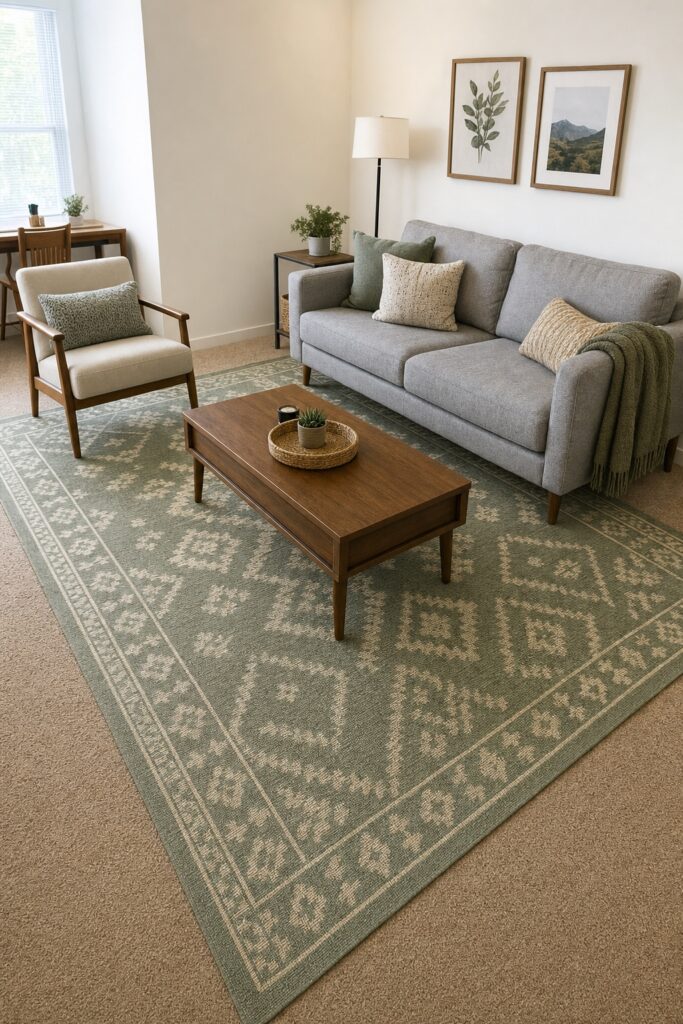
You will never love the carpet, so stop looking at it: put a big rug over it and let the rug be the floor. The classic mistake is buying small — a 5×7 floating island in the middle of the room reads as a bath mat that wandered. Go big enough that the front legs of the sofa and chairs all sit on the rug; that's what visually claims the seating zone as one room-within-a-room.
Pattern is your ally over carpet: a flat-woven rug with real pattern hides the semester's traffic and spills better than any pale solid, and it carries more visual weight against the beige. Layering a rug over carpet is deposit-neutral and completely reversible — a rug pad made for carpet keeps it from creeping.
Vertical blinds: curtains over, blinds surrendered
Vertical blinds can't be removed without a landlord conversation and a closet to store them in — so surrender them. Push them fully open to one side, then hang long curtains in front, mounted without drilling: no-drill brackets that grip the window trim, or a tension rod inside the frame if the panels are light. Check the fit and the weight rating before buying; a bracket that fits 2-inch trim doesn't fit none.
Curtains do three jobs at once here: they hide the blinds, they add the biggest fabric surface in the room (instant softness), and hung high and wide they make the window — and the whole wall — read taller. Floor-length or nothing; the awkward sill-length curtain reads dorm faster than any fairy light ever did.

Big-box furniture: cover, top, and swap
The bookcase, the desk, the coffee table — the flat-pack basics are fine bones with boring skin, and paint isn't an option on a deposit. Three no-paint moves change them. Cover: a slipcover or a well-tucked throw turns the scratchy hand-me-down chair into "the cozy chair." Top: a woven runner, a stack of books, a lamp, and one object with personality make any flat surface read styled instead of assembled. Swap: cabinet knobs and drawer pulls cost little, need only a screwdriver, and are the single highest-leverage upgrade a plain dresser can get — keep the originals in a bag for move-out.
The shelf itself is decor if you style it as blocks: books grouped by size (spines in, if the colors fight), one plant per shelf level, one framed photo, and thirty percent empty space. A packed shelf is storage; a styled shelf is a wall feature that happens to store things.

The big light: lamps on, ceiling off
Every rental has it: the single ceiling dome — the one that lights the room like a garage or an interrogation. The fix costs two lamps: a floor lamp in the dead corner and a table lamp on the desk or side table, all wearing warm bulbs (2700–3000K on the box), and a house rule that the ceiling switch stays off after dark.
This is the highest mood-per-dollar move in the whole guide. Warm pools of lamp light at different heights make a generic room feel layered and intentional; the same room under the ceiling dome looks like it's waiting for a security deposit inspection. If you buy nothing else from this article this month, buy the floor lamp.

Mismatched furniture: one color ties it
A college apartment's furniture is an arranged marriage — your desk, a roommate's futon, a curb-found coffee table, somebody's aunt's lamp. You can't afford to replace them, and you don't need to: mismatched furniture reads collected instead of random the moment one color repeats across it.
Pick one accent color and enforce it in the cheap layer: two pillows, a throw, a lampshade, a piece of art, maybe a vase — five to six appearances of the same navy (or terracotta, or sage) around the room. The eye connects the repeats into a plan and files the mismatched wood tones under "eclectic." This is the cheapest unifier in decorating, and it's also the easiest to change when next year's apartment has different light.

The shared living room: agree on three things
The common room belongs to everyone, which means it belongs to no one's Pinterest board. Skip the fight by agreeing on exactly three shared decisions: the rug, whatever covers the sofa, and the coffee table situation. Keep those three neutral-ish and split their cost — they're the infrastructure. Then give every roommate a personality allowance that's easy to swap: their own pillow on the sofa, one shelf of the bookcase, wall space above their designated corner.
The neutral-base-personal-layer split is the same peace treaty that works in a two-person dorm, scaled up to an apartment. Agree in the group chat before anyone orders anything, and write down who paid for what — the rug question returns at move-out with interest.

Your bedroom: the one room that answers to you
The shared spaces run on compromise; your bedroom doesn't. This is where the maximal version of every move goes: the peel-and-stick accent wall behind the bed (check the lease first, buy from the removable category, and test a strip in the closet for a week before committing a wall), the bedding layered like you mean it, the full gallery of printed photos — printed, because a phone full of pictures decorates nothing.
Make the bed the room's centerpiece, since it's the biggest object you own: headboard wall gets the accent treatment, bedding gets the accent color, and a clip lamp or small table lamp replaces the ceiling light here too. For the whole-apartment version of starting from an empty room, our first apartment guide runs the furnishing order; this section is about making the room yours once the bed exists.

Cables and clutter: hide the ugly river
Nothing undoes a styled room faster than the cord river — the gray tangle running from the TV, the power strip breeding under the desk, chargers colonizing every outlet. The fixes are cheap and boring: a cable management box swallows the power strip, a fabric cord sleeve turns six cables into one tidy line, and a woven basket next to the console eats the controllers and the three remotes nobody will admit to needing.
Route cords along furniture legs and baseboards rather than sticking adhesive raceways all over painted walls — adhesive plus rental paint plus move-out day is a gamble the wall usually loses. And put the chargers in one place (a small tray with a multi-port charger) instead of five outlets' worth of scattered cords; the counters instantly look calmer.

The $0 layer: decorate with what you own
Before the last Target run, shop your own apartment. Course books stack into risers and bookends. The photos on your phone become a gallery for the price of drugstore prints and thrifted frames. A scarf you never wear is a dresser runner; a pretty tote hangs as wall storage; the glass jars from last month's candles hold pens, makeup brushes, and plant cuttings — which, in water, are free decor that grows.
This layer is what makes an apartment look like yours instead of like a haul video. Bought decor says you shopped; owned objects say you live here. The mix is the goal: the big moves above handle the room's bones, and the free layer on top supplies the personality no store sells.

FAQ
Can I paint anything?
Assume no until the lease or landlord says otherwise in writing — and even with permission, you'll likely owe repainting at move-out. Peel-and-stick wallpaper, big art, and textiles get you 90% of paint's effect with 0% of the deposit conversation.
I can only afford one thing this month. What do I buy?
The floor lamp with a warm bulb. It changes how every other object in the room looks after sunset, which is when a college apartment actually gets lived in. The big rug is the second purchase; the curtains are third.
Does peel-and-stick wallpaper really come off clean?
From smooth, well-cured paint, generally yes — that's what the removable category is designed for. From old, matte, or poorly prepped paint, it can lift flakes. Test a strip somewhere invisible for a week first, peel slowly at a sharp angle when you leave, and keep "removable describes good conditions" as your working rule.
How do I make it not look like a dorm?
Kill the dorm tells: sill-length curtains, one overhead light doing everything, small posters scattered wide, and furniture lining the walls like a waiting room. Floor-length curtains, lamps, one big anchor piece per wall, and a rug that claims the seating zone read adult immediately — none of them cost much more than their dorm versions.
What's worth keeping after graduation?
The things this guide told you to spend on: the rug, the lamps, the curtains, the real-frame art, the good bedding. They're apartment-agnostic and they'll outlive three leases. The peel-and-stick, the slipcovers cut to this sofa, and the shelf styling are for this year — let them go without guilt.


