
Concrete Planter From Egg Trays: How to Pour a Bubble Pot at Home
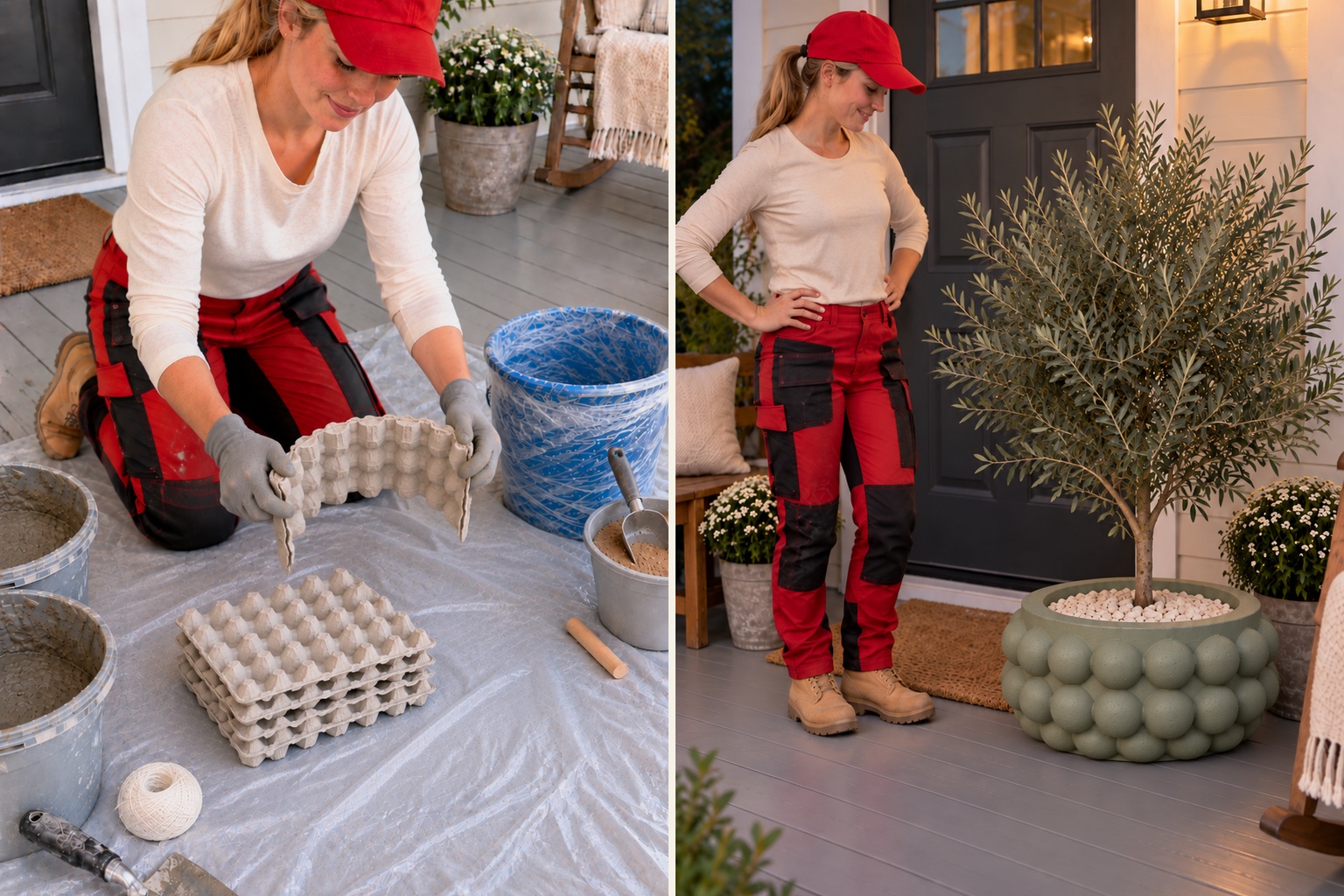
Picture your front door on a crisp fall evening. The porch light is on, and beside the door stands a round sage-green pot covered in soft bubbles, a little olive tree rising out of a layer of pale stones.
A neighbor walking a dog stops at the step and asks, "Is that stone? Where did you find it?"
This guide contains Amazon affiliate links. As an Amazon Associate I earn from qualifying purchases, at no extra cost to you.
That's the bubble concrete planter from our video. Five egg trays make the mold, a bucket full of sand makes the inside, and concrete fills the space between. You can pour it in about an hour, then wait two days before you peel it. Three bags of sand mix are the main cost, and the whole pot comes to about $75 to $120, not counting the plant.
When a bubble pot video goes around, the comments ask the same things. How did the concrete get down the sides? What is the stick for? How heavy is that thing, really? Every answer is below, with 7 steps and a picture for each, plus the five mistakes that make a concrete pot crumble, crack or burn your hands.
At a glance
- Time: about an hour to pour, two days to set, then an hour to peel and paint
- Skill: beginner. You mix, pour and peel; no power tools.
- Cost: about $75 to $120, not counting the plant and soil
- Best time to build: now. On Pinterest, searches for concrete planters and fall porch ideas run highest in early October, and front porch Christmas ideas peak in mid November. Poured this week, it's by the door before the holiday guests arrive.
Jump to a section
- How the Egg Tray Planter Works
- What You Need, and What It Costs
- Step 1: Bend Five Egg Trays Into a Ring
- Step 2: Pour the Floor and Push in the Dowel
- Step 3: Set a Sand-Filled Bucket in the Middle
- Step 4: Pour Concrete All Around the Bucket
- Step 5: Peel the Egg Trays After Two Days
- Step 6: Pull Out the Bucket and the Dowel
- Step 7: Paint It, Then Plant It
- The Mistakes That Make It Fail
- Keep the Bubble Pot Looking New
- FAQ
If you buy one thing
Start with five big paper egg trays
They are the whole mold: each cup becomes one round bubble, and the flat 30-egg size bends into a ring that small cartons cannot make.
How the Egg Tray Planter Works

The egg trays shape the outside, the bucket shapes the inside, and the concrete takes the space in between.
- Five big egg trays stand in a ring, cups facing in, tied with string. Each cup becomes one round bubble on the outside of the pot.
- A 2-inch layer of concrete makes the floor, with a short wooden dowel in the middle for the drain hole.
- A bucket full of sand stands on that floor, and concrete fills the gap all around it. The sand keeps the bucket from floating up.
In the original video, the pour seems to flow down the sides on its own, and the finished pot gets lifted like a toy. Here the floor goes in first, the bucket second, the walls last, and the pot stays where you pour it: it weighs around 175 pounds.
What You Need, and What It Costs

- Paper egg trays, five of the big 30-egg kind, about 12 inches square.
- Sand mix (also sold as topping mix), three 60-pound bags.
- 5-gallon bucket, plus plastic wrap and sand to fill it.
- Wooden dowel, 1 inch thick and about 6 inches long, for the drain hole.
- String, a few feet of strong cotton string or twine.
- Nitrile gloves and safety glasses, plus a board to kneel on.
- Exterior masonry paint in sage green, a small can, and a brush.
- White pebbles, one 20-pound bag, for the top of the soil.
- Pot feet, three, to lift the finished pot off the ground.
- Tools: a large plastic sheet, a second bucket and a trowel for mixing, scissors and a stiff brush.
What it costs: about $75 to $120 in all, not counting the plant and soil. That's with prices we found at US stores on October 20, 2026. The three bags of sand mix are about $33. The paint is about $15 to $20 and the pebbles about $14 to $28. The trays, gloves, dowel, string and pot feet are about $15 to $40, less if a cafe gives you the trays.
Two buying tips:
- Ask a cafe or a farm stand for big egg trays. The flat 30-egg trays bend into a ring; small 12-egg cartons don't.
- Pick sand mix, not regular concrete mix. It has no big stones, so it fills every egg cup and gives round, smooth bubbles.
Step 1: Bend Five Egg Trays Into a Ring

- Spread the plastic sheet where the pot will stand, or as close to it as you can.
- Bend each egg tray into a gentle curve, cups facing in.
- Stand the five trays edge to edge in a circle, about 19 inches across.
- Wrap the string twice around the ring and pull the knot tight.
Watch out: pour where the pot will live. Finished, it weighs around 175 pounds, so moving it later takes a hand truck and a helper.
Step 2: Pour the Floor and Push in the Dowel

- Put on the nitrile gloves and safety glasses, and kneel on the board, not on the sheet.
- Mix one bag of sand mix with clean water in the bucket, to a thick paste, following the bag.
- Pour a 2-inch layer into the bottom of the ring and level it.
- Push the dowel straight down into the middle, its top level with the concrete.
Watch out: wet concrete can burn skin without hurting at first. OSHA's guide to preventing skin problems from portland cement recommends nitrile or butyl gloves, not cotton, plus eye protection and a dry board to kneel on. Rinse any splash off with clean, cool water.
Step 3: Set a Sand-Filled Bucket in the Middle

- Wrap the outside of the 5-gallon bucket in plastic wrap, so it slides out later.
- Fill it to the top with sand and pat it down.
- Set it, mouth up, on the wet floor in the middle of the ring, with an even gap all around.
Watch out: don't skip the sand. An empty bucket floats up in wet concrete, and the pot ends up with a thin, weak floor.
Step 4: Pour Concrete All Around the Bucket

- Mix the other two bags, one at a time.
- Pour into the gap all around the bucket, moving around the ring as you go.
- Tap the outside of the trays gently all the way around, so the concrete settles into every cup.
- Smooth the top of the wall with the trowel.
Watch out: tap, don't poke. Tapping settles the concrete into the cups, while poking it leaves air pockets that show as holes.
Step 5: Peel the Egg Trays After Two Days

- Cover the pot with damp towels or plastic and leave it for two days.
- Snip the string and tear the soggy trays off in chunks.
- Scrub the stuck paper bits off with the stiff brush.
Watch out: wait the full two days. Peeled too soon, the bubbles crumble at the edges.
Step 6: Pull Out the Bucket and the Dowel

- Grip the bucket rim, twist it and pull it straight up.
- Reach in and pull the dowel out of the floor to open the drain hole.
- Let the pot dry for another day before you paint it.
Watch out: if the bucket sticks, twist it, don't pry it. Prying against the wall can chip the rim.
Step 7: Paint It, Then Plant It

- Brush on two coats of the masonry paint, letting the first coat dry.
- Tip the pot onto the pot feet with a helper, so the drain hole can drain.
- Fill it two-thirds with potting soil, plant the tree and top the soil with white pebbles.
Watch out: fill it where it stands. With soil and a tree in it, nobody is moving it.
The Mistakes That Make It Fail

People who see a bubble concrete pot look for what went wrong. These five give it away:
- Poured far from the door. It weighs around 175 pounds. Pour it where it will stand.
- Bare hands in wet concrete. Wear nitrile gloves; cement burns don't hurt until the damage is done.
- An empty bucket. Fill it with sand, or it floats and thins the floor.
- Peeling on day one. Wait two days, or the bubbles crumble.
- No drain hole. The dowel makes one; without it, the roots sit in water.
Get those five right, and the pot looks like it came from a garden shop.
Keep the Bubble Pot Looking New

- Keep it on the pot feet, so water drains out instead of sitting underneath.
- Touch up the paint each spring where the bubbles get scuffed.
- Brush dust and leaves out of the bubbles with a soft brush.
- Top up the white pebbles when the rain washes soil over them.
Then switch on the porch light, and let the next neighbor ask where you found it.
Watch this build, and the next ones, on YouTube, Instagram and Facebook.
Start here
Want it by the door before the holiday guests arrive? Start with the trays: the rest is three bags of sand mix and a weekend.
FAQ
How Heavy Is a Concrete Planter This Size?
Around 175 pounds for a pot about 19 inches across and 12 inches tall. Pour it close to where it will stand.
What Concrete Is Best for a Planter?
Sand mix, also sold as topping mix. It has no big stones, so it fills small shapes like egg cups smoothly.
How Long Before You Can Take the Mold Off?
Wait two days with the pot kept damp. Then the trays peel off without taking the bubbles with them.
Why Does a Concrete Planter Need a Drain Hole?
Without one, water collects at the bottom and the roots rot. A dowel pushed into the wet floor leaves a clean hole.
Can You Paint a Concrete Planter?
Yes, with exterior masonry paint once the pot is dry. Two thin coats cover the gray evenly.
How Much Does a Concrete Egg Tray Planter Cost?
About $75 to $120, not counting the plant and soil, at US store prices in October 2026. The sand mix is the biggest part.


