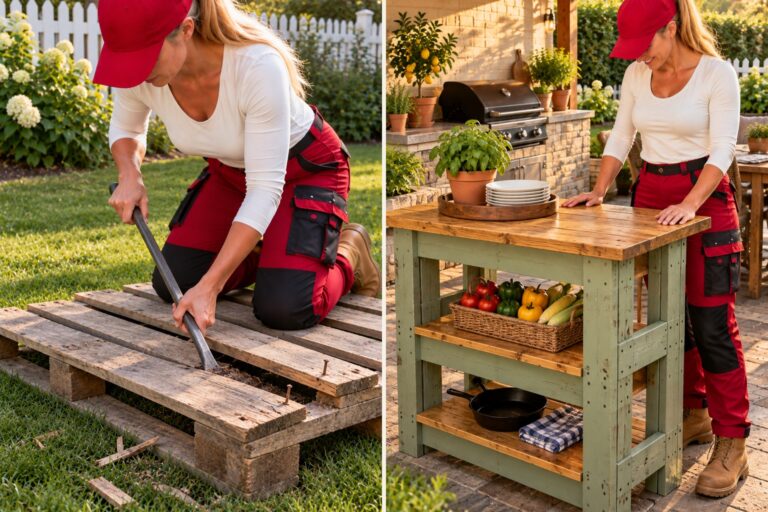
DIY Farmhouse Table From One Old Pallet: A Table for 12

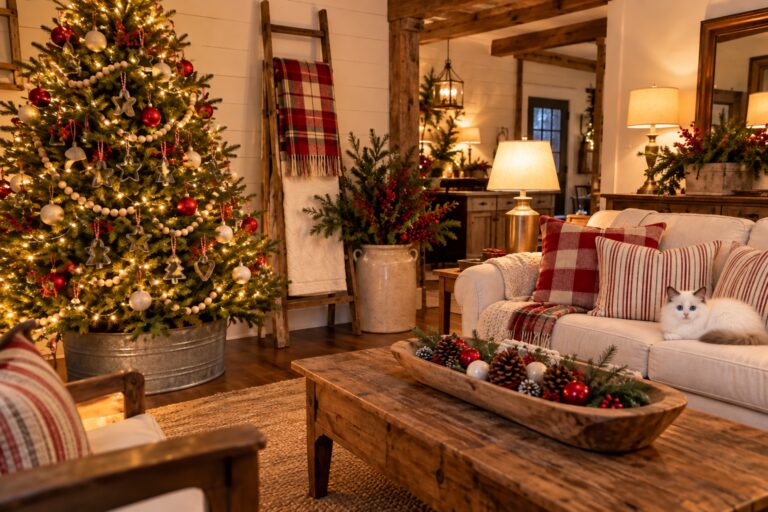
Picture Thanksgiving evening. Twelve chairs fill the dining room, and the long walnut table holds every dish without a single card table at the end.
The candles are lit, the window glows gold, and the cat has claimed the window seat. Then your sister runs a hand along the grain: "Where did you find a table this big?"
This guide contains Amazon affiliate links. As an Amazon Associate I earn from qualifying purchases, at no extra cost to you.
That's the farmhouse table from our video. It started as one long weathered pallet on the back porch. Two X legs, one long stretcher and six wide planks make a table about 10 feet long, 40 inches wide and 30 inches high. You can build it yourself in a weekend. With free pallet wood, the stain, clear coat and screws come to about $70 to $80.
When a pallet table video goes around, the comments ask the same things. Is pallet wood safe indoors? Why would anyone hammer screws? Won't an X leg wobble? Every answer is below, with 7 steps and a picture for each, plus the five mistakes that give a pallet table away as homemade.
At a glance
- Time: a weekend: one day to take apart, sand and stain, then a day to build and seal
- Skill: beginner, with two power tools: a drill and a sander
- Cost: about $70 to $80 with free pallet wood; about $150 to $230 with new boards
- Best time to build: now. On Pinterest, searches for a Thanksgiving table climb from mid-October and peak right after the holiday. Built in early November, it's finished with time to spare.
Jump to a section
- How the Farmhouse Table Is Put Together
- What You Need, and What It Costs
- Step 1: Choose a Safe Pallet and Sand Every Board
- Step 2: Stain the Boards Walnut and Let Them Dry
- Step 3: Build Two X Legs on the Floor
- Step 4: Stand the Legs Up and Add the Stretcher
- Step 5: Lay the First Plank and Screw It Down
- Step 6: Add the Rest of the Planks
- Step 7: Seal the Top and Set the Table
- The Mistakes That Make It Fail
- Keep the Farmhouse Table Looking New
- FAQ
If you buy one thing
Start With a Random Orbital Sander
Weathered pallet boards are gray, rough and splintery, and sanding is most of the work. An orbital sander turns a whole stack of them pale and smooth in an afternoon instead of a weekend.
How the Farmhouse Table Is Put Together

The table is two X legs joined by one long board, with a plank top screwed on.
- Each X leg is two thick boards crossed and screwed where they overlap, with a short crossbar screwed across the top.
- A long stretcher runs from one X crossing to the other, so the legs can't rock toward each other.
- Six or seven wide planks lie across the two crossbars. Two screws go through each plank into each crossbar.
In the original video, the screws are hammered in and the stand looks shaky. Here every screw goes in with a drill, each crossing gets four screws, and the stretcher locks the base.
What You Need, and What It Costs

- Wood pallet, one long one or several standard ones, with the HT stamp. Most pallets are 48 inches long, so a 10-foot top needs long boards.
- 2×6 lumber, 10-foot boards, if your pallet boards are too short or too thin for the top.
- Pry bar, a long one, for lifting boards without splitting them.
- Random orbital sander with 80- and 120-grit discs.
- Walnut wood stain, one quart.
- Water-based polyurethane, one quart in satin, for the top.
- Deck screws, 3 inch, one 5-pound box.
- Tools: cordless drill, tape measure, square, pencil, hand saw or circular saw, gloves, safety glasses and a dust mask.
What it costs: about $70 to $80 with free pallet wood, not counting tools. That's with prices we found at US stores on October 24, 2026. A quart of stain is about $13 to $21, a quart of clear coat about $28, and a 5-pound box of deck screws about $30. If you buy ten 10-foot 2×6 boards instead, add about $80 to $150.
Two buying tips:
- Ask a lumber yard or a building-supply store for a long pallet. Pallets that carried long lumber are the rare ones with boards long enough for the top.
- Buy the screws in one box. A table this size uses about 50 of them, and small packs cost far more per screw.
Step 1: Choose a Safe Pallet and Sand Every Board

- Find the stamp on the pallet and check the code: HT means heat-treated.
- Pry the boards up slowly, working along each nail line, and pull every old nail.
- Sand every board with 80 grit, then 120 grit, until the gray surface turns pale.
Watch out: a dining table touches food and hands every day. Use these three rules:
- Use HT pallets only. HT means the wood was heated, not sprayed with chemicals.
- Skip any pallet marked MB. MB means it was fumigated with methyl bromide, a toxic pesticide.
- Skip stained, oily or smelly pallets. They may have carried spills.
The USDA guide to wood packaging treatment explains what the HT and MB codes mean.
Step 2: Stain the Boards Walnut and Let Them Dry

- Wipe the sanding dust off every board with a dry cloth.
- Brush the walnut stain along the grain, one board at a time.
- Wipe off the extra after a few minutes and let the boards dry overnight.
Watch out: stain every side, including the edges and the ends. A pale edge shows the moment the planks sit side by side.
Step 3: Build Two X Legs on the Floor

- Cross two 4-foot boards on the floor so the X stands about 27 inches tall and about 34 inches wide at the feet.
- Mark a level line at the top and the bottom, and cut along it so the X sits flat.
- Drive four screws through the crossing, then screw a 40-inch crossbar across the top ends. Build the second X the same way.
Watch out: a screw only holds where two boards overlap. Place every screw inside the crossing, never in the open end of one board.
Step 4: Stand the Legs Up and Add the Stretcher

- Carry one X leg inside and stand it at one end of the table spot.
- Stand the second X about 8 feet away, so the top will hang over each end by about a foot.
- Lay the long stretcher into both crossings and drive two screws at each end.
Watch out: check that both legs stand straight before the stretcher goes in. A leaning leg now means a rocking table later.
Step 5: Lay the First Plank and Screw It Down

- Lay the first plank along one long edge, resting on both crossbars.
- Center it so it hangs over each crossbar by the same amount.
- Drive two screws through the plank into each crossbar.
Watch out: pre-drill near the board ends. Old pallet wood is dry and splits easily when a screw goes in close to the end.
Step 6: Add the Rest of the Planks
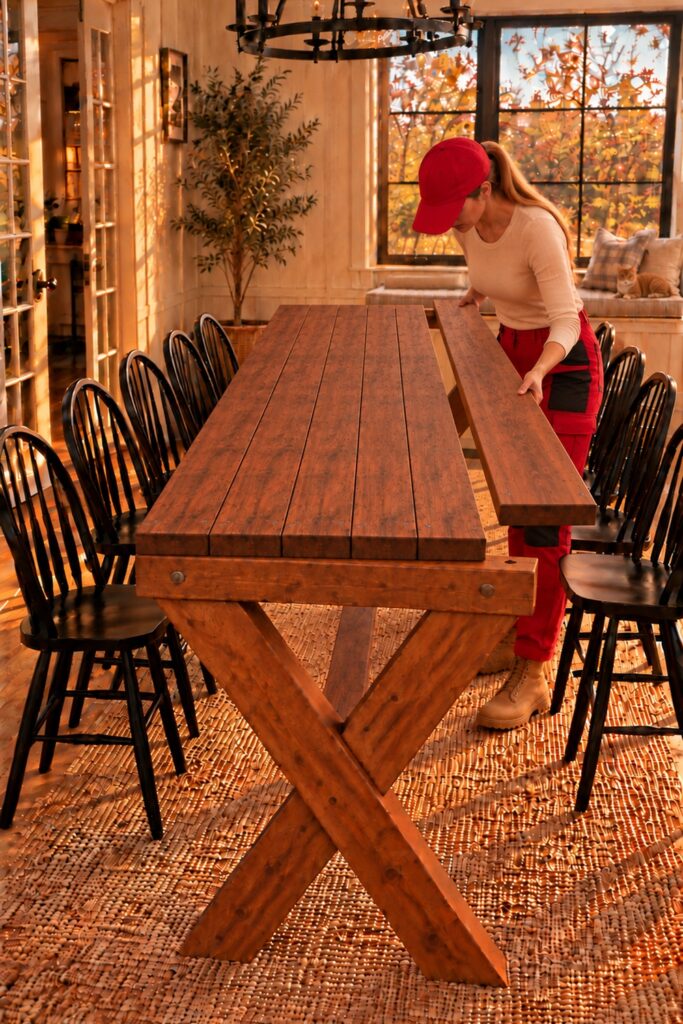
- Lay the next plank tight against the first and screw it down the same way.
- Keep going one plank at a time until the top is about 40 inches wide.
- Line the screw heads up in a straight row across the crossbars.
Watch out: carry one plank at a time. The table is heavy once it's together, so build it where it will stand.
Step 7: Seal the Top and Set the Table

- Sand the top lightly by hand with 120 grit.
- Brush on a thin coat of water-based polyurethane and let it dry.
- Add a second coat, then roll out a runner and set the candles down the middle.
Watch out: don't skip the clear coat. Stained wood alone soaks up gravy, wine and water rings.
The Mistakes That Make It Fail

People who see a pallet farmhouse table go looking for what's wrong. These five give it away in seconds:
- Hammered screws. They split the wood and never hold; use a drill.
- Screws in the wrong place. Every screw goes through two boards that overlap.
- No stretcher. Without it, the X legs rock toward each other.
- Thin top boards. Thin pallet boards bounce across 8 feet; use thick ones or 2×6 lumber.
- No clear coat. Bare stained wood soaks up the first spill.
Get those five right, and the table looks like a store-bought farmhouse table, not a weekend project.
Keep the Farmhouse Table Looking New

- Wipe spills with a damp cloth and dry the wood right away.
- Use trivets under hot dishes; heat can cloud the clear coat.
- Check the screws once a year and tighten any that have loosened.
- Add a fresh coat of polyurethane when the top starts to look dull.
Then light the candles, fill all twelve chairs, and let the next guest ask where you found it.
Watch this build, and the next ones, on YouTube, Instagram and Facebook.
Start here
Want it ready for Thanksgiving? Start with the sander: the rest is an old pallet, a can of stain and a weekend.
FAQ
How Long Should a Table for 12 People Be?
Plan on 8 to 10 feet. Each person needs at least 24 inches of table edge, and 30 inches is more comfortable.
How Tall Is a Dining Table?
Most dining tables are about 30 inches tall, within a range of 28 to 31 inches. That height fits standard dining chairs.
Is Pallet Wood Safe for a Dining Table?
It can be. Use only pallets stamped HT, skip any marked MB, and skip pallets with stains, oil or a chemical smell. Sand every board and seal the top.
How Much Does a DIY Farmhouse Table Cost?
About $70 to $80 with free pallet wood, for stain, clear coat and screws. With new 2×6 lumber, it's about $150 to $230.
Do You Need to Seal a Pallet Wood Table?
Yes. Stain only changes the color. Two thin coats of water-based polyurethane protect the top from spills and water rings.
Can You Build It From Standard Pallets?
Yes, for the legs and crossbars. Standard pallets are 48 inches long, so the long top planks need a long pallet or 10-foot boards.