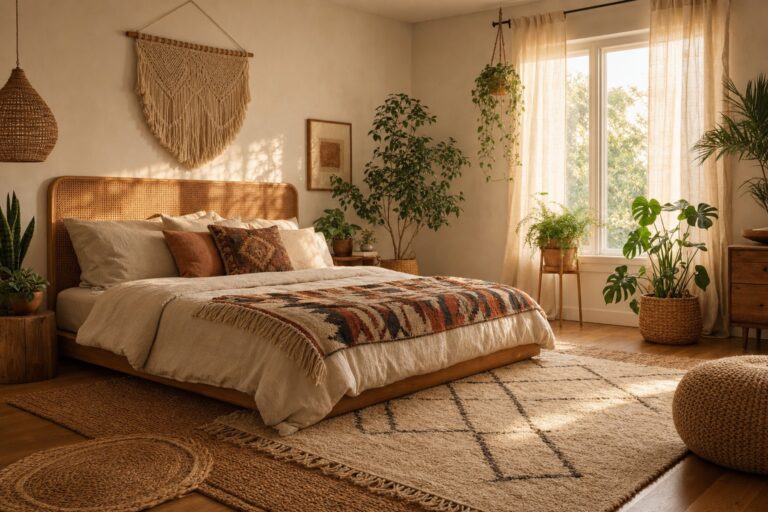
Small Bedroom Ideas for Teens: One Room, Three Jobs

Small bedroom ideas for teens start with a layout that leaves room for homework and relaxing as well as sleep. Decide what the bed needs to do, then choose the desk, storage, and seating around the space that remains.
- Keep your current bed: fit a compact study space and use under-bed storage before adding more furniture.
- Need seating for friends: make a daybed the sofa so the same space handles sleep and hanging out.
- Need a desk beneath the bed: check the loft-bed option against the manufacturer's instructions, ceiling clearance, and ladder access.
Before moving furniture, sketch the room with its door, windows, closet, and outlets. Use each piece's full dimensions and leave space for the desk chair, drawers, and doors to open.
Jump to a section
- Think in zones: one room, three jobs
- Raise the bed, win the floor
- Or make the bed the sofa
- A study zone that actually gets used
- The hangout corner
- Storage that hides in plain sight
- Walls that change as fast as they do
- A palette that grows with them
- Light beyond the big light
- Make a small teen bedroom feel bigger
- The one-weekend refresh
- FAQ
Think in zones: one room, three jobs

Divide the room into three zones — sleep, study, hang out — and give each one a real address, even if it's only a corner. The bed claims a wall, the desk claims the window, and the hangout corner claims whatever's left, marked with a rug or cushions so it reads as its own place and not leftover floor.
Zones matter more in a teen room than almost anywhere else in the house because the room works a triple shift: bedroom at night, office after school, living room on weekends. When the zones blur — homework on the bed, friends on the homework chair — the room feels smaller and every activity fights the others. The diagram above is the whole strategy; the rest of this article is how each zone earns its keep.
Raise the bed, win the floor

A loft bed can put the desk beneath the mattress, sharing one part of the room vertically. Measure the usable space beneath the frame and leave the ladder approach clear; the frame and access still take floor space.
Follow the bed manufacturer's assembly, mattress-thickness, weight-limit, and clearance instructions. Measure sitting room above the intended mattress and usable height under the frame. The CPSC's bunk-bed guidance explains the guardrail and mattress requirements. Skip a loft if the model or room cannot meet those conditions.
Or make the bed the sofa

If lofting isn't an option, a daybed does the two-for-one instead: bolsters along the back turn it into the hangout seating by day, and it's a full bed by night. That one move merges the sleep zone and the hangout zone, freeing the rest of the room for the desk and open floor. Many daybeds add storage drawers or a trundle underneath — a sleepover solved in the same footprint.
Size is worth a real conversation. A twin is 38 by 75 inches and a full is 54 by 75 — that 16-inch difference is a whole stretch of walkable floor in a small room. The twin-plus-daybed-styling combination usually beats the full bed for teens whose rooms double as social space, because the floor you keep does more daily work than the mattress width you give up.
A study zone that actually gets used

Put the desk where the daylight is, give it one genuinely good task lamp, and move the storage onto the wall — that combination is what separates a desk that gets used from a desk that collects laundry. A narrow desk (even 18 inches deep) is enough for a laptop and a notebook, and shallow fits small rooms better than the big executive fantasy.
The wall does the heavy lifting: a pegboard or rail above the desk holds supplies in cups and small shelves, which keeps the work surface clear enough to start homework without excavating first. A comfortable chair matters more than it seems — if the seat is bad, the bed wins, and the bed is where homework goes to die.
The hangout corner

Claim a four-by-four corner with a small rug, two big floor cushions, and something warm overhead, and the room suddenly has a social address that isn't the bed. This is the zone most teen rooms skip, and it's the one that makes the room feel grown-up — the difference between "come see my room" and "we hang out in the kitchen."
Floor seating is the right technology here: cushions and poufs stack away when the floor is needed, cost a fraction of real furniture, and set a completely different mood than sitting on a made bed. A low shelf within reach for games, books, and a speaker finishes the zone. It will not stay tidy. That's fine; it's a hangout corner, not a showroom.
Storage that hides in plain sight

The storage a small teen room needs already exists inside it — under the bed, behind the door, and above the door line. Rolling under-bed drawers swallow the off-season clothes and the hobby gear; an over-door organizer handles the small chaos (chargers, hair stuff, that category of things with no category); one high shelf above the door line stores the keep-but-rarely-touch boxes.
Two rules keep it working. Closed beats open in a teen room — bins and drawers forgive the mess that open shelving broadcasts. And anything tall needs anchoring to the wall: a bookcase that seems stable will meet a yanked backpack strap eventually, and the CPSC's Anchor It guidance covers the two-minute fix. When the room's closet is the real bottleneck, the closet organization guide picks up that thread.
Walls that change as fast as they do

Build the walls for turnover: clip grids, washi tape, and removable hooks — systems where this month's obsession swaps out in five minutes without a single new hole. A teen's taste has a half-life of about a semester. Fighting that with framed, nailed, permanent decor guarantees a room that feels dated to its owner by winter break.
A wire grid with clips takes prints, photos, ticket stubs, and sketches in any arrangement; washi tape puts lightweight prints straight onto the paint and comes off cleanly; a picture ledge lets frames lean and shuffle. Leave some clips empty on purpose — an unfinished wall is an invitation, and the room stays theirs to edit. This is also the cheapest section of this entire article, which matters when the decorator is spending allowance.
A palette that grows with them

Keep the expensive layers neutral and let the cheap layers carry the color. Walls, bed frame, dresser, and curtains in warm whites and wood tones; this year's identity arrives through bedding, a throw, art prints, and desk objects. When the phase changes — and it will — the update costs a duvet cover, not a repaint.
This split also solves the "not babyish, not boring" negotiation between parents and teens. The neutral shell reads calm and grown-up; the accent layer can go as bold as the current mood demands, because nothing bold is permanent. A muted version of the loud color usually keeps everyone happy — terracotta instead of traffic-cone orange, sage instead of slime green — and it photographs better, which, for this decorator, is not a small point.
Light beyond the big light

Three warm light layers at three heights — an LED strip under a shelf, a desk lamp, string lights over the bed — and the overhead switch retires. The single ceiling light is the enemy of every mood a teen room wants to have: it flattens the cozy corner, glares on the screen, and makes 9 p.m. feel like a supermarket.
Layered light gives the room settings: desk lamp for homework, string lights for hanging out, LED glow for everything after. Keep the tones warm — the internet's cool-blue LED default reads harsh in a small room — and check one thing on adhesive strips: most peel off smooth paint cleanly, but on matte or older finishes they can lift paint, so test a corner behind furniture first. Every light in this section plugs in; none of it requires anything a landlord or a parent would veto.
Make a small teen bedroom feel bigger

The room can't grow, but the reading of it can: a full-length mirror, a low-profile bed, and curtains hung high and wide are the three fastest expanders. The mirror doubles light and implies a second window; the low bed drops the room's visual weight so the walls feel taller; curtains mounted near the ceiling and wider than the frame make the actual window read half again its size.
Underneath all three is the same principle — keep floor and wall visible. A small room with visible edges reads bigger than a bigger room without them. The full toolkit of these tricks (scale, sightlines, color placement) lives in our small bedroom guide; everything there applies to a teen's room unchanged.
The one-weekend refresh

Start with bedding, personal art and one useful lamp. In this room, a blue quilt and yellow accents bring color to plain walls, while a pinboard of sketches makes the room feel personal.
Try it with what you own: Pick one color from a favorite drawing or photo and repeat it in bedding or a pillow. Display a few personal sketches, keep space for homework, and place a lamp where you read or draw. Keep the bed and desk if they still work for the room.
FAQ
How do you fit a desk in a small teen bedroom?
Give the bed decision first priority: a loft bed puts the desk in the bed's old footprint, and a daybed against the wall frees a window wall for it. If neither changes, go narrow — an 18-inch-deep desk with a pegboard above it works in almost any room and keeps the surface usable.
Is a loft bed worth it for a teenager?
A loft can be useful when a desk fits beneath it and the room meets the specific bed's assembly, mattress, guardrail, weight-limit, and clearance instructions. Check sitting room above the mattress and keep the ladder approach clear. If climbing is unwelcome or the fit is too tight, a daybed can combine sleeping and seating at floor level.
What makes a small teen room look bigger?
A leaning full-length mirror, a low bed, curtains hung high and wide, and visible floor. Keep big surfaces (walls, bedding base, curtains) light and put the dark, bold color in small swappable doses.
How can a teen decorate without damaging the walls?
Clip grids, washi tape, removable adhesive hooks used within their weight ratings, and a leaning picture ledge cover nearly everything a teen wall wants to do. Test adhesive on a hidden corner first on matte or older paint — that's the one finish that sometimes lifts.
What about a small room shared by two teens?
Zones still work — they just get assigned: each teen owns their bed wall and its overhead space, and the desk and hangout zones become shared territory with the storage split evenly. Bunking or lofting both beds is usually the only way a shared small room gains a real hangout zone.