
Apartment Patio Ideas: Turn a Bare Concrete Slab Into a Room You Use

Most apartment patio ideas assume you have a patio. What you have is a concrete rectangle with a sliding door on one side, a shared walkway on the other, and a rule against drilling anything.
That's still enough. A slab this size can hold one good scene — a morning coffee corner, a two-person dinner spot, a green corner you look at from the couch — as long as you decide which one before you buy furniture. This guide goes in build order: measure, pick the job, fix the floor, then layer up. Everything here comes back off the wall and out of the ground when your lease ends.
Start with the rectangle you can actually use
Measure the slab, then subtract the parts you don't get to decorate. What's left is the number that decides everything else.
Two subtractions, in this order:
- The door. A sliding door steals nothing on the swing, but you still need about 30 inches of clear floor in front of the track so you can step out with a mug in one hand. A hinged patio door is worse: it swings its own width into the space, so a 32-inch door claims a 32-inch arc you cannot furnish.
- The lane. Keep a walking lane about 30 inches wide running from the door to the far end of the slab. That's our working width — enough for one person to pass a chair without turning sideways — and on a small patio the door zone and the lane are usually the same strip.
Run it on a common size. A 6-by-10-foot slab is 60 square feet. Give a 30-inch lane the full depth and it costs you 25 square feet, which leaves about 35 square feet in a strip roughly 3½ feet deep and 10 feet long.
That leftover strip is the whole design brief, and its depth is the number that matters. A typical outdoor chair is about 22 inches deep and wants 18 inches behind it to slide back — 40 inches total, or a hair under 3½ feet. Your strip is exactly one chair deep. It's why a four-piece set never works out there, and why two bistro chairs have to sit side by side or at one end rather than facing each other across a table.
Write your own number down before you shop. Nearly every sad apartment patio is a full-size furniture set squeezed onto a slab that could only hold half of it.

Give the patio one job
Pick the single thing you'll do out there most weeks, then furnish only for that. Four jobs cover almost everyone:
- Coffee for one. One lounge chair, one small side table, one plant. Uses the least floor, gets used the most.
- Dinner for two. A 24- to 30-inch bistro table and two chairs. Needs the pull-out clearance above, so it eats the most room.
- A green corner. No seating at all — a tiered plant stand and pots, arranged to be looked at from inside through the glass.
- Somewhere to be alone. One low lounger or hanging chair on a freestanding stand, and nothing else competing with it.
The temptation is to plan for the barbecue you'll host twice a year. Furnish for the Tuesday instead. If guests come, folding chairs live in a closet and come out for the evening — that's what folding chairs are for.
One honest note on the green corner: it's the best-looking option on a slab you can't do much with, and the cheapest to change your mind about.

Cover the concrete — but let it breathe
Bare concrete is what makes a patio read as leftover construction rather than a room. Two ways to fix it, and both have a moisture problem you need to plan around.
Interlocking deck tiles snap together over a slab with no adhesive and no permission needed. Standard tiles run 12 by 12 inches and half an inch thick, so a 6-by-10 slab takes about 60 of them, and they lift out in an afternoon when you move. Choose a perforated or open-grid base rather than a solid one — the grid is what lets water drain through and lets damp evaporate up from the concrete instead of sitting under your floor.
An outdoor rug is faster and cheaper. Polypropylene is the material to buy: it doesn't absorb water and it dries fast, unlike jute or cotton, which rot outdoors. The catch is underneath. Concrete is porous and stays damp long after the surface looks dry, and a rug lying flat on it with no airflow can grow mildew within weeks in a humid summer.
So whichever you choose, add one habit: lift it. Roll the rug back or pop up a few tiles once a month, let the slab dry in the sun for an hour, and sweep out the silt that collects underneath. A patio floor that never gets lifted is where the black ring comes from — and on a rental slab, that ring is your deposit.
Skip carpet-backed indoor rugs entirely. The rubber backing holds water against the concrete and stains it.

Buy one good chair instead of a four-piece set
On 35 usable square feet, a matching set is the wrong shape of purchase. A four-piece "patio conversation set" is designed for a suburban deck, and on a slab it fills every inch while leaving nowhere to put a drink.
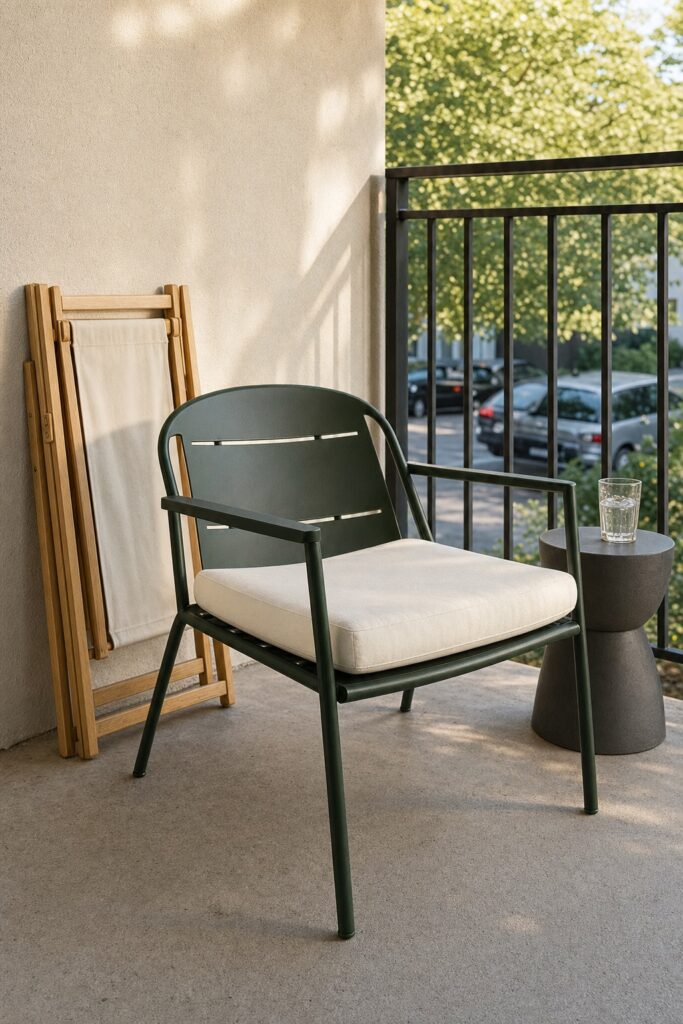
Spend the same money on one chair you actually want to sit in, plus a small table. A deep lounge chair with a real cushion, or a proper metal bistro chair with a curved back — either reads as intentional in a way four flimsy pieces never do. Then add seating that disappears: one folding chair, one stool that doubles as a side table, or a storage bench.
What to look for on a small patio, in order:
- Legs you can see under. Open-leg chairs let the floor run underneath, which keeps a tight space from looking blocked. Solid-base furniture eats the slab visually.
- Weight it can't lose. On an upper floor, anything light enough to lift with one finger will end up in the parking lot. Powder-coated steel and cast aluminum stay put; hollow resin doesn't.
- A back you can lean on. Backless stools get used for ten minutes at a time. That's fine as a spare, not as the main seat.
Wood is the trade-off worth naming: teak and acacia look best and need oiling once a season, or they weather grey. Grey is fine if you like grey. Decide before you buy, not in October.
Plant up, not out
Floor space is the scarce resource, so put the greenery in the air. A tiered plant stand, a narrow shelf ladder, rail planters hooked over the top rail, and a couple of hanging pots give you the volume of a garden while using about two square feet of ground.
Match the plants to what your slab actually gets, which is usually one of two extremes:
- Hot and exposed (west or south facing, no cover): rosemary, lantana, geraniums, sedum, and most herbs. These want the heat and forgive a missed watering. Terracotta dries out fast in full sun, so go bigger than feels necessary — small pots on a hot slab need water twice a day in August.
- Deep shade (ground floor with a balcony overhead, or north facing): ferns, begonias, coleus, and pothos moved out for the summer. Sun-lovers here get leggy and sad within a month, which is the most common reason a patio garden fails.
Pots need drainage holes and something under them. A pot sitting flat on concrete leaves a permanent dark ring and can stain; pot feet or a cheap plant caddy solve it and let you sweep underneath.
For hanging anything, use hardware rated for outdoor use — regular adhesive hooks give up in heat and rain. Our guide to decorating with removable hooks covers the weight limits worth respecting indoors, and outside you should treat those numbers as optimistic.

Shade you can carry back inside
If the slab bakes from 2 p.m. onward, you won't use it, and no amount of decorating fixes that. Shade is a furniture decision, not an afterthought.
Three renter-safe options, from cheapest to best:
A clamp-on umbrella grips a railing or a chair arm with a screw clamp. It's the only real option if you have no floor to spare, and it's the least stable — take it down in wind.
A freestanding market umbrella with a weighted base is the honest answer for a ground-floor slab. Base weight matters more than the umbrella: retailer buying guides put a freestanding 7.5- to 9-foot umbrella at 40 to 50 pounds minimum, and heavier where it's windy. A base that's too light is not a small problem — it's a nine-foot lever waiting for a gust.
A shade sail looks best and is the hardest to do legally, because it needs three or four anchor points and most of them would be your building. If you can rig it between two freestanding poles with weighted bases and nothing touches the structure, it works. Otherwise skip it.
Whatever you pick, take it down when you leave for the weekend.

Light it when there's no outlet
Check for an outlet first — many ground-floor patios have a covered GFCI outlet near the door, and if yours does, plug-in string lights are brighter and never need charging.
If there's no outlet, solar is the obvious move and the one that most often disappoints. Solar string lights want six to eight hours of direct sun to run all evening, and a ground-floor patio under someone else's balcony gets a fraction of that. The lights don't fail dramatically; they just glow for ninety minutes and quit.
Two workarounds that actually hold up:
- USB-rechargeable string lights. You bring them in every few days and charge them like a phone. Unglamorous, reliable, unaffected by shade.
- A split-panel solar kit, where the panel connects by cable and can sit in the one sunny spot — the railing top, the far corner — while the lights hang where you want them.
Then add one light at sitting height. Overhead string lights alone make a patio look like a venue; a small battery lantern on the table is what makes it feel like a room. Flameless candles do the same job, and they're the safe version of the next section.

The rain test: sort everything into three piles
There's no roof, so every object out there needs an answer to one question: what happens to it in a thunderstorm you slept through?
Stays out year-round. Powder-coated steel, cast aluminum, teak and acacia, resin wicker over an aluminum frame, polypropylene rugs, ceramic and concrete planters, solar and outdoor-rated lights.
Goes in a box. Cushions, throw pillows, blankets, lanterns with batteries, seat pads. A deck box that doubles as a bench is the single most useful thing you can put on a small patio — it seats a guest, it swallows the soft stuff, and it costs you one footprint instead of two.
Never goes out. Indoor rugs, particleboard or MDF furniture, unsealed wicker, upholstered anything, untreated pine, paper lanterns. MDF swells and crumbles after one soaking; unsealed natural wicker goes brittle and grey in a single season.
Sort honestly before you buy. Most "my patio looks bad" problems are really pile-three objects living outdoors.

Point the seating away from the walkway
Ground-floor patios usually have one real flaw: people walk past. If your chair faces the path, you'll feel watched and stop going out.
Turn the seating 90 degrees so it faces your best corner — the planted end, the tree in the courtyard, or simply the wall of your own building — and put the tallest thing you own between you and the traffic. That's usually the plant stand, which is why it's worth having a tall one.
Two more moves that cost nothing:
- Put the deck box or a bench on the walkway side. A waist-high object reads as an edge and stops the space feeling like a corridor.
- Angle the chair toward the door rather than square to the railing. Angled seating makes a small slab look arranged rather than pushed to the walls.
If the exposure is bad enough that layout can't fix it, that's a screening problem, and we have a whole guide to solving it without drilling: patio privacy ideas that work in a rental.

The rules nobody hands you: grills, flames, and your lease
Read this before you buy a grill, because this is the one mistake with a fine attached.
Under the International Fire Code — adopted in most US cities — charcoal burners and other open-flame cooking devices may not be operated on combustible balconies or within 10 feet of combustible construction. Fire marshals apply it plainly: Nashville's office, for example, does not allow the use, placement, or storage of unapproved cooking devices or LP gas containers on balconies, under any overhang, or within 10 feet of a structure. That covers charcoal kettles, propane grills, and the propane tank itself — even switched off and stored in the corner.
Exceptions exist and they're worth knowing: buildings with sprinklers, one- and two-family homes, and designated grilling areas are treated differently, and electric grills are commonly permitted where flame devices aren't. Your city's fire code and your lease both get a vote, so check both rather than assuming.
The same logic applies to the pretty stuff. Real candles, tiki torches, and tabletop fire bowls on a slab tucked under someone's wooden balcony are the same category of risk. Flameless candles and a lantern give you the identical look at zero risk to your lease.

The 20-minute end-of-season pack-down
Do this in the right order on the first cold weekend and the patio comes back in spring the way you left it.
- Soft things first. Cushions and pillows into the deck box or a closet, fully dry. Damp cushions in a sealed box grow mildew all winter.
- Lift the floor. Roll the rug and stand it on end indoors, or pop the deck tiles and stack them. Both hold water underneath through every freeze.
- Dry and sweep the slab. Get the silt out of the corners. This is the step that keeps the dark rectangle from setting into the concrete.
- Bring in anything hollow. Ceramic and terracotta pots crack when trapped water freezes; empty them or move them inside. Plastic and concrete planters can stay.
- Fold, weight, or store the umbrella. Never leave a canopy open over winter. If the base stays out, leave it standing upright with the pole out.
Then take one photo of the empty slab. Next spring, you'll know exactly what fits where — and if you're moving instead, that photo is your proof the concrete came back clean.

FAQ
Can I put an outdoor rug directly on my apartment patio?
Yes, but plan for the damp underneath. Concrete stays wet long after it looks dry, and a rug lying flat on it with no airflow can grow mildew within a few weeks in humid weather. Choose polypropylene, add an outdoor-rated rug pad or deck tiles beneath it, and roll it back once a month so the slab dries out.
What can I do with a patio when I can't drill anything at all?
Almost everything in this guide is freestanding on purpose: deck tiles, an outdoor rug, a plant stand, rail-hooked planters, a weighted umbrella, and battery or solar lights all sit on or hook over what's already there. The only things that genuinely need hardware are shade sails and wall-mounted planters, and both have freestanding substitutes.
How do I stop patio furniture from blowing off an upper-floor balcony?
Buy weight instead of trying to add it. Powder-coated steel and cast aluminum stay put where hollow resin doesn't, and umbrella bases should be at least 40 to 50 pounds for a 7.5- to 9-foot canopy. Anything genuinely light — folding chairs, empty planters, lanterns — comes inside when you're not out there.
Are grills allowed on an apartment patio?
Often not. The International Fire Code bars charcoal and other open-flame cooking devices from combustible balconies and within 10 feet of combustible construction, and many fire marshals extend that to storing a propane tank out there. Electric grills are frequently allowed where flame devices are not. Check your city's fire code and your lease before buying.
What plants survive on a shady ground-floor patio?
Ferns, begonias, and coleus handle deep shade outdoors, and houseplants like pothos are happy spending the summer out there and coming back in before the first cold night. Sun-loving herbs and flowering annuals will stretch and thin out within a month under a balcony, so save those for a slab that gets real afternoon light.
How much does it cost to make a bare slab look finished?
The cheapest version that genuinely works is a polypropylene rug, one comfortable chair, a small table, and three plants — often under $200 secondhand. Deck tiles are the biggest single line item at roughly 60 tiles for a 6-by-10 slab, and they're also the change that makes the largest visual difference, so they're worth saving for rather than skipping.


