
Gabion Fire Pit: How to Build One on Pavers in a Weekend

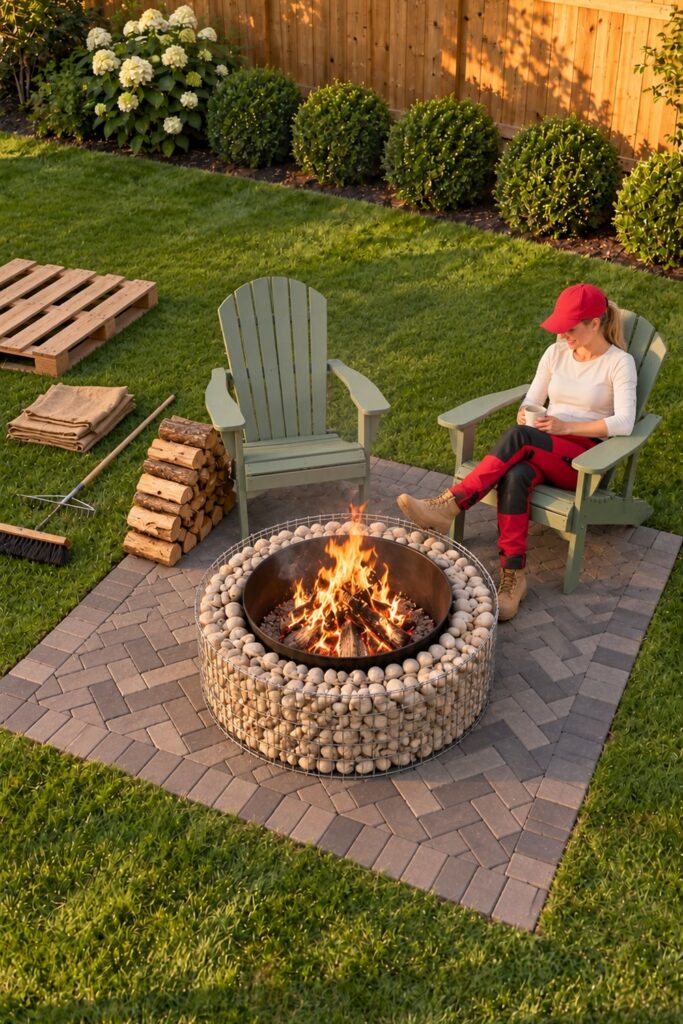
Picture a cool October evening in the backyard. The sun has dropped behind the fence, two sage-green chairs face a ring of white stones, and a fire crackles in the middle. A friend holds her hands out to the warmth and asks, "Who built this for you?"
This guide contains Amazon affiliate links. As an Amazon Associate I earn from qualifying purchases, at no extra cost to you.
That's the gabion fire pit from our video. A black steel ring holds the fire. A round wire cage full of white stones stands around it, and a square of pavers keeps it all off the grass. You can build it yourself in a weekend. The pad is most of the cost: about $650 to $1,050 in all, or about $190 to $400 for the fire pit alone on a patio you already have.
When the fire pit video went around, the comments asked the same things. What is that round black frame called? Where do you get the cage? How do you get the ash out? Every answer is below, with 7 steps and a picture for each, plus the five mistakes that make a fire pit like this sink, crack or break your city's fire rules.
At a glance
- Time: a weekend: one day to dig and pack the base, one day for the pavers and the fire pit
- Skill: beginner, but heavy work. No power tools, unless you rent a plate compactor or a saw for the edge cuts.
- Cost: about $650 to $1,050 with the paver pad, or about $190 to $400 for the fire pit alone on a patio you already have, not counting tools
- Best time to build: now. On Pinterest, searches for a DIY fire pit run highest in early October, and fire pit ideas keep climbing until April. Built this month, it's ready for the first cold evenings, and for spring.
Jump to a section
- How the Gabion Fire Pit Goes Together
- What You Need, and What It Costs
- Step 1: Dig the Square and Pack the Gravel Base
- Step 2: Lay the Pavers in a Herringbone Pattern
- Step 3: Sweep Sand Into the Joints
- Step 4: Set the Steel Ring in the Middle
- Step 5: Clip the Wire Cage Around the Ring
- Step 6: Fill the Cage With White Stones
- Step 7: Light a Small First Fire
- The Mistakes That Make It Fail
- Keep the Fire Pit Clean and Steady
- FAQ
If you buy one thing
Start with a 36-inch steel fire ring
It holds the fire, keeps the heat off the stones and keeps the fire inside the 3-foot size many cities allow. The cage and the stones are sized around it.
How the Gabion Fire Pit Goes Together

The stones never touch the fire. The steel ring holds the fire, the cage holds the stones around it, and the pavers keep everything off the grass.
- A square of pavers, 8 feet on each side, sits flush with the lawn on 1 inch of sand and 4 inches of packed gravel.
- A steel ring, 36 inches across, stands in the middle with 2 inches of sand in its bottom. The fire never sits right on the pavers.
- A wire cage, 54 inches across and as tall as the ring, stands around it. White stones fill the 9-inch gap between them.
In the original video, the pavers go on sand laid straight onto the fabric. Here 4 inches of gravel go under the sand. Sand alone sinks and heaves after the first hard frost, and that's when pavers crack.
What You Need, and What It Costs

- Steel fire ring, 36 inches across and about 12 inches tall. It holds the fire and keeps the heat off the stones.
- Galvanized welded wire, one 2-foot by 25-foot roll in 14 gauge, with holes no bigger than 2 inches. The cage takes about 15 feet.
- Hog ring pliers and a box of galvanized hog rings, to clip the cage closed.
- Landscape fabric, about 3 by 50 feet, to line the bottom of the dug square.
- Paver base, about 43 bags of 0.5 cubic feet (about a ton), for 4 inches of packed gravel.
- Sand, about 14 bags of 0.5 cubic feet: 11 for the bed, the rest for the joints and the ring.
- Concrete pavers, about 330 of the 4-by-8-inch size, for an 8-foot square in herringbone.
- White river rock, 3 to 4 inches across, about 17 bags of 0.5 cubic feet (roughly 900 pounds).
- Tools: shovel, stakes and string, garden rake, hand tamper (or a rented plate compactor), level, rubber mallet, push broom, bolt cutters, and a brick chisel or a rented masonry saw for the edge cuts. Wear work gloves and safety glasses, plus a dust mask when you cut pavers.
What it costs: about $650 to $1,050 in all, not counting tools. That's with prices we found at US stores on October 20, 2026. The fire ring is about $65 to $90. The wire, hog rings and fabric are about $55 to $80, and the river rock about $85 to $255. The pad is the big part: about $110 to $225 in pavers, about $300 in paver base and $55 to $85 in sand.
Two buying tips:
- Price the paver base and the river rock by the ton at a local landscape yard. About a ton of base and half a ton of rock can cost less than 60 bags, even with a delivery fee.
- Pick stones bigger than the holes in the wire. River rock of 3 to 4 inches can't slip through 2-inch holes.
Step 1: Dig the Square and Pack the Gravel Base
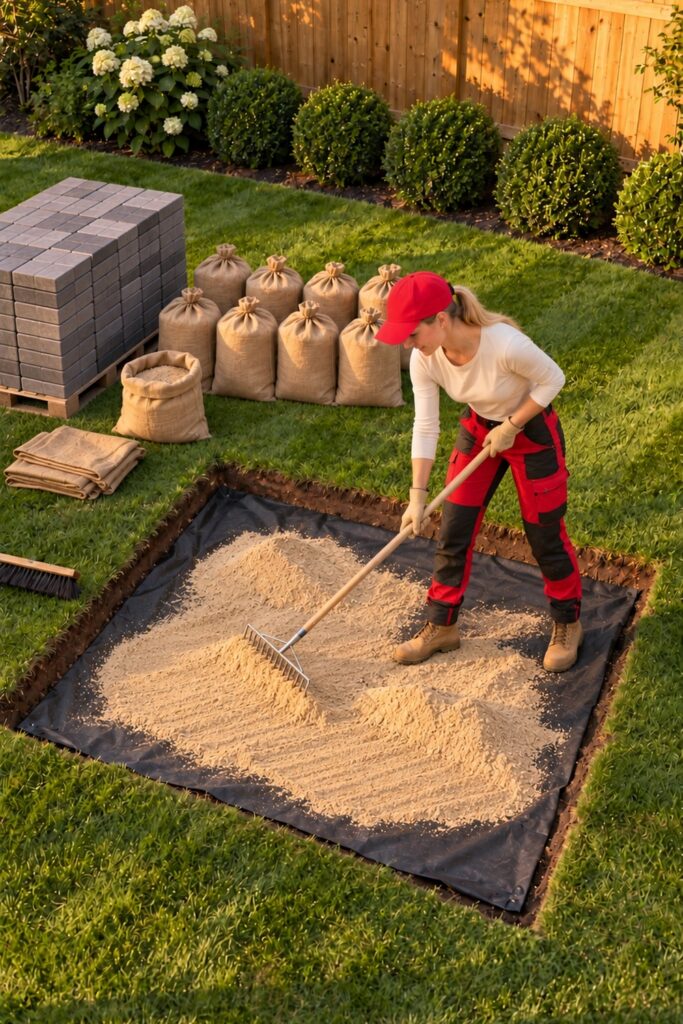
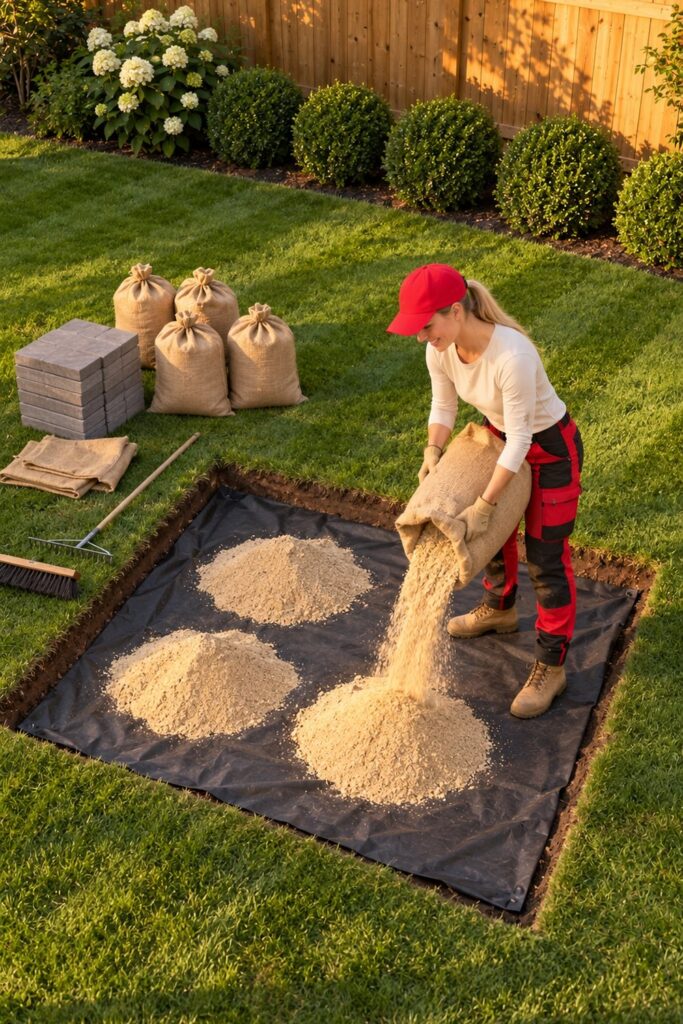
- Pick a spot at least 25 feet from the house, deck and fence, with no branches above it. Many cities ask for that, such as Duluth, Minnesota.
- Mark an 8-foot square with stakes and string, and dig it about 7 inches deep with a flat bottom.
- Line the bottom with the landscape fabric, overlapping the strips by 6 inches.
- Spread the paver base 2 inches at a time, wet it lightly and tamp each layer hard, until it's 4 inches thick.
- Spread 1 inch of sand on top and rake it flat.
Watch out: don't skip the gravel. In the original video the sand goes straight onto the fabric, and a sand-only pad sinks and heaves after the first hard frost.
Step 2: Lay the Pavers in a Herringbone Pattern
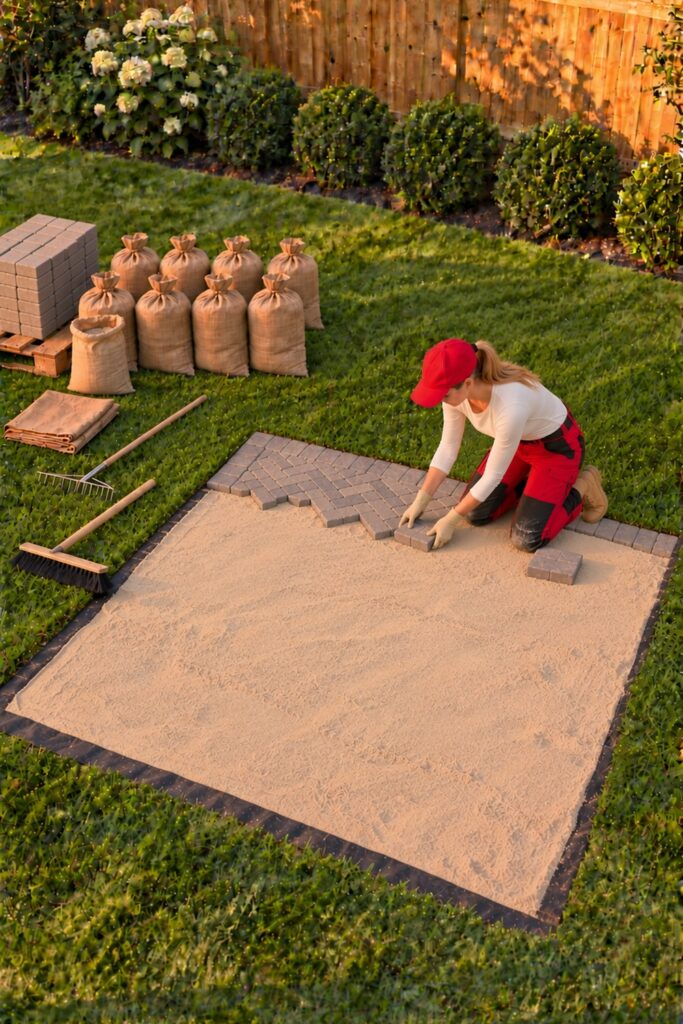
- Start in one corner and set each paver straight down onto the sand. Never slide it.
- Lay them in a zigzag, each paver tight against the last.
- Tap each row level with the rubber mallet, and check it with the level every few rows.
- Cut the edge pieces with the chisel or the saw, then lay a border row lengthwise around the edge.
Watch out: don't kneel on the raked sand. Kneel on the pavers you've already laid, so the bed stays flat.
Step 3: Sweep Sand Into the Joints

- Scatter a thin layer of sand over the dry pavers.
- Sweep it back and forth with the push broom until every joint is full.
- Tamp the whole pad over a scrap board, then sweep in more sand.
Watch out: sweep only when the pavers are dry. Wet sand sticks to the tops and won't settle into the joints.
Step 4: Set the Steel Ring in the Middle
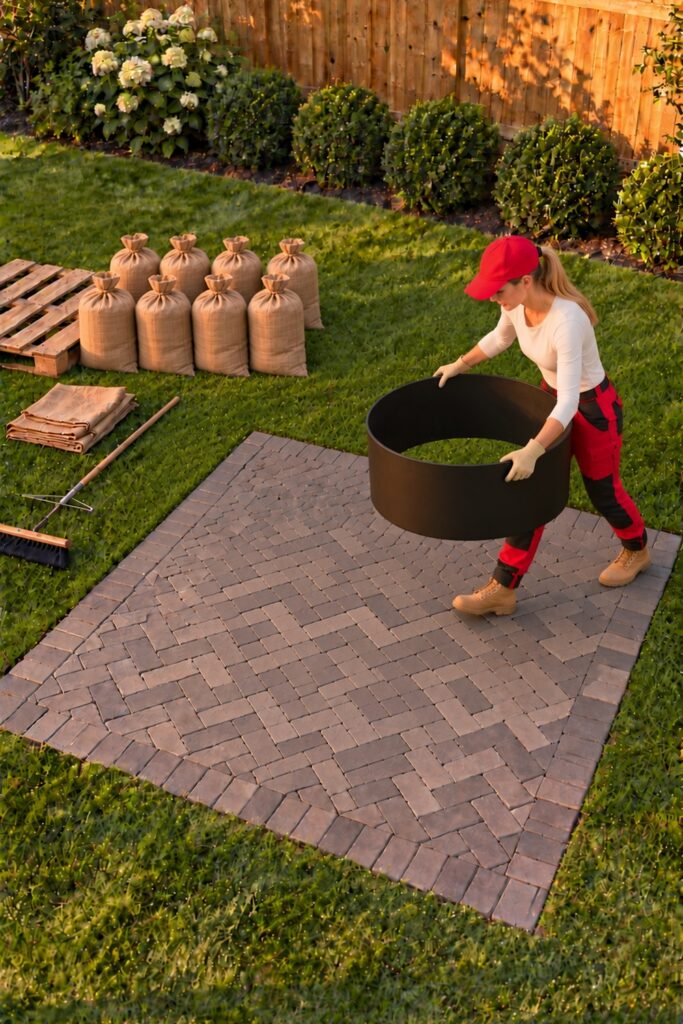
- Find the center of the pad with two strings stretched corner to corner.
- Set the fire ring over the center, the same distance from all four sides.
- Pour 2 inches of sand into the bottom of the ring and smooth it.
Watch out: never build the fire straight on the pavers. A hot fire sitting on concrete can crack it, so the sand stays in the ring for good.
Step 5: Clip the Wire Cage Around the Ring
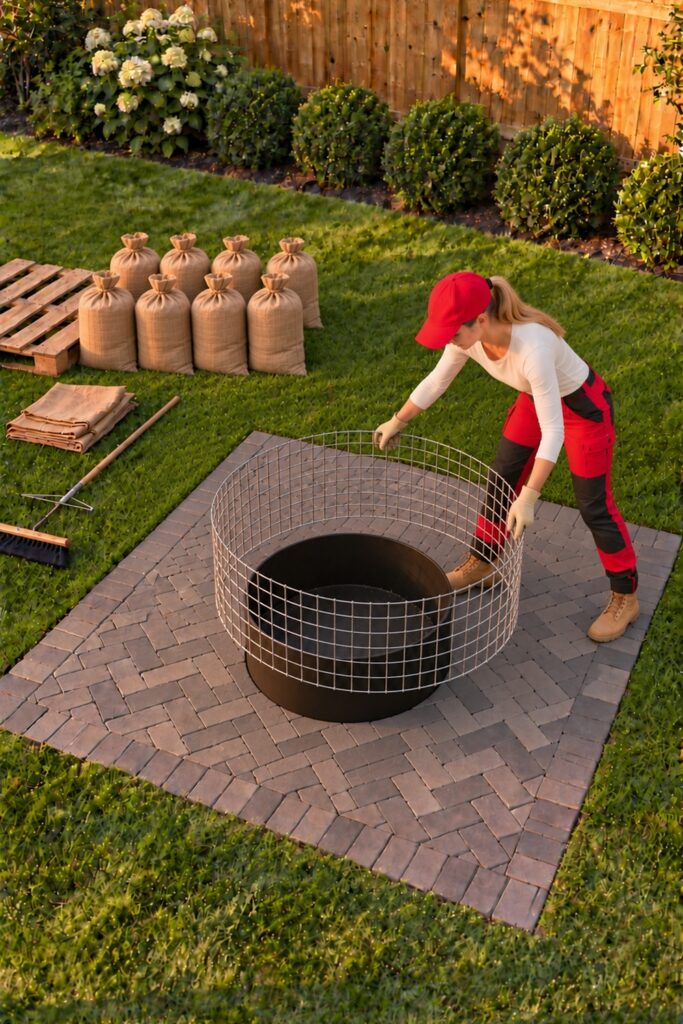
- Cut a 15-foot strip from the roll with the bolt cutters.
- Snip along one horizontal wire, so the strip is as tall as your ring.
- Bend it into a circle 54 inches across, overlap the ends by two squares and close the seam with a hog ring every 2 inches.
- Lower the cage over the ring, so the gap is about 9 inches all the way around.
Watch out: trim the cut wire ends flush and bend any sharp tips inward. A wire end sticking out catches legs and blankets.
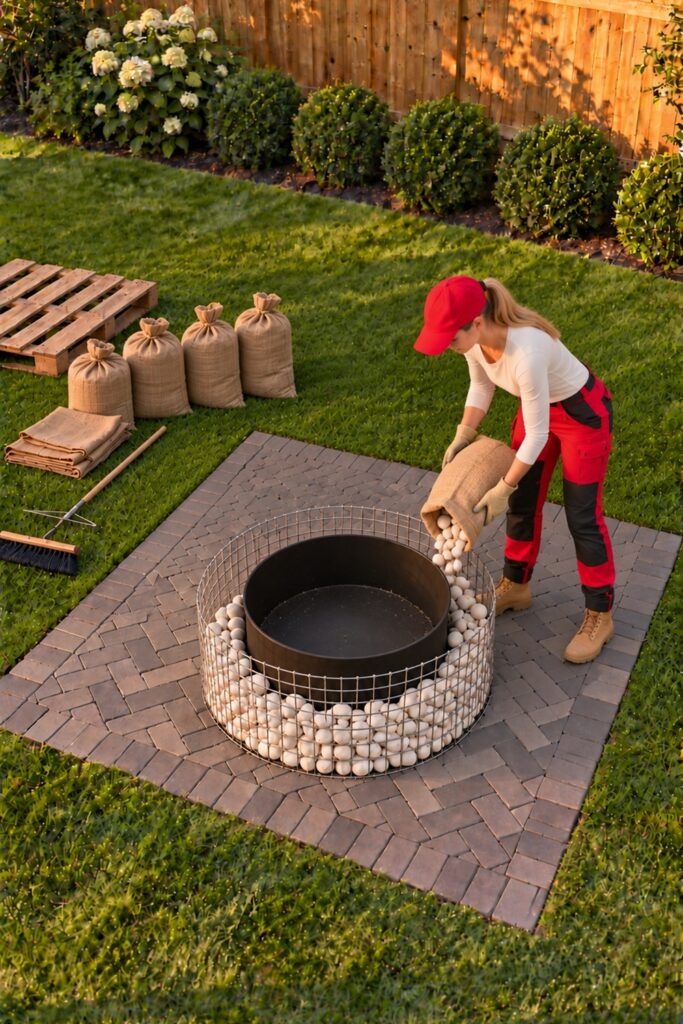
Step 6: Fill the Cage With White Stones

- Rest each bag on the cage rim and tip it into the gap.
- Move around the ring as you pour, so the stones rise evenly.
- Stop when the stones reach the top of the ring.
- Turn the prettiest stones to face out against the wire.
Watch out: keep every stone outside the steel ring. River rock holds water, and a wet stone in the fire can crack or burst.
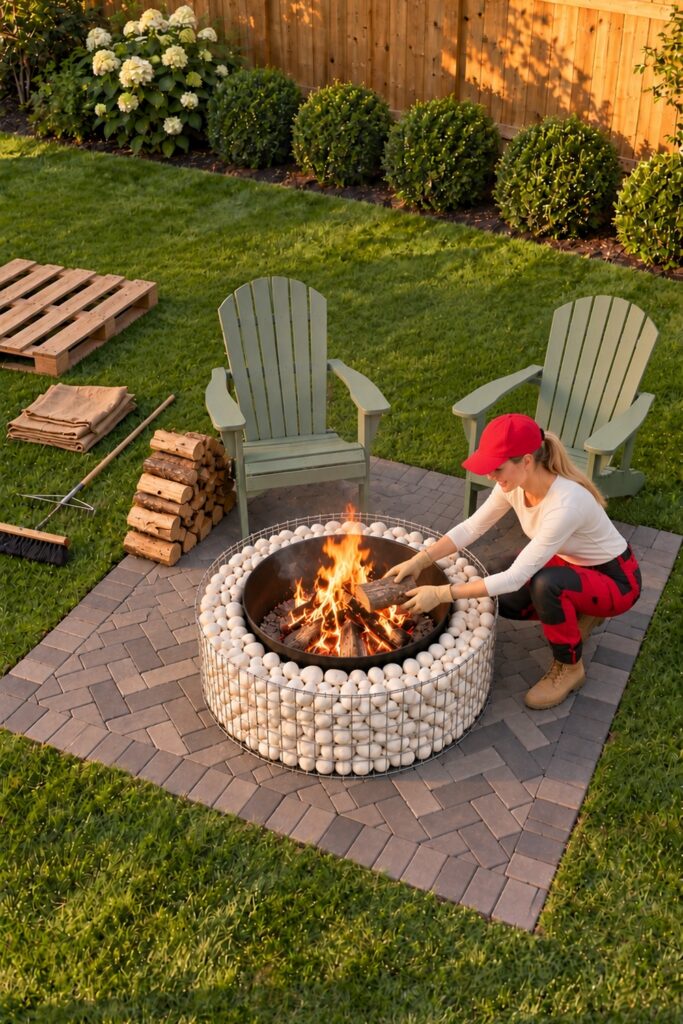
Step 7: Light a Small First Fire

- Set a garden hose or a fire extinguisher next to the pit before you strike a match.
- Lay a few pieces of clean, dry firewood in the ring, with kindling underneath.
- Tie long hair back, and light it with a long fireplace lighter at arm's length.
- Keep the first fire small, and stay with it until it's out.
Watch out: never start or boost the fire with gasoline or lighter fluid. Duluth's fire department allows only clean, dry wood, a fire no wider than 3 feet, and a hose or extinguisher close at hand.
The Mistakes That Make It Fail
Fire pits like this fail in the same five ways, and each one shows within a season:
- Too close to the house. Many cities want an open fire 25 feet from the house, deck and fence. Measure before you dig.
- Sand on bare dirt. Without 4 inches of packed gravel, the pad sinks and heaves after the first frost.
- A fire right on the pavers. Keep 2 inches of sand in the bottom of the ring.
- Stones inside the ring. River rock goes in the cage, never in the fire.
- A cage left open at the seam. Clip it every 2 inches, or the stones push it apart.
Get those five right, and the fire pit looks like it was always there, glowing in the middle of the yard.
Keep the Fire Pit Clean and Steady
- Scoop the ash out once it's cold, with a small shovel and a metal bucket. The stones sit outside the ring, so no ash gets into them.
- Top up the sand in the ring when the ash scoop takes some with it.
- Sweep fresh sand into the paver joints each spring.
- Check the hog rings each spring, and add one wherever the seam has opened.
- Hose the stones off once a season, then let them dry for a few days before the next fire.
Then pull the two chairs a little closer, add one more log, and let someone else ask who built it.
Watch this build, and the next ones, on YouTube, Instagram and Facebook.
Start here
Want it crackling before the first cold evening? Start with the ring: everything else is sized to it.
FAQ
How Far Should a Fire Pit Be From the House?
Many US cities ask for at least 25 feet from a house, deck or fence for an open fire. Your city's fire department page has the exact rule.
Can You Put a Fire Pit on Pavers?
Yes, with a steel ring and 2 inches of sand in its bottom, so the fire never sits right on the concrete. The pavers keep sparks off the grass.
What Stones Go Around a Fire Pit?
Round river rock, 3 to 4 inches across, works in the cage outside the ring. Keep it out of the fire itself, because wet river rock can crack in the heat.
How Do You Get the Ash Out?
Wait until it's cold, then scoop it from the ring into a metal bucket. The stones sit outside the ring, so they stay clean.
How Much Does a Gabion Fire Pit Cost?
About $650 to $1,050 with the paver pad. On a patio you already have, the ring, wire and stones come to about $190 to $400.
Do You Need a Permit for a Backyard Fire Pit?
Some cities ask for one. Check your city's fire department page before the first fire.


