Coastal Living Room Decor Is a Light Problem, Not a Color Problem

Coastal decor in a living room is a light effect before it is a color scheme. Sand, sky and sea water are all pale, high-reflection colors — they look like themselves only when there's light bouncing off them.
Put the same pale blue in a room with one window and a building across the street, and it doesn't read breezy. It reads gray. That's why so many coastal living rooms end up looking cold instead of calm, and it's why this guide ranks every decision by how much light it gives back to the room.
Jump to a section
- Coastal is a light effect, and your room has a fixed light budget
- Find your window direction first
- Walls: check the LRV number, not the color name
- Curtains: the biggest single light decision in the room
- The sofa is the one thing you can't accessorize around
- The rug: sand underfoot, and the size that actually works
- The black rectangle problem: what to do about the TV
- One reflective surface, placed opposite the window
- Bulbs: the number on the box decides whether the room reads warm or cold
- Layout: turn the seating toward the light
- Coastal without repainting or replacing the sofa
- FAQ
Coastal is a light effect, and your room has a fixed light budget
Your living room has a set amount of daylight, and you can't buy more. What you can do is stop wasting it, and choose finishes that hand it back instead of soaking it up.
Ranked by how much light each decision returns for the effort, the order is:
- Curtains — they sit on the light source itself. Biggest lever in the room.
- Walls — the largest surface area by far.
- The rug — the second largest, and it sits where light lands.
- The sofa — the single biggest object.
- Wood tone — every hard surface in the room reads as one decision.
- A reflective surface — one, placed deliberately.
- Bulbs — free to change, and they decide what the room looks like after 5 p.m.
- Accessories — almost no effect on light, which is exactly why they can't rescue a dim room.
Work down that list, not up it. Most coastal living rooms fail because they start at number eight — cushions, a coral sculpture, a framed sailboat — and never touch the top four.

Find your window direction first
Stand in the room at about 2 p.m. on an overcast day and hold a sheet of white printer paper flat against the wall. If it looks slightly gray or blue, you have cool light. If it looks cream, you have warm light. That single test tells you more than any color name.
North-facing rooms get cool, steady light all day. This is the hard case for coastal, because cool daylight plus a cool pale blue equals gray. Push the whole room warm — sand, oatmeal, cream, pale wood — and keep the blue to small, deliberate doses at eye level where it's read as a color rather than a wall.
South-facing rooms get bright, warm light for most of the day. These can carry cooler blues and true grays without going flat. If your room is south-facing, you have the most freedom of anyone reading this.
East-facing rooms are warm in the morning and flat by mid-afternoon; west-facing rooms are dim early and get strong, orange evening light. West rooms are the ones where a heavy blue can suddenly look purple around 6 p.m., which surprises people.
The point isn't to obey a rule. It's to know which way your room pushes every color you bring in, so you stop blaming the paint.

Walls: check the LRV number, not the color name
Paint colors have a published number that tells you exactly how much light they reflect, and almost nobody looks at it.
It's called Light Reflectance Value. The scale runs 0 to 100, where 0 is absolute black and 100 is pure white, and Sherwin-Williams prints it on the back of every color chip. Two "warm whites" with the same name energy can be twenty points apart, and in a dim room those twenty points are the whole difference.
- For a living room short on daylight, look for LRV 70 or higher. That's the range that keeps a pale color reading pale instead of dingy.
- For a bright room you can drop into the 60s and get a deeper, more interesting sand color without losing the effect.
- Sheen matters too. The same manufacturer notes that higher gloss reflects more light than a matte finish. In a dim living room, an eggshell will do noticeably more for you than a flat, and it wipes clean where flat marks.
Our decorating opinion, clearly ours: in a living room, put the sand on the walls and the sea somewhere else. A blue living room wall commits the largest surface in the room to the one color that goes gray fastest in poor light. A warm off-white or soft oatmeal wall lets the blue arrive on the things you can move — cushions, art, a throw — where it stays a choice.

Curtains: the biggest single light decision in the room
Curtains cover the actual source of light, which makes them the highest-leverage thing in a coastal living room and the thing most often got wrong.
The mistake is stacking the panels over the glass. When the rod stops at the window frame, open panels bunch across the window itself and can cover a third of it. Run the rod 8 to 12 inches past the frame on each side so the fabric parks on the wall, and the window gives you everything it has.
Go light and unlined where you can. Unlined linen or a loose cotton diffuses daylight into the soft, slightly hazy quality that reads as coastal. Heavy lined panels in a living room turn the window into a hole in the wall when they're shut. Save the blackout for the bedroom.
Hang them high and floor length. Rod close to the ceiling, hems just off the floor. It's the same move we use in the bedroom version of this look, and it does even more in a living room because the window is usually bigger.
One honest exception: if you have a strong west window, you'll want something you can close in the evening or the room becomes unusable in July. A pale, loosely woven panel plus a simple roller shade behind it gives you both.

The sofa is the one thing you can't accessorize around
It's the biggest object in the room and it sets the tone before anyone looks at anything else.
What makes a sofa read coastal isn't the color, it's the softness. A slipcovered sofa with a slightly relaxed fit is the coastal sofa, because the loose fabric catches light unevenly and looks lived in. A tight, structured sofa in exactly the same pale linen reads formal, not beachy.
Choose exposed legs if the room is small. A sofa you can see the floor under stays visually light and lets the rug run underneath it. A skirted sofa sitting flat on the floor reads as a solid block, which is heavier than its color.
The honest limitation: pale upholstery and dogs, kids or red wine is a genuine problem, and no amount of styling advice fixes it. If that's your life, the answer is a machine-washable slipcover or a performance fabric — not a pale sofa you spend three years protecting.
If the sofa you own is dark, keep it. Get the curtains, the rug and the walls light, then break up the dark mass with a washed-linen throw over one arm and two pale cushions. A dark sofa in a light room reads as an anchor. A dark sofa in a dark room reads as a cave.

The rug: sand underfoot, and the size that actually works
The rug is the second largest surface in the room and the one people most often buy too small.
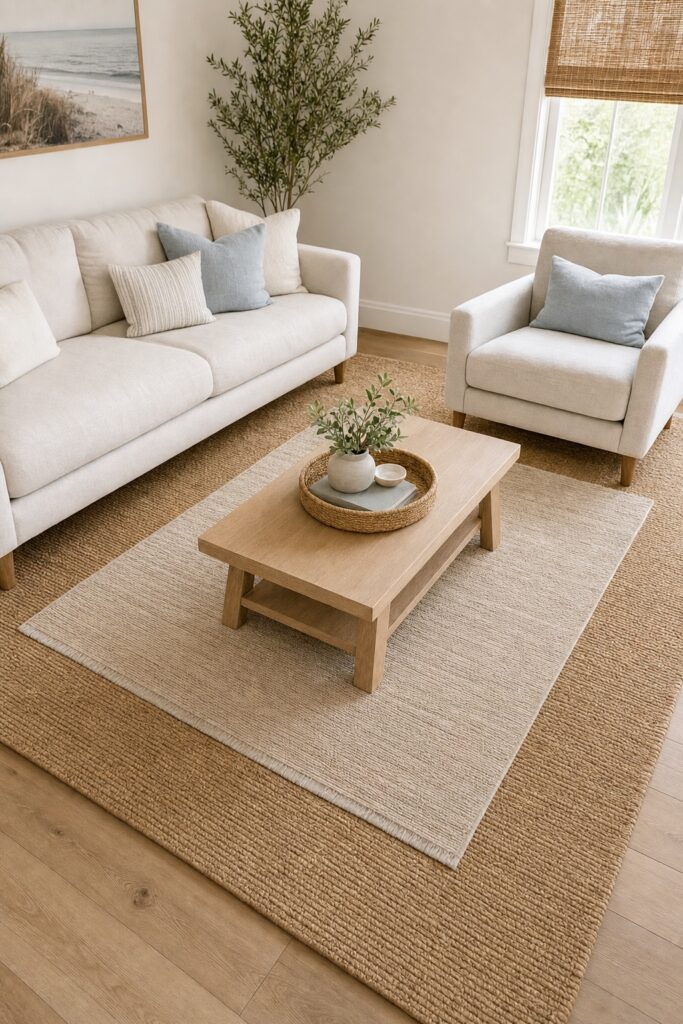
Size first. The front legs of every seating piece should sit on the rug. In a typical small living room that means 8 by 10 feet, not the 5 by 8 that looks like a reasonable purchase online. A small rug floating in the middle of the floor cuts the room into pieces and makes it read smaller — the opposite of what you're paying for.
Color: sand, not white. A true white rug in a living room is a two-week decision. Oat, flax, pale wheat — anything in that family gives the same lightness and survives real life.
On jute, honestly. Jute is the default coastal recommendation because it's cheap and it has exactly the right texture. It also sheds for months, feels rough underfoot and is genuinely hard to clean when something soaks in. If you want the look without the complaints, a flatweave wool in the same sand tone is the better living room rug, or layer a smaller soft rug over a big jute one so your feet land on the soft part.
The black rectangle problem: what to do about the TV
Every coastal living room article quietly pretends televisions don't exist. In a pale room, a 55-inch black screen is the highest-contrast object present, and it pulls the eye harder than anything you'll ever style around it.
Three things genuinely help:
- Stop it being the only dark mass. A lone black rectangle on a pale wall is a hole. Give it company at a lower intensity — a dark-framed piece of art nearby, a charcoal-toned lamp base, a deep-toned ceramic — and the eye reads a pattern instead of an intruder.
- Build it into a horizontal band. Mount it low, centered over a light console, with two things of similar height either side. Read as a band across the wall it disappears far better than read as a floating square.
- Paint the wall behind it a shade deeper. This is the one place in a coastal living room where a darker color helps, because it reduces the contrast between screen and wall. It's counterintuitive and it works.
What doesn't help: a cabinet with doors, or a sliding panel across it. Anything built specifically to hide a television announces that there's a television. Concealment furniture also tends to come in a heavier style than the rest of a coastal room.

One reflective surface, placed opposite the window
One mirror or one glass-topped table, positioned on purpose, does more for a dim coastal room than a shelf of decorative objects.
Where it goes: on the wall opposite or at right angles to the window, hung high enough that it catches sky and ceiling rather than the back of the sofa. A mirror reflects whatever is in front of it, so check what it's actually showing before you commit to the hook.
What it should look like: a pale wood, rattan or simple painted frame. An ornate gilt mirror is a different style speaking loudly in the middle of a quiet room.
The honest limit: a large mirror facing a window that looks at a brick wall six feet away gives you more brick wall. In that case put the reflection to work on the ceiling instead — a lower, wider mirror angled slightly, or a glass or pale stone coffee table that bounces light upward off the floor.
One is the number. Two large mirrors facing each other is a hallway trick, and in a living room it's unsettling.

Bulbs: the number on the box decides whether the room reads warm or cold
Everything above is about daylight. For about half the hours you use the room, there isn't any, and the bulbs take over.
Light color is measured in Kelvin, and ENERGY STAR explains the scale plainly: lower numbers look more yellow, higher numbers look whiter and then bluer. Most bulbs made to match old incandescent warmth fall in the 2200–3000K range; whiter light is around 3500–4100K; the bluish-white ones run 5000–6500K.
For a coastal living room:
- 2700K in your lamps. It's the warm end of that range and it keeps a sand-and-cream room looking soft after dark rather than clinical.
- Skip the 5000K "daylight" bulbs entirely in here. They make pale blue look like an office corridor. They're a laundry room bulb, not a living room bulb.
- Three sources at different heights beats one ceiling light. A table lamp, a floor lamp, and something low — a small lamp on a shelf or console. A single overhead fixture flattens a pale room and shows every crumb.
- Match your bulbs to each other. One 2700K lamp beside one 4000K lamp is the single most common reason a carefully chosen palette looks slightly off at night.

Layout: turn the seating toward the light
Most living rooms are arranged around the television by default. A coastal room feels different mostly because the seating acknowledges the window.
Try the sofa perpendicular to the window rather than backing onto it. Sitting with the light coming across you, instead of over your shoulder onto a screen, is most of the difference between a room that feels like a beach house and one that feels like a den.
Keep the low things near the window and the tall things on the dark wall. A tall bookcase beside a window blocks light for the entire room; on the opposite wall it reflects it. If you have one tall piece, this decides where it goes.
Float the sofa a few inches off the wall if there's room. Even three inches of gap reads as deliberate and stops the furniture looking like it's been pushed back for a party.
If your living room is long and narrow, you don't really get to choose — the sofa goes on the long wall and that's that. In that case the layout job is simpler: keep everything under about 36 inches tall on the window side, and let the tall storage live at the far end.

Coastal without repainting or replacing the sofa
Nearly everything above has a version that needs no paint, no new furniture and no permission, which matters if you're leasing or the budget is spent.
- Curtains on the existing brackets, extended with a longer rod, or a tension rod inside a recessed window. Pale unlined linen. This is still the biggest lever even when it's the only thing you change.
- Bulbs. Free, immediate, and the whole room reads warmer tonight. Keep the originals in a bag.
- A slipcover over the sofa you already own, or a large washed-linen throw across the back and seat if a full cover doesn't fit.
- The rug, in the right size, over whatever floor you've got. This is the single most effective purchase in the list.
- One large pale textile on a wall where you can't paint — a plain woven hanging or a big piece of unframed canvas art on removable hooks. Our guide to removable hooks covers what those adhesive strips will actually hold.
- Art last, and less of it. One large piece of water or sky beats six small nautical prints, and it's cheaper. If you want a wall of frames instead, the gallery wall rules apply exactly the same here.
Start at the top of the light list and stop when the room looks right. Most people get there before they reach the accessories, which is the whole point.

FAQ
What colors make a living room look coastal?
A warm off-white or sand base on the largest surfaces, pale natural wood, and blue arriving in small, deliberate doses on cushions, art and throws. Putting blue on the walls commits the biggest surface in the room to the color that goes gray fastest in weak light — sand on the walls and sea on the movable things is the more reliable order.
Why does my coastal living room look cold instead of calm?
Almost always a light problem rather than a color problem. Pale blues and grays need light bouncing off them to read as breezy; in a north-facing room with cool daylight they go flat and gray. Warm the base colors, raise the light reflectance of the walls, get the curtains off the glass, and switch to 2700K bulbs.
What LRV should I look for in a coastal paint color?
For a living room short on daylight, LRV 70 or higher keeps a pale color reading pale. A bright room can go into the 60s and carry a deeper, more interesting sand. The number is printed on the back of the color chip, and a higher-gloss sheen reflects more light than a matte one.
What size rug does a small living room need?
Big enough that the front legs of every seating piece sit on it — usually 8 by 10 feet in a typical small living room, not 5 by 8. A rug that floats in the middle of the floor visually chops the room up and makes it feel smaller.
How do I deal with a TV in a coastal living room?
Reduce its contrast rather than trying to hide it. Mount it low over a light console as part of a horizontal band, give it some company in the form of one or two other dark-toned objects nearby, and consider painting just that wall a shade deeper. Cabinets and sliding panels built to conceal a screen draw more attention than the screen did.
Can I get a coastal living room without painting?
Yes, and the two highest-impact changes need no paint at all: pale unlined curtains on a rod that extends past the window, and a large sand-toned rug. Add 2700K bulbs, a slipcover or linen throw on the sofa you already own, and one large piece of water or sky art on removable hooks.