Reading Nook in the Living Room: Find the Space First

A reading nook in the living room needs a comfortable seat, usable light, and somewhere for the book when you stand up. It does not always need another armchair. Start by testing a seat you already own in the part of the room where you would like to read.
Keep the main walking route working while you experiment. A corner that looks empty may be the space everyone uses to reach the window or move between the sofa and dining area. The nook has to share the living room with those ordinary movements.
Jump to a section
- Find the light for a reading nook in the living room
- Keep the route past the chair usable
- Measure the occupied nook, not just the chair
- Put the lamp and drink within reach
- Use the sofa when another chair will not fit
- Choose support before the decorative throw
- Let the nook share the room’s rug and palette
- In a rental, try the arrangement before mounting anything
- FAQ
Find the light for a reading nook in the living room

Try the window-side position with a book at the time you expect to use it. Daylight can make the corner pleasant, but its direction changes and it will not serve an evening reading routine on its own.
In the light-colored corner shown here, the chair sits near the window rather than filling the opening. Check that your own seat leaves window controls, curtains, ventilation, and any required access usable.
Also check reflections if you read on a screen. You may prefer the chair turned slightly rather than facing the brightest part of the window. A place that works at breakfast may need a different lighting setup after dinner.
Keep the route past the chair usable

Walk the room before you move the chair, then repeat the route with it in position. Include the route to the door, storage, and the seat people already use most often.
This living room keeps the chair within the seating area and a route beside the group. That is a more useful relationship to copy than the exact angle of the chair. Your sofa and door positions may be different.
Try carrying a laundry basket or walking past someone seated. If you have to turn sideways or ask them to move every time, the nook is occupying circulation space. Shift it or use an existing sofa seat instead. Our small living-room guide covers the broader arrangement.
Measure the occupied nook, not just the chair

Allow for the person using the chair and the furniture beside it. The chair's listed width and depth describe only part of the space. Feet, an extended recliner, an ottoman, the lamp base, and the side table can make the working footprint much larger.
Mark the candidate furniture positions on the floor using a method suitable for the surface. Sit in the arrangement and stand up. Check that the table is close enough to use without making the chair difficult to enter.
There is no single clearance that suits every reader or every chair. Use the furniture instructions and the access needs of your household. If you cannot test a chair before buying, check its full measurements and return conditions rather than relying on a styled product photograph.
Put the lamp and drink within reach

Place a task light so it reaches the page and a stable table where your hand naturally lands. The floor lamp here directs light toward the chair, while the small table holds the book and mug without becoming another display surface.
Check the view from the seat. A visible bulb can be uncomfortable even when the lamp looks attractive from the doorway. The FTC's light-bulb guide distinguishes brightness from warm or cool appearance; choose for both rather than treating warm light as automatically gentle.
Keep the lamp clear of fabrics as its instructions require. Do not balance a drink on a soft upholstered arm simply because there is no room for a table. That may be a sign that this seat needs a different position or a smaller, stable side surface.
Use the sofa when another chair will not fit

Turn one end of the sofa into the reading spot if the room is already full. Bring the light and book storage to that position instead of bringing in another seat.
A cushion can support your preferred posture, and a throw can stay folded where it is easy to reach. Test those with the sofa you have. More cushions are not helpful if you remove them all before sitting down.
Agree on how the seat works when other people use the room. If the television and conversation make reading difficult at your usual time, a different location may serve you better than more decor around this one.
Choose support before the decorative throw

Sit in a candidate chair long enough to notice where you want support. Check the back, seat depth, arms, and how your feet rest. A small wooden chair may work for short reading breaks; it may not suit the way you like to settle in for an evening.
The simple chair shown here uses a soft layer at the contact surface. That can change the feel of an existing seat, but it cannot correct every mismatch in size or shape.
If you already own the chair, try an appropriate cushion before replacing it. If you are buying, prioritize how you sit over whether the chair matches the saved image. A chair that feels good for your usual reading session has earned its place, even if it is simpler than the one on your saved board.
Let the nook share the room’s rug and palette
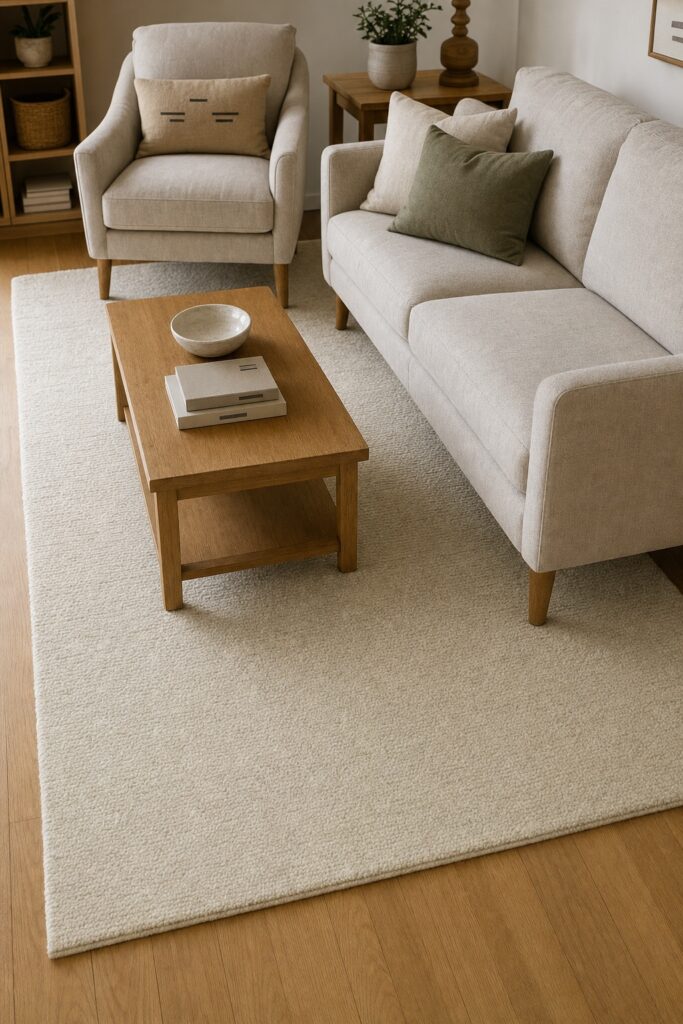
Use the existing rug and colors to connect the reading seat to the room. A second small rug is optional. It can add another edge to navigate when the chair already belongs to the main seating group.
In this arrangement, the sofa and chair meet the same rug. The shared surface makes them read as a group, while the chair still has a position of its own.
Keep a small amount of book storage close by: the current book and a few next reads may be enough. If you add a bookcase, follow its installation and anchoring instructions. Do not choose tall storage merely to make a little nook feel more complete.
In a rental, try the arrangement before mounting anything

Start with movable furniture and an appropriate existing outlet. Live with the chair or sofa position before adding wall shelves, mounted lights, or other fixtures that need permission and a suitable wall.
The compact room pictured here shows why a new armchair is not always the answer. Its sofa, dining area, and route already claim the available floor. A reading place at the sofa can preserve those functions.
Keep cords out of routes and from under rugs or furniture, following ESFI's cord-safety guidance. If the lamp cannot reach a suitable outlet safely, change the placement.
Try one reading session in the proposed spot before making the shopping list. Write down the actual annoyance—poor light, nowhere for the book, an uncomfortable seat—and solve that next.
FAQ
Does a reading nook need to be in a corner?
No. One end of the sofa or a chair within the main seating group can work. The useful features are a comfortable position, adequate light, and a place for the book.
Can I use an ottoman in a small nook?
Yes, if it fits while someone is using it and leaves the room's route open. Test the extended seating footprint, not just the ottoman tucked away beside the chair.
How many books should I keep beside the seat?
Keep enough for the way you read. A small current-reading pile is easier to place than the whole collection. Move the main book storage elsewhere if it crowds the nook.
What if the room has no spare outlet near the chair?
Consider another seat position before deciding on a new lamp. Do not run a cable across the room or conceal it under a rug to preserve a decorative arrangement.