
Small Balcony Ideas, Sorted by How Deep Your Balcony Actually Is

Most small balcony ideas fail for one boring reason: they were photographed on a balcony bigger than yours. A four-piece seating set looks wonderful until you measure and discover your balcony is 44 inches deep.
So these are sorted by the two things that decide what will actually fit — how deep your balcony is, and what kind of railing it has. Find your class, and the ideas below it are ones you can genuinely copy.
Two measurements decide which ideas will fit
Take a tape measure outside. You need two numbers and one observation, and the whole article opens up from there.
Depth, wall to railing. This is the number that matters, not the length. Most apartment balconies fall between 40 and 72 inches deep, and each band allows a completely different set of ideas. A standard outdoor chair is about 22 to 26 inches deep and needs roughly 18 inches behind it to sit down without climbing over anything.
Length, end to end. This decides how many pieces, not which kind.
Then look at your railing, because it's the second gate. A solid masonry or concrete wall, a glass panel, and open metal balusters give you three different balconies even at identical dimensions — different privacy, different wind, different hanging options, and a different amount of your floor that anyone can see.
Write both numbers on your phone before you shop. Almost every returned balcony purchase is a depth problem.

Under 4 feet deep: the step-out balcony
At under 48 inches you have a standing balcony, and the sooner you accept that the better it looks. Two chairs and a table will fit on paper and be miserable in practice — you'll be climbing over furniture to reach the rail.
The rule here: one seat maximum, everything else vertical or on the rail. Anything that needs to be pulled out to be used is the wrong thing.

The standing rail bar
A narrow shelf that hooks over or clamps to the railing, deep enough for a mug and a phone and nothing more. You stand, you lean, you look out. It costs almost nothing, it folds flat, and on a genuinely tiny balcony it's the only piece of furniture that never gets in the way.
Check your lease and railing type before clamping anything to it — glass panels usually can't take a clamp, and some buildings prohibit anything attached to the railing at all.

One chair, one stool, nothing else
A single lightweight chair pushed to one end, and a small stool that works as a table, a footrest, or a plant stand depending on the hour. The whole balcony stays walkable. This is the arrangement that makes a tiny balcony feel generous rather than crammed, and it's the one most people talk themselves out of.
Choose a chair you can lift with one hand. On a small balcony every piece gets moved constantly, and a heavy chair simply stops being moved.

The all-plant balcony
Give up seating entirely and make it a view instead of a room. Tiered plant stands against the wall, rail planters along the front, one trailing plant at each end. You look at it from inside all year, which on a 40-inch balcony is honestly what you were going to do anyway.
This is also the highest-impact option for a balcony that's cold or windy for eight months. A view is useful in February. A chair isn't.

4 to 6 feet deep: the strip balcony
Between 48 and 72 inches you have real furniture options, but only along one axis. The balcony is a strip, and everything works better when it's arranged along the length rather than across the depth.
The rule here: one row, backs to the wall, faces to the view. The moment you put something in the middle, the walking route dies.

Two chairs turned to face out
The most-used arrangement on any strip balcony: two chairs side by side against the wall, both facing the rail, with a tiny table between or in front of them. Nobody sits opposite anybody — which sounds unsociable and is actually how people use balconies. You sit next to each other and look out.
A table between two chairs needs only about 14 inches of width to hold two cups. Don't buy the bigger one.

A bench with the storage underneath
A hinged-lid outdoor storage bench does two jobs on a balcony that has no cupboard: it's the seating, and it swallows the cushions, the throw and the string lights when the weather turns. Add a long cushion and two pillows and it reads as a built-in.
Look for drainage holes or a lid that overhangs. A sealed box on a wet balcony becomes a mildew box by August.

The bistro set, placed properly
The classic two-chairs-and-a-round-table does work at this depth — but along the length of the balcony, not across it, and pushed to one end rather than centered. Centering it is what makes a bistro set feel like an obstacle course.
A 24-inch round table is plenty for two coffees and a plate. The 30-inch version is where a strip balcony stops working.

One lounger, and that's the point
If your balcony gets real sun and you'd rather lie down than sit up, skip seating for two entirely and put in one lounger along the length. It's a decision to make the balcony a private thing rather than a social one, and on a strip that's usually the more honest choice.
Pick one that folds. Left out through a winter, a permanently open lounger takes the whole balcony hostage.

Over 6 feet deep, or wrapping a corner: the room-sized balcony
Past about 72 inches, or on an L-shaped corner balcony, you can put things across the depth as well as along it. This is where the ideas from the magazines finally apply.
The rule here: define zones, or it turns into a corridor with furniture in it. Space is only an advantage if you commit it to something.

The outdoor living room
A small outdoor sofa against the long wall, two light chairs opposite, a low table between, and a rug underneath to draw the whole thing together. Once there's a rug, the balcony stops reading as leftover architecture and starts reading as a room.
Keep the sofa low. Tall backs on a balcony block the view from inside, which is the thing you look at 300 days a year.

Two zones, one rug each
The most useful thing a big balcony can do is be two places: a morning corner with a chair and a small table, and an evening corner with the seating and the light. Two small rugs mark them more clearly than any furniture arrangement does.
This is also the arrangement that survives a shared household best, because two people can be outside without negotiating.

The dining balcony
A proper table for four, chairs that tuck fully underneath, and the whole thing positioned so the door swings clear. Eating outside is the single best use of a big balcony, and it's the one most people never set up because the furniture stayed pointed at the view instead of at each other.
Measure the door swing before you buy the table. It is the mistake.

The garden balcony
Depth means you can have a real growing setup: a rail of herbs, a tiered stand of leafy plants, two large floor pots with something tall, and still keep a chair. Group pots in threes at different heights rather than lining them up — a row of identical pots reads as a nursery display, a cluster reads as a garden.
Group by water needs, not by looks. The tidiest-looking arrangement is the one where you kill half the plants because they wanted different things.

Your railing decides the rest
Same balcony, three railings, three different sets of possibilities. This is the gate almost every balcony article skips.

Solid wall: the private box
A masonry or solid concrete railing hands you privacy for free, and takes light in exchange. The move is to lift everything: a taller chair, plants on stands rather than the floor, and a light color on anything you put against that wall so it bounces what light you get.
You also can't hang rail planters on a solid wall — so the planting goes on stands, on the floor in tall pots, or on the wall behind if you're allowed.

Glass panels: keep the floor clear
Glass gives you the view and none of the privacy — everything on your floor is visible from outside, including the hose, the bag of soil and the drying rack. On a glass-railed balcony the discipline is that the floor stays clean and everything ugly lives in one closed box.
Glass also traps heat and shows every water spot. A run of planters along the base softens it, and a light outdoor rug stops the floor looking like a shop window.

Open balusters: close the gaps low
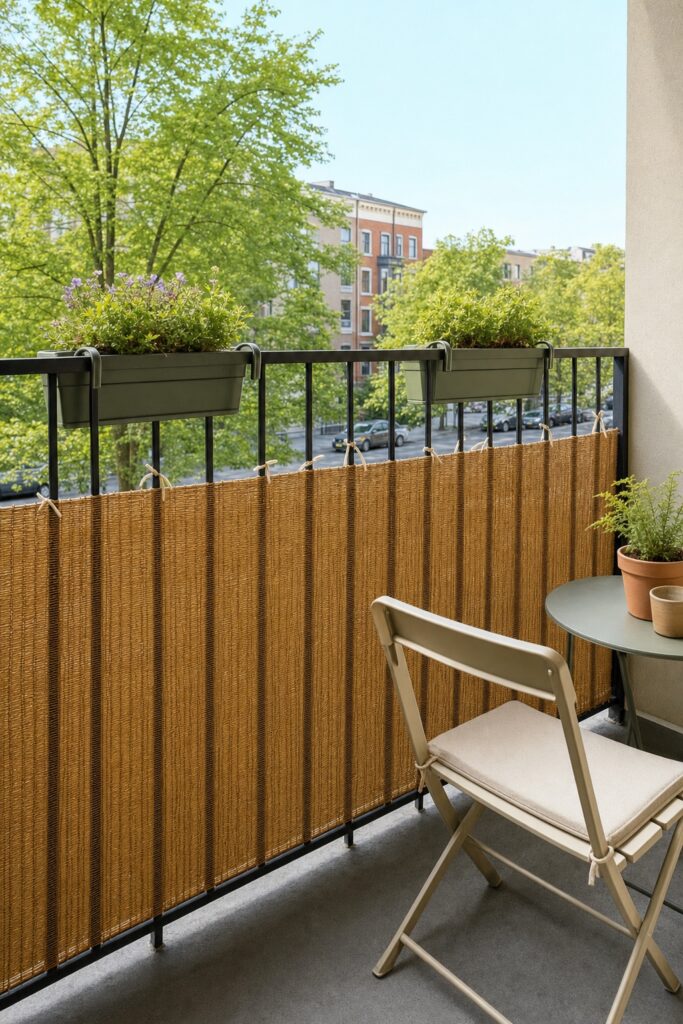
Open metal railings are the most flexible — you can hang planters, tie on screening, hook things over the top rail. They're also the least private at floor level and the windiest.
The fix is a low layer: rail planters or a run of reed or woven screening along the bottom two-thirds. It keeps the open view at eye level and hides the floor. If privacy is the main thing you're solving, our balcony and patio privacy guide works through it by sightline.
Four looks, any size
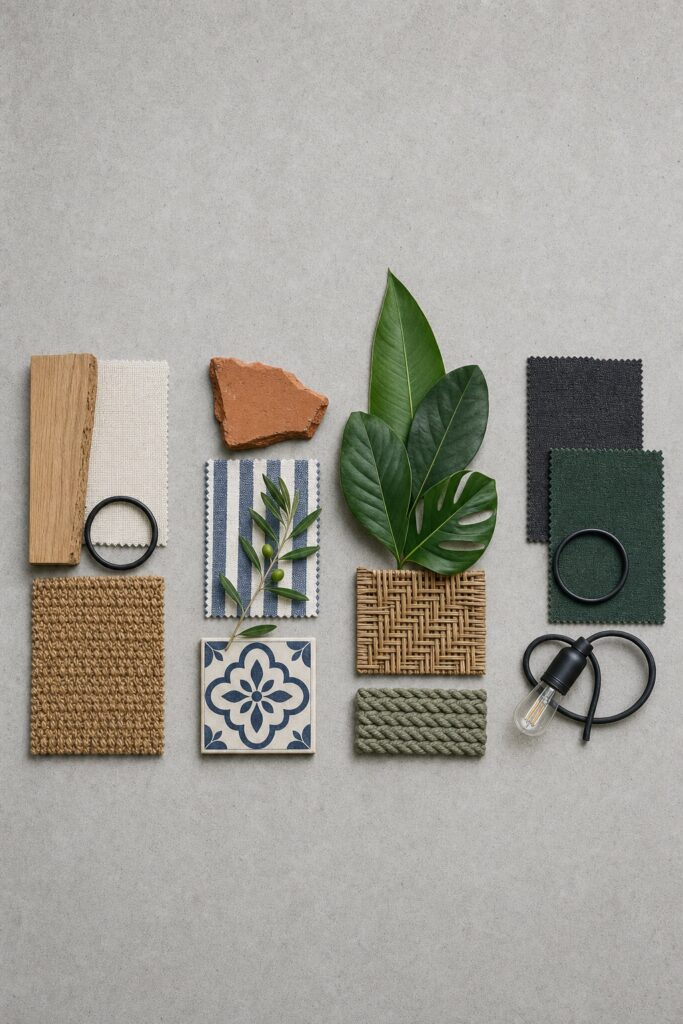
Depth decides the furniture; the palette is free. These four hold up outdoors — meaning they survive fading, they don't show every water mark, and they still look intentional in November.
Warm minimal
Teak or acacia, cream cushions, one black metal detail, a jute-look outdoor rug. Nothing decorative that isn't also useful. It's the easiest look to keep tidy on a small balcony, because there's nothing extra to tidy.

Mediterranean
Terracotta pots, a blue-and-white striped cushion, olive and rosemary, a small tiled-top table. Warm, forgiving of sun-fading, and it gets better as the terracotta weathers rather than worse.

Jungle green
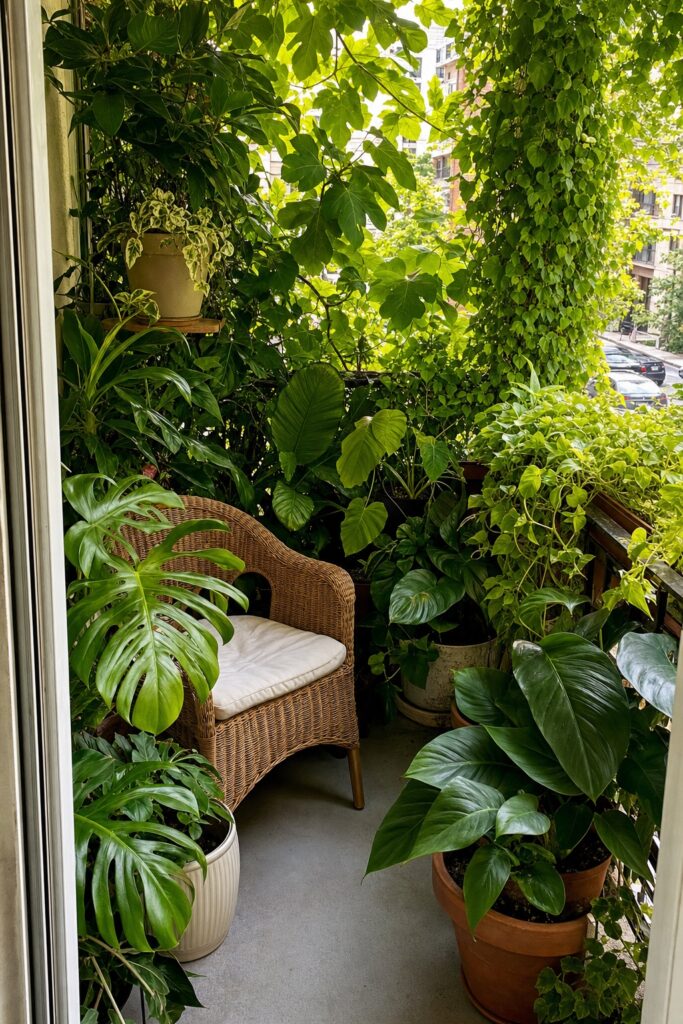
Plants as the entire decorating scheme — big leaves, several heights, one wicker chair to sit in among them. This is the look that turns a view of a parking lot into a view of leaves, which is the most valuable thing a city balcony can do.
Moody evening
Charcoal and deep green, a dark chair, warm string lights, a lantern with a battery candle. It's a balcony designed for after work rather than for a bright Sunday, and it photographs beautifully at dusk.

What survives, what doesn't, and what to buy first
A balcony is outdoors in a way a patio isn't — higher wind, more sun, nowhere for water to go. Three things people buy first are the three that don't last.
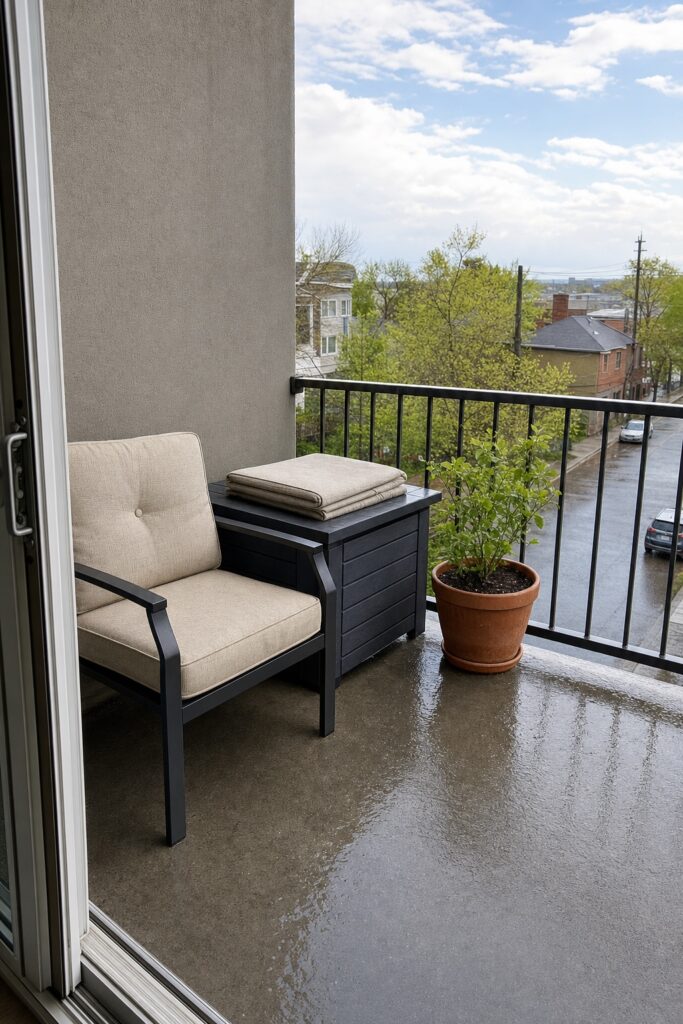
- Untreated indoor cushions. They soak, they mildew, they fade in one season. Buy outdoor fabric or buy a cover, and bring them in when they're wet.
- Very lightweight furniture on an upper floor. A folding chair that lifts with one finger also lifts in a gust. Weight matters more the higher you are, and anything that can go over the rail eventually does.
- Anything that needs to stay dry. Woven baskets, paper lanterns, untreated wood trays. If it can't be rained on, it isn't balcony furniture; it's furniture you'll carry in and out until you stop bothering.
On weight, the reassuring part: modern US building codes design residential balconies for a substantial live load — commonly 100 pounds per square foot for multifamily construction under current code tables. Furniture, pots and people are not the problem. What is worth respecting is an older balcony that feels springy, or shows rust stains, rot or cracking where it meets the building — that's a report-it-to-the-building situation, not a decorate-around-it one.
Buy in this order: something to sit on, something to put a cup on, one light, a rug, then plants. Most balconies get abandoned because there was never a surface for the coffee, and everything after that is decoration.
For the ground-floor version of all this — concrete slabs, walkways and grills — we worked through it separately in our apartment patio guide.
FAQ
How deep does a balcony need to be for two chairs and a table?
About 48 inches, and only if you arrange them along the length rather than across it. A standard outdoor chair is 22 to 26 inches deep and needs roughly 18 inches behind it to sit down comfortably. Under 48 inches, one chair plus a stool is the arrangement that actually gets used.
What can I put on a small balcony that's under 4 feet deep?
One lightweight chair and a stool, or a rail-mounted shelf you stand at, plus vertical planting. Anything that has to be pulled out to be used will be climbed over instead. The all-plant version — no seating, tiered stands and rail planters — is often the better choice on a very shallow balcony you mostly look at from inside.
Can I hang planters on my balcony railing?
On open metal balusters, usually yes. On glass panels, usually not, and clamps can damage the fixing. On a solid masonry wall it's not possible at all, so planting goes on stands or in floor pots. Check your lease as well as your railing — many buildings restrict anything mounted on or overhanging a railing.
How much weight can an apartment balcony hold?
More than you're likely to put on it. Modern US codes design residential balconies for a substantial live load — commonly 100 pounds per square foot for multifamily buildings — so ordinary furniture, planters and people are well within it. The real concern is condition rather than load: a balcony that feels springy or shows rust, rot or cracking where it meets the wall should be reported to the building.
What outdoor furniture survives on a windy upper-floor balcony?
Anything with enough weight to stay put, and nothing with a large flat surface that catches air. Metal or heavier wood over the lightest folding pieces, low backs rather than tall ones, and no free-standing umbrella unless it's weighted properly. Bring cushions in when they're wet — wet cushions are heavy, slow to dry, and the first thing to mildew.
What should I buy first for a small balcony?
Something to sit on, then something to put a cup on, then one light. Balconies get abandoned because there was never a surface for the coffee — a chair with nowhere to set anything down doesn't get used twice. Rug and plants come after, once you know how you actually use the space.


