
Dorm Room Ideas, Sorted by What Actually Holds Them Up

Save enough dorm room ideas and they start to look like the same room: pale bedding, a rug, a wall of pictures, and warm light coming from somewhere. What almost none of them tell you is the only thing that matters once you're standing in the room with a suitcase — what is holding any of it up.
A dorm is not a bedroom you can adjust. The walls may be painted block. Nails are usually banned. The furniture was chosen by a purchasing department and the ceiling belongs to the fire marshal. Ideas don't fail there because they're bad ideas. They fail because nothing in the room will take them.
So this gallery is sorted by what holds each idea up: things that stand on the floor, things that hang off furniture the school already installed, things that stick to the wall, and things that plug in. Work out which groups your room allows, then copy freely inside them.
Jump to a section
Three things your room already decided
Do these three checks before you buy anything, because each one closes or opens a whole group below.
The bed size is already decided for you. Residence hall mattresses are extra-long twins: UCLA's housing office lists a 36-by-80-inch mattress in every room type. That's five inches longer than the twin bed you grew up with, so regular twin sheets will not stay on it. Buy twin XL, and buy the mattress cover in twin XL too.
Find out how many lights you have. In most rooms the answer is one, in the ceiling, in the middle. UCLA's furniture list is blunt about the rest: you get a desk, and "students must provide their own desk lamps." Every school is different in the details and identical in this one — the room is lit like a corridor until you fix it.
Run your palm across the wall. Smooth painted drywall or smooth painted block will take adhesive strips. Rough, gritty, pitted or unpainted block will not — the adhesive can't make a seal, and 3M says as much about rough and unfinished surfaces in its own guidance for Command products. This single test decides whether the whole sticks-to-the-wall group is open to you or closed.
Then read your housing handbook once, properly. They rhyme with each other. Ohio University's is a fair sample: "Covering more than 25% of wall space with decorations, paper, posters, or other items is prohibited," "3M Command products should be used to attach items to walls," "Hanging tapestries, lights, or other items from the ceiling is prohibited," and duct tape is limited to plastic on windows in winter. Note the second one carefully — the same page bans Command products in five specific halls and asks for finishing nails there instead. The rules are not just school by school. They can be building by building.

Ideas that stand on the floor
No policy in the country objects to an object standing on the ground. This is the group to spend on first, it's the group that moves with you to next year's room, and it's the only group that works if your walls turn out to be rough block.
The catch is floor area. A standard double gives each person somewhere near a bed's worth of free floor, so every piece here has to earn its footprint twice — once as decoration, once as storage or seating.

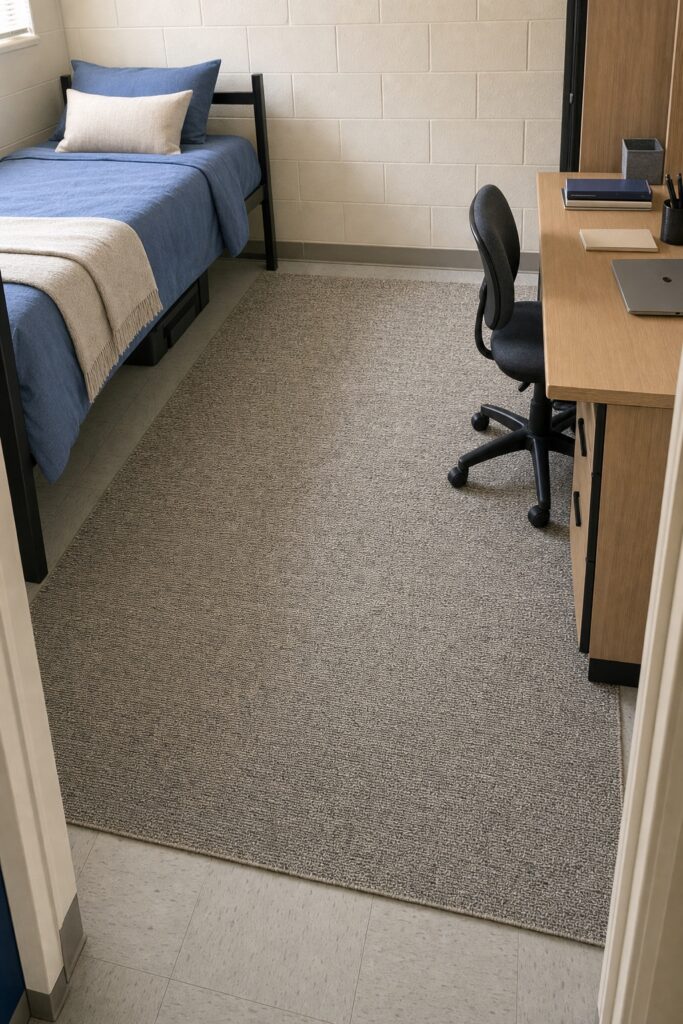
A rug big enough to reach the desk chair
Dorm floors are vinyl tile or thin commercial carpet laid over concrete, which is why the room is cold underfoot and loud in the evening. A rug is the only purchase that fixes both at once, and it's the one thing every finished-looking dorm photo has in common.
The usual mistake is a 3-by-5, which floats in the middle of the floor like a bath mat and makes the room look bigger only in the sense that it looks emptier. Measure the walking strip between the bed and the desk chair and buy a rug that covers it — in a standard double that's usually a 5-by-7. Keep the pile low so the door still swings over it, and skip the rug pad unless the floor is hard tile, where the grip is worth it.
A floor lamp aimed at the corner the ceiling misses
One fixture in the center of the ceiling lights the middle of the room and leaves the two corners you actually sit in dark. A floor lamp in the far corner does more for how the room feels than anything you hang.
Buy an LED lamp, and check the handbook before you buy any lamp with a bowl on top — the University of Colorado Boulder's list puts halogen lamps in the same sentence as heaters and heat lamps and bans all three as fire hazards. That style of torchiere is the one that gets confiscated.
Warm bulbs, around 2700K. Cool white in a room with white walls and a laminate desk is how you get an office at midnight.

A narrow tower in the dead strip
Every dorm room has a leftover column of floor somewhere — beside the wardrobe, between the desk and the wall, behind the door. It's usually 10 to 14 inches wide, and it's usually holding a laundry bag.
A narrow shelf tower fits that strip and takes the pile off your desk, which is the surface that decides whether the room reads as tidy. Four shelves is the useful number: two for things you want seen, two for things you don't, in boxes.

A full-length mirror, leaned rather than fixed
The mirror is the piece most likely to be banned in the form you were planning — hung, on a door, or screwed to anything. Leaned against the wall, it's furniture, and furniture is allowed.
Two conditions. Lean it somewhere it can't be walked into, which usually means behind the door swing or in the corner past the bed, not opposite it. And if it came with an anti-tip strap, use the strap — a full-length mirror in a room where people move fast in the dark is worth ten seconds of caution.

A cart that parks, and a warning about its height
The rolling cart is the most-recommended object in dorm decorating, usually with a line about parking it under the desk. Measure first: the common three-tier carts are close to 30 inches tall, and a dorm desk is around 29 — Ursinus College publishes its first-year desks at 41 by 23 by 29 inches. The cart parks beside the desk, not under it.
That's still worth doing. A cart holds the categories that otherwise colonize two surfaces — snacks, skincare, chargers, whatever your version is — and it's the one storage piece you can wheel out of the way when four people are sitting on the floor.

Ideas that hang off what the school already installed
Here's the group almost nobody writes about, and it's the best one. The school has already put permanent hardware in your room: a door, a closet rod, a desk hutch, a window frame, and a steel bed frame. None of it is your wall, so none of it is governed by the wall rules, and all of it will take weight.
The bed frame is the strongest object in the room, and our guide to what fits under a lofted bed covers loading it properly. The five below use everything else.

The back of the door, which is a free square yard
The inside of your door is about six feet of vertical surface doing nothing. Over-door hooks turn it into the coat closet, the towel rail and the bag park in one move, with no adhesive involved.
Buy for the right door, though. Residence hall doors are usually fire-rated and thicker than the bedroom door at home — around 1¾ inches — and an over-door hook made for a 1⅜-inch door will splay and slip. Check the stated door thickness on the packet. And keep the top of the door clear of anything that stops it closing fully: a fire door that can't latch is the one decorating decision that gets a formal write-up.

A hanging shelf on the closet rod
A fabric hanging organizer turns a column of hanging space into five folded shelves, which is the right trade for most people — you probably fold more than you hang.
Know what it costs you. Ursinus publishes its singles and doubles at roughly 46 inches of closet width, so a 12-inch organizer takes about a quarter of your rod. If your wardrobe is shared, agree on that quarter before one of you installs it.

A tension rod inside the window frame
The school gave you a pull-down shade — Ursinus lists one 44-inch window with a shade attached as the standard in a double — and that shade is the single most institutional thing in the room. You can't remove it. You can put something in front of it.
A tension rod inside the window recess, holding a light curtain, is the version that survives inspection: nothing is fixed to the wall, nothing hangs from the ceiling, and it comes down in one minute in May. Keep the fabric clear of any heater or vent under the window, and keep it short enough that it doesn't pool on the sill.

The desk hutch, used as a shelf instead of an overflow
Most dorm desks have a hutch — the shelf unit bolted to the back. Everyone fills it with textbooks, so everyone ends up looking at a wall of spines while they work.
Move half the books to the tower or the cart, and give the hutch three objects and a small lamp instead. When you're sitting at the desk, that shelf is at eye level. It's the most-looked-at three feet in your room, and it's currently a bookshelf you don't read from.

A tension rod across a corner, for the pile on the chair
Every room has a chair that clothes live on. A tension rod wedged across a corner, high up, becomes the second closet that pile actually wanted — coats, a bag, the jacket you wear every day.
Be honest about friction. A tension rod holds what a tension rod holds: outerwear, yes; a full season of clothes, no. Load it and push down on it before you trust it, because the failure mode is at three in the morning.

Ideas that stick to the wall
This is the group with the rules, and the rules are worth knowing exactly rather than approximately, because they're less strict than the internet believes and stricter in odd places.
The wall coverage cap is the fun one. A quarter of the wall sounds tiny until you do the arithmetic: a wall ten feet long and eight feet high is 80 square feet, so 25 percent is 20 — about a four-by-five-foot rectangle of stuff. That's far more than most rooms use. What it does rule out is the edge-to-edge photo collage, which is exactly the look that gets flagged.
Then there's the adhesive itself. Follow the weight rating and the removal method, both of which our guide to decorating with adhesive hooks covers in detail, and remember the palm test from the top of this article: on rough block, nothing in this group is available to you and the floor and furniture groups are your whole gallery.

One big piece instead of twelve small ones
Twelve small things stuck up separately read as clutter, take three times the adhesive, and eat your coverage allowance in crooked increments. One large piece reads as a decision.
Choose light. A big print on foam board or a stretched fabric panel weighs a fraction of anything framed in glass, and glass above a bed is a bad idea in a room with a metal frame and a roommate. Center it on the bed or the desk rather than on the wall — the furniture is what your eye lines it up against.

A fabric hanging, pulled flat and fastened at the corners
The draped tapestry is the classic dorm image and the classic dorm violation. Two things get it removed: hanging loose, and hanging big. CU Boulder's list is specific — "Tapestries/wall hangings/flags larger than 3×3 are considered fire hazards and are not allowed."
The version that stays up is flat. Stretch it, fasten every corner and the middle of each long edge so nothing hangs free, keep it off the ceiling entirely, and keep it well clear of light fixtures, vents, sprinkler heads and smoke detectors. Check your own handbook for a size cap before you buy, because the number moves from school to school.

A grid above the desk, sized to the desk
If you want several pictures, make them look intentional by making them a rectangle. Six prints in matching frames, two inches apart, in a block no wider than the desk below it, is a grid. The same six scattered is a mess.
Matching frames do the work here, and they're what makes cheap prints look chosen rather than accumulated. Keep the whole block inside your coverage allowance and leave the wall above your pillow empty — you'll sit up into it eventually.

One board, instead of tape on the paint
Tickets, photos, the schedule, the postcard from home: all of it ends up taped to the wall in a shape nobody planned. Put a single cork or felt board up instead and let it hold the whole moving collection.
It's one adhesive install for a hundred changing things, it costs you one small rectangle of coverage instead of a growing one, and in May it comes off the wall as one object with everything still on it.

A removable panel where a headboard would be
If your wall passed the palm test — smooth and painted — a panel of removable wallpaper or peel-and-stick tile behind the bed gives you the one thing a dorm room never has: a wall with a pattern on it.
Keep it to a headboard-sized rectangle rather than a whole wall, both for the coverage rule and for your own sanity in May. Our peel-and-stick tile guide explains the small test patch to run first and the surfaces that peel paint on removal — do the test before you cover anything.

Ideas that plug in
Light is the difference between a dorm room and a photo of a dorm room, and it's also where the fire rules bite hardest. Every idea here works around two facts: you have very few outlets, and the ceiling is off limits.
Plan the power first. One good surge protector per person, plugged straight into the wall — not into another strip — and cords routed along the baseboard rather than across the floor. Never run a cord under the rug. It's the one shortcut in this article that can genuinely start a fire.

The lamp the school didn't give you
The desk comes without a lamp, on purpose, at most schools. Get one that clips or stands on the hutch shelf and aim it at the wall rather than at your face, so the light comes back off the paint instead of glaring off the desk.
A second small lamp on the dresser gives you the two-lamp minimum that makes any room look inhabited after dark. Both warm, both LED, both on the surge protector.

A clip light on the bed frame
The clip light is the most dorm-specific object in this article: it clamps to the steel upright of the bed and needs no surface, no adhesive and no wall. In a lofted or bunked bed it's the reading light you otherwise don't get.
LED only, and point it away from the mattress and bedding. Anything that gets warm does not belong six inches from fabric.

String lights, run along something, never from the ceiling
Every dorm photo has them, so it's worth being exact. Some schools ban decorative lights outright, some cap the number of strands or bulbs, and Ohio University's handbook prohibits hanging lights from the ceiling at all — which kills the draped-across-the-room version most of those photos show.
Run them along the top edge of the wardrobe, down the bed frame, or around the window recess instead. LED strands only, plugged into the surge protector, and clipped rather than taped — the same handbook allows duct tape for exactly one purpose, and decoration isn't it.

The cord plan nobody makes, and everybody needs
Your desk will end up with a laptop charger, a phone charger, a lamp and a monitor or a speaker on it. Left alone, that's five cables hanging off the back edge in view of the door.
Bundle them with a strip of adhesive clips along the underside of the desk, or a cheap sleeve, and let one cable come up to the desktop. It takes fifteen minutes, costs a few dollars, and it's the difference between a desk that looks set up and one that looks moved into. Do it on day one, before the cables set into their habits.

What gets taken down
Save yourself the packing space. Across handbooks, these are the recurring bans, and they're all fire-driven rather than fun-driven:
- Candles and incense, lit or not, at nearly every school. CU Boulder names candles as a fire hazard outright.
- Halogen lamps and heat lamps — the same list, the same reason.
- Anything hung from the ceiling: lights, tapestries, canopies, paper lanterns.
- Oversized wall fabric — over three feet square at CU Boulder, with different numbers elsewhere.
- Nails, screws and anchors, and duct tape used to hang anything.
- Anything on or near a sprinkler head or smoke detector. This is the one that isn't about your deposit; it's the one that can flood a building or silence an alarm.
None of that removes the look you want. It removes four specific objects, all of which have a legal version above.
If you only do three things
Start here, in this order: the rug, one lamp, one large thing on the wall. Those three change the floor, the light and the eye level — the three inputs your brain uses to decide whether a room is finished.
Everything else in this article is refinement, and refinement is better bought in October, once you've lived in the room and know where the dark corner and the clothes pile actually are. If you're moving in with someone, settle the shared pieces first; our guide to a dorm room for two people covers who buys what before you both arrive with a rug.

FAQ
How can I hang things in a dorm room without nails?
Three ways, in order of reliability. Hang it off hardware the school installed — the door, the closet rod, the desk hutch, the bed frame — which no wall rule touches. Stand it on the floor instead. Or use adhesive strips, which most handbooks recommend by name, on a wall that's smooth and painted. Nails, screws and anchors are prohibited at most schools, and duct tape is prohibited almost everywhere as a hanging method.
Do adhesive strips work on cinder block dorm walls?
Only if the block is smooth and painted. 3M's own guidance rules out rough and unfinished surfaces for Command products, because the adhesive needs a continuous seal and a porous, pitted surface never gives it one. Run your palm over the wall before you buy: if it feels gritty or leaves dust on your hand, plan for floor-standing and furniture-hung ideas instead. Also check your building specifically — Ohio University recommends Command products generally, then bans them in five named halls.
Are string lights allowed in dorm rooms?
It depends on the school, and the detail that catches people out is usually not the lights themselves but where they're hung. Ohio University prohibits hanging lights from the ceiling entirely. Other schools cap the number of strands, or ban decorative lighting outright. LED strands, clipped along furniture rather than taped or draped overhead, are the version most likely to be fine — but read your own handbook, because this is the rule that varies most.
What size sheets do I need for a dorm bed?
Twin XL. Residence hall mattresses are extra-long twins — UCLA lists 36 by 80 inches, five inches longer than a standard twin — so regular twin fitted sheets won't reach the corners. Buy the mattress protector in twin XL as well; it's the item people forget and then sleep on a bare plastic mattress for a week.
How do I make a dorm room look bigger?
Clear the floor and lift the eye. A rug that covers the walking strip makes the floor read as one surface rather than several; keeping storage tall and narrow rather than low and wide leaves more visible floor; and two lamps at different heights push light into the corners, which is what makes a small room read as deep rather than boxed. Raising the bed, where your frame allows it, turns the space underneath into storage and hands the floor back.
What should I not bring to a dorm room?
Candles, incense, halogen lamps and heat lamps top nearly every prohibited list, all as fire hazards. Add oversized wall fabric — larger than three feet square at CU Boulder — anything intended to hang from the ceiling, and nails, screws and duct tape. Beyond the rules, skip the third rug, the second mirror and anything full-size: the room is smaller than the photos, and a college apartment checklist is a better guide to what actually earns its space than a dorm shopping haul.


