
Floating Faucet Fountain: How the Water Trick Works, and How to Build One

Picture a warm evening in the backyard. A friend walks around the corner of the house, stops, and stares at the garden: a brass faucet is hanging in the air, with nothing above it and nothing holding it, and water is pouring out of it into an old barrel.
"Okay," she says, "how does that work?"
This guide contains Amazon affiliate links. As an Amazon Associate I earn from qualifying purchases, at no extra cost to you.
That's the floating faucet fountain from our video, and you can build it yourself in an afternoon. The trick needs only three parts: a small pump, a clear tube and an ordinary outdoor faucet. Together they cost about $55 to $80.
Whenever a video of one of these goes around, people ask the same things. Where does the water come out? Won't it tip over? Is a plug next to water safe? Every answer is below, with 7 steps and a picture for each, plus the five mistakes that give the trick away.
At a glance
- Time: an afternoon, plus about a day for the glue to cure
- Skill: beginner. The only power tool is a drill.
- Cost: about $75 to $110 if you own a big watertight pot, or $230 to $300 with an oak barrel and liner
- Best time to build: now, if your evenings are still mild, because it can run until the first freeze. If frost is close, build it over the winter, so it's pouring before searches for DIY fountains take off at the end of February.
Jump to a section
- How the Floating Faucet Trick Works
- What You Need, and What It Costs
- Step 1: Line the Barrel and Set the Pump
- Step 2: Stand the Tube on the Pump
- Step 3: Drill Small Holes Near the Top
- Step 4: Seal the Faucet Onto the Tube
- Step 5: Fill It and Hide the Pump Under Stones
- Step 6: Plug in the Outdoor-Safe Way
- Step 7: Switch on and Tune the Flow
- The Mistakes That Make It Fail
- Keep It Running: Leaks, Green Water and Winter
- FAQ
If you buy one thing
The One Part Worth a Few Extra Dollars
A fountain pump with a low-water shut-off turns itself off if the barrel runs low, so one hot week without topping up won't burn it out. Pick one rated to lift 5 or 6 feet or more.
How the Floating Faucet Trick Works

The faucet isn't floating. It sits on top of a clear tube, and the falling water hides the tube.
- A small pump at the bottom of the barrel pushes water up the tube.
- The top of the tube sits inside the faucet's spout, with a ring of small holes just below its end.
- The water comes out of the holes, fills the spout and pours back down around the tube.
From a few steps away, a clear tube wrapped in moving water disappears. The barrel is both the heavy base and the tank, so the same water goes round and round.

What You Need, and What It Costs

- Half oak barrel, about 27 inches across and 16 inches tall. A big watertight pot or tub works too.
- Liner made for a half barrel, about 20 gallons. Wood on its own can leak.
- Submersible fountain pump rated to lift 5 to 6 feet or more, ideally with a low-water shut-off.
- Clear rigid acrylic tube, about 1/2 inch across and 2 to 3 feet long.
- Small brass outdoor faucet (a hose bibb).
- Two-part waterproof epoxy.
- Two bricks, wire mesh and a bag of river stones.
- Vinyl tubing and waterproof tape, only if the tube sits loose on the pump.
- Tools: a drill with a small bit, about 1/8 inch.
What it costs: about $230 to $300 with the oak barrel and liner, or $75 to $110 with a pot you already own. The pump, tube and faucet that make the trick are about $55 to $80 of that. These are prices we found at US stores on October 7, 2026.
Two buying tips:
- Take the faucet with you when you buy the tube. The tube should slide up into the spout with a little room around it.
- Read the pump's height chart, not just the big number on the box. Pumps push less water the higher they lift, so for a 2- to 3-foot tube, pick one rated for 5 or 6 feet. Iowa State University's water garden guide explains why.
Step 1: Line the Barrel and Set the Pump

- Put the barrel in its final spot: level, and within reach of an outdoor outlet. Once it's full, it's too heavy to move.
- If it's an old barrel, check that the metal hoops still hold the boards tight, as the University of Illinois Extension advises.
- Drop the liner in so it sits flat on the bottom.
- Set the pump in the middle and leave it loose.
- Run the cord up the back inside wall and over the back rim, where nobody will see it.
Watch out: don't glue the pump down. Every pump needs cleaning sooner or later, and a glued one means taking the whole fountain apart.
Step 2: Stand the Tube on the Pump

- Push the bottom of the tube onto the pump's outlet so it stands straight up.
- If it's loose, slip a short piece of vinyl tubing between the tube and the outlet as a sleeve, then wrap the joint with waterproof tape.
- Step back and check it from the front and from the side.
Watch out: a tube that leans even a little makes the faucet look crooked, and the faucet's weight makes the lean worse.
Step 3: Drill Small Holes Near the Top

- Drill 6 to 8 small holes, about 1/8 inch each, in a ring about 1/2 inch below the top of the tube.
- Go slowly and let the drill do the work, so the acrylic doesn't crack.
- Blow out the dust.
Watch out: the holes must end up inside the faucet's spout. If they sit too low, the water sprays out under the faucet and everyone can see the trick.
Step 4: Seal the Faucet Onto the Tube

- Turn the faucet's handle to closed, so the water stays in the spout end.
- Mix a little two-part waterproof epoxy.
- Coat the outside of the top inch of the tube, well away from the holes.
- Slide the tube up into the spout, and hold the faucet straight for a few minutes while the glue grabs.
- Let it cure completely before any water touches it. The package says how long; it's often a full day.
Watch out: glue over the holes is the most common reason a floating faucet doesn't run at all.
Step 5: Fill It and Hide the Pump Under Stones
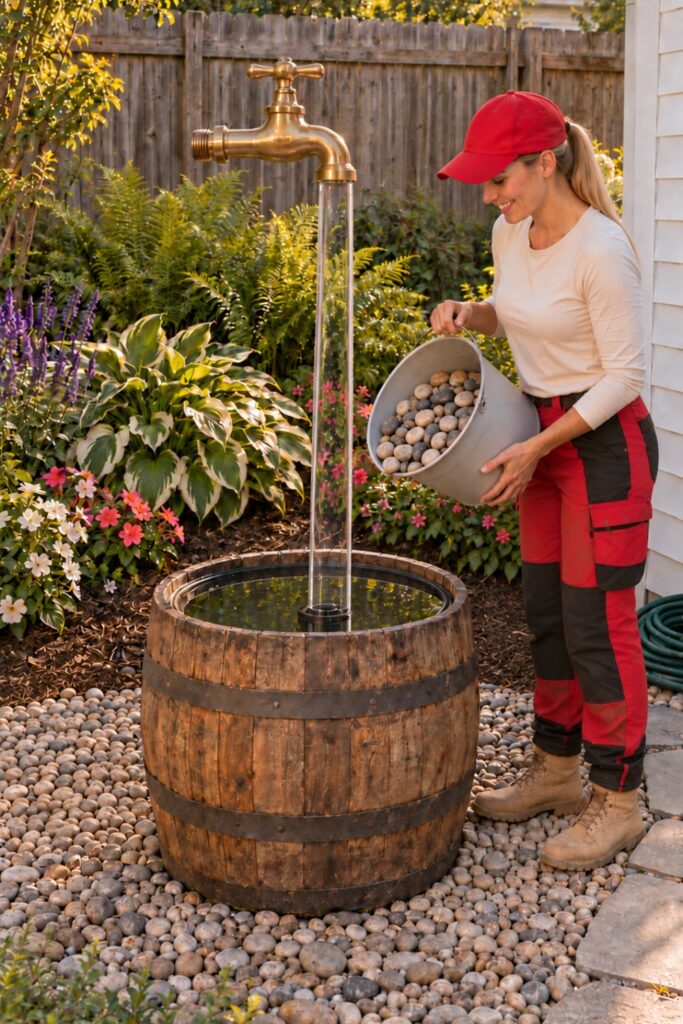
- Set two bricks on the barrel floor, one on each side of the pump, a little taller than it.
- Cut the wire mesh to rest on the bricks, and notch it around the tube. It keeps the stones' weight off the pump.
- Pile river stones on the mesh. They hide the pump and hold the tube steady.
- Fill the barrel with the hose until the water is a few inches below the rim.
Watch out: the pump must stay under water at all times, because the water keeps it cool. A pump with a low-water shut-off protects it if you forget to top up.
Step 6: Plug in the Outdoor-Safe Way

Water and electricity are close together here, so follow these three rules:
- Plug the pump only into an outdoor outlet with GFCI protection, the kind with Test and Reset buttons. It shuts the power off if current leaks where it shouldn't.
- Check that the outlet has a weatherproof "in-use" cover that closes over the plug. The code requires one for anything that stays plugged in outside, like a pump.
- If your outlet has neither, call an electrician before the fountain goes in. Never run an indoor extension cord across the lawn.
The Electrical Safety Foundation recommends GFCI protection for electrical devices used outside, and the US electrical code requires it on outdoor outlets.
Step 7: Switch on and Tune the Flow

- Plug in and watch the water climb the tube. Within seconds it fills the spout and pours down around the tube.
- If the stream is thin and you can still see the tube, turn up the pump's flow dial, or use a stronger pump.
- If water splashes out of the barrel, turn the flow down, or add stones where the stream lands.
- Walk to the spot where guests will first see it, and check the view from there.
- Finish with a water lily or two and a ring of stones around the barrel.
That first pour, when the faucet seems to hang in the air, is the moment to film.
The Mistakes That Make It Fail
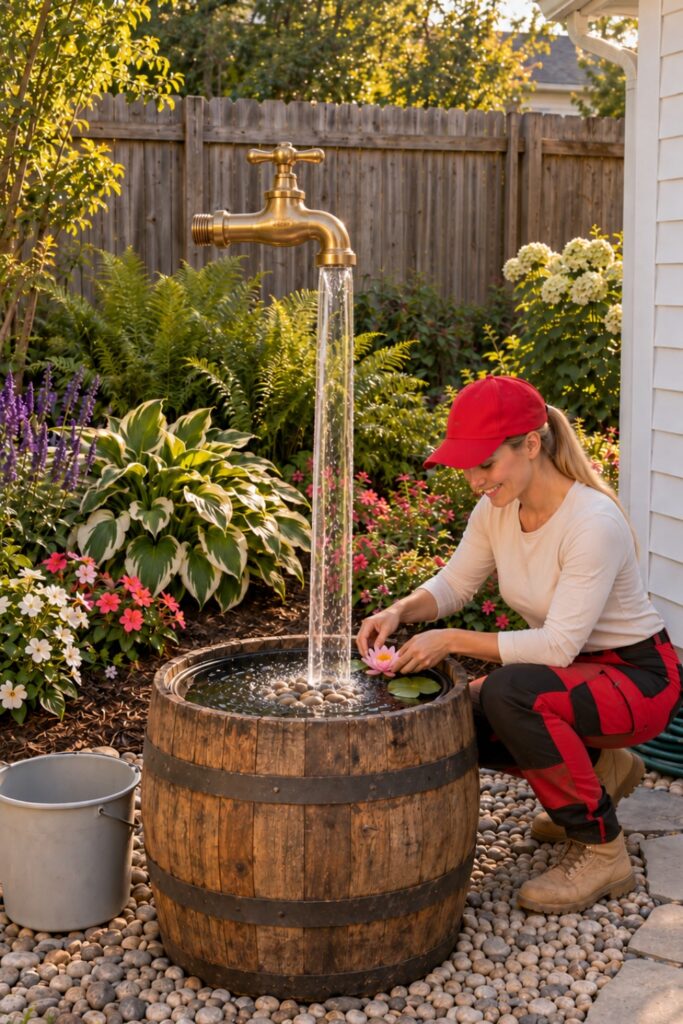
People who see a floating faucet go looking for the trick. These five give it away in seconds:
- Glue over the holes. No water comes out, or it sputters.
- A glued-down pump. It works until the day it needs cleaning.
- Holes below the spout. The water sprays out under the faucet.
- A heavy faucet on a thin tube. It leans, and a strong gust can tip it. Use a small faucet, a 2- to 3-foot tube and stones around the base.
- A cord on show, or an indoor plug. Hide the cord over the back rim, and use a covered GFCI outlet.
Get those five right, and you get the picture above: a faucet that seems to hang in the air, and a lot of people asking how it works.
Keep It Running: Leaks, Green Water and Winter

- Top it up every few days, and more often in hot weather. The pump must never run dry.
- Leaks: a wooden barrel without a liner usually weeps. Small leaks often close up as the wood swells, but the University of Illinois Extension points to a liner as the reliable fix.
- Green water usually means too many nutrients, says Iowa State University Extension. Swap part of the water for fresh, and add a water plant or two.
- Cleaning: when the stream looks weaker, unplug the pump, lift out the stones and mesh, and rinse the pump's intake.
- Winter: before the first freeze, unplug the pump, take it out and drain the tube. Empty the barrel too, so it can't crack when the water freezes (Iowa State University Extension advice). Store the pump in a bucket of water somewhere above freezing, so its seals don't dry out.
Then pull a chair up to it on a warm evening, and wait for the first person to ask how it works.
Watch this build, and the next ones, on YouTube, Instagram and Facebook.
Start here
Want it pouring on the first warm evening? Start with the pump. One with a low-water shut-off keeps the whole fountain running.
FAQ
Does the Faucet Really Float?
No. It sits on a clear tube hidden inside the falling water.
How Much Does a Floating Faucet Fountain Cost to Make?
About $230 to $300 with a half oak barrel and a liner, at US store prices we checked on October 7, 2026. With a big watertight pot you already own, about $75 to $110.
How Long Does It Take to Build?
An afternoon of work, plus the time the epoxy needs to cure before the water goes on. That's often a full day, so check the package.
What Size Pump Do I Need?
One rated to lift well above the height of your tube, because pumps move less water the higher they push. For a 2- to 3-foot tube, pick a fountain pump rated for 5 or 6 feet or more.
Can It Run All Day?
Yes, as long as the pump stays fully under water. An outdoor timer can run it only when you're home to enjoy it.
Can I Make a Smaller One for a Porch or Patio?
Yes. Use a smaller watertight pot, a 2-foot tube and a smaller pump, on a spot that can take the weight of the water, near a covered GFCI outlet. For more ways to make a small outdoor space feel like a room, see our apartment patio ideas.
Is It Safe With Kids and Pets Around?
Use a GFCI outlet with an in-use cover, keep the cord behind the barrel, and keep the base heavy with stones so the tube can't be pulled over. As with any water feature, watch small children around it.


