
Heart-Shaped Tulip Bed: How to Plant It With the Egg Carton Trick


Picture a bright April morning in your front yard. A heart of hot-pink tulips, lined with white ones, glows around a center of black pebbles.
Every car slows down as it passes. A neighbor out walking her dog stops at the edge of the lawn: "Did you plant that yourself?"
This guide contains Amazon affiliate links. As an Amazon Associate I earn from qualifying purchases, at no extra cost to you.
Yes, you planted it yourself last fall. That's the heart-shaped tulip bed from our video: a ring of tulips around a heart of black pebbles. A metal edge sets it into the lawn. You can build it in one weekend this fall, and it blooms on its own next spring. Most of the cost is the bulbs and the pebbles.
When a heart tulip bed video goes around, the comments ask the same things. Isn't that too shallow? Won't the squirrels eat every bulb? Does the egg carton trick really work? Every answer is below, with 7 steps and a picture for each, plus the five mistakes that give a tulip heart away.
At a glance
- Time: one weekend this fall, then about six months of waiting for the flowers
- Skill: beginner. You dig with a spade, and that's the hard part.
- Cost: about $300 to $400 with polished black pebbles, much less with dark bark mulch in the center
- Best time to build: now. Tulips are planted as bulbs in fall, after the soil cools and before it freezes. Plant them this month, and the heart blooms next April or May.
Jump to a section
- How the Heart Tulip Bed Works
- What You Need, and What It Costs
- Step 1: Mark the Heart With a Hose and Paint
- Step 2: Cut and Lift the Turf
- Step 3: Dig the Planting Ring 8 Inches Deep
- Step 4: Set the Edging, Fabric and Pebbles
- Step 5: Lay the Egg Trays and Bulbs, Tips Up
- Step 6: Cover, Clean Up and Pin the Wire
- Step 7: Water Well and Wait for Spring
- The Mistakes That Give It Away
- Keep It Blooming: After the Flowers Fade
- FAQ
If you buy one thing
Order the bulbs this week
About 85 tulip bulbs make a heart 6 feet wide: hot pink for the outside row and white for the inside. Bags of 50 cost far less per bulb than small packs, and the best colors sell out as fall goes on.
How the Heart Tulip Bed Works

A ring of tulips sits inside a metal edge, around a center of pebbles on weed fabric. Egg trays at the bottom of the ring space the bulbs out for you.
- The heart is about 6 feet wide. The planting ring runs just inside the edging, about 10 inches wide and 8 inches deep.
- Egg trays line the bottom of the ring. One bulb sits in every other cup, which puts the bulbs about 4 to 5 inches apart.
- Two rows of bulbs make the colors: hot pink on the outside, white on the inside. Soil covers them, and wire on top keeps squirrels out.
The cups of an egg tray sit only about 2 inches apart, too close for tulips. Using every other cup is the change that makes the trick work.
What You Need, and What It Costs

- Tulip bulbs, about 85: roughly 45 hot pink for the outside row and 40 white for the inside.
- Cardboard egg trays, the 30-cup kind, about 10 of them. Paper ones, not foam.
- Metal landscape edging, black, 20 feet.
- Landscape fabric for under the pebbles, a 3 x 50-foot roll.
- Black polished pebbles, about four 0.5-cubic-foot bags, or dark bark mulch.
- Chicken wire, a 24-inch roll, 25 feet long.
- Landscape staples to pin the wire.
- Marking paint and a garden hose to lay out the heart.
- Compost, one bag, to mix into the ring.
- Tools: a flat spade, a rubber mallet, a rake, a tape measure, a hand brush and a kneeling pad.
What it costs: about $300 to $400 in all, at prices we found at US stores on October 14, 2026. The pebbles are $120 to $145 of it, the edging $85 to $105 and the bulbs $50 to $85. Dark bark mulch in the center costs far less than polished pebbles.
Two buying tips:
- Buy bulbs in bags of 50. Store bags work out to about 50 to 85 cents a bulb, against $1.50 or more in small packs.
- Save egg trays now, or ask a café or a neighbor who keeps hens. You need about 10 of the 30-cup cardboard trays.
Step 1: Mark the Heart With a Hose and Paint
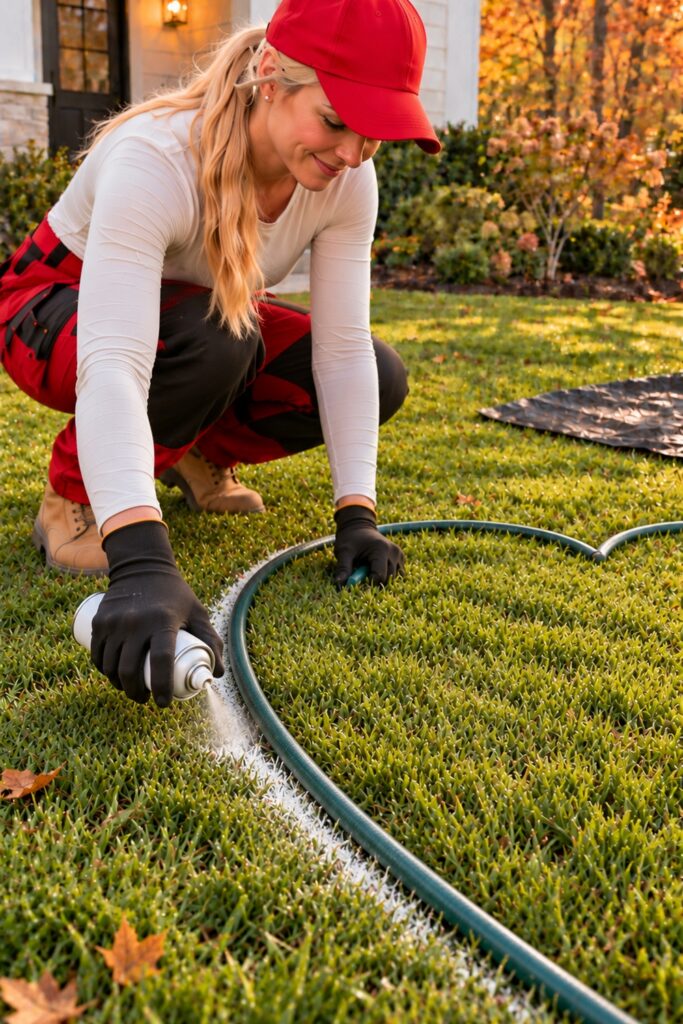
- Lay a garden hose on the lawn in a heart about 6 feet wide.
- Walk to the street or the front door, look back and adjust the shape.
- Spray marking paint along the hose, then lift the hose away.
Watch out: check the shape from where people will see it. A heart that looks right up close often looks lopsided from the street.
Step 2: Cut and Lift the Turf

- Cut straight down along the paint line with a flat spade.
- Slide the spade under the grass, about 2 inches deep, and lift it out in pieces.
- Use the best pieces to patch bare spots elsewhere in the lawn.
Watch out: cut the outline clean and straight down. A ragged edge lets grass creep back in, even with edging.
Step 3: Dig the Planting Ring 8 Inches Deep

- Dig a ring about 10 inches wide just inside the outline.
- Dig it 8 inches deep, and check with a tape measure all the way around.
- Loosen the bottom with the spade, and mix a bag of compost into the soil you set aside.
Watch out: this is the step people skip. Tulips go 6 to 8 inches deep, two to three times the bulb's height, so a shallow ring means floppy flowers.
Step 4: Set the Edging, Fabric and Pebbles

- Tap the metal edging into the outline with a rubber mallet, with its top just above the grass.
- Lay landscape fabric over the center of the heart, inside the ring.
- Pour the pebbles onto the fabric and rake them level, about 2 inches deep.
Watch out: keep the fabric and pebbles out of the ring. The bulbs need loose soil, not a sheet of fabric, above them.
Step 5: Lay the Egg Trays and Bulbs, Tips Up

- Kneeling on a pad on the grass, lay the egg trays flat in the bottom of the ring.
- Set one bulb in every other cup, pointed tip up.
- Put the pink bulbs in the outside row and the white bulbs in the inside row.
Watch out: the pointed end goes up, the flat, rooty end down. Bulbs poured in from a bucket land every which way.
Step 6: Cover, Clean Up and Pin the Wire

- Fill the ring with the compost-and-soil mix, back to the level of the lawn.
- Brush any soil off the pebbles with a hand brush.
- Lay chicken wire over the ring, and pin it down every foot or so with landscape staples.
Watch out: squirrels dig up freshly planted bulbs. Iowa State University Extension recommends wire over the bed, taken off in early spring before the leaves come up.
Step 7: Water Well and Wait for Spring

- Water the ring well once, so the soil settles around the bulbs.
- Leave it alone for the winter. The bulbs need the cold to bloom.
- Lift off the chicken wire in early spring, before the first leaves push through.
Then watch for the first green tips in March. The morning the pink opens is the moment the whole street notices.
The Mistakes That Give It Away

These five come up again and again under tulip heart videos, and each one has a simple fix:
- Planting too shallow. Tulips go 6 to 8 inches deep. Measure the ring before the trays go in.
- Filling every cup. Egg cups are about 2 inches apart. Use every other cup.
- Bulbs upside down. Set each one by hand, pointed tip up.
- No squirrel guard. Pin chicken wire over the ring until early spring.
- The wrong season. Bulbs go in the ground in fall, not spring.
Get those five right, and you get the heart in the picture above: pink and white around black, blooming right on time.
Keep It Blooming: After the Flowers Fade

- Spent flowers: snap off the faded heads, so the plant feeds the bulb instead of seeds.
- Leaves: let them turn yellow before you cut them back. They feed the bulb for next year.
- Summer: plant low annuals in the ring once the tulip leaves are gone.
- Weeds: pull any that sprout in the pebbles while they're small.
Then wait for April, take a picture from the sidewalk and see who stops to ask. For more ways to make the front of your home welcoming, see our entryway ideas.
Watch this build, and the next ones, on YouTube, Instagram and Facebook.
Start here
Want pink in the yard by April? Plant this month: get the bulbs in before the ground freezes.
FAQ
How Deep Do You Plant Tulip Bulbs?
About 6 to 8 inches, measured to the bottom of the bulb. That's two to three times the bulb's height.
When Should You Plant Tulip Bulbs?
In fall, after the soil cools and before the ground freezes. They need winter cold to bloom in spring.
Does the Egg Carton Trick Work for Tulips?
Yes, with cardboard trays and one bulb in every other cup. The cardboard breaks down in the soil, and the spacing comes out about 4 to 5 inches.
How Do You Keep Squirrels From Digging Up Tulip Bulbs?
Lay chicken wire or hardware cloth over the planted bed and pin it down. Take it off in early spring, before the leaves come up.
How Many Tulip Bulbs Do You Need for a Heart Bed?
About 85 for a heart 6 feet wide with two rows, spaced 4 to 5 inches apart. Two bags of 50 cover it.


