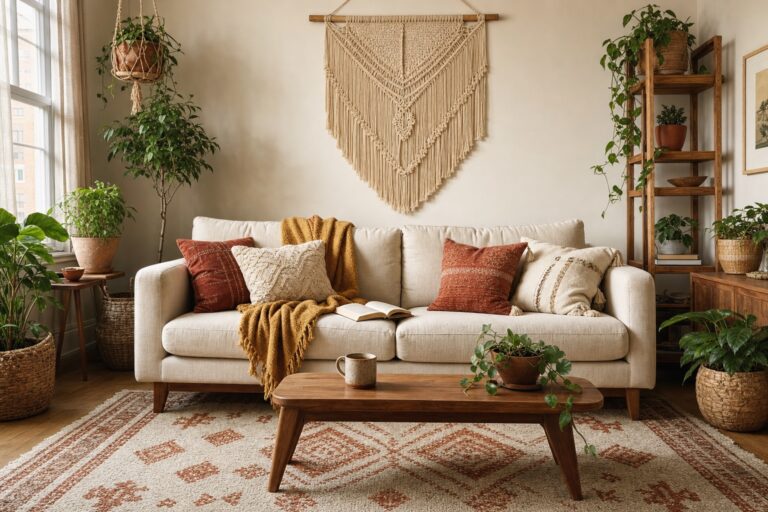
Small Living Room Ideas That Make Every Inch Work

A small living room usually feels cramped because of how it's arranged, not because of how many square feet it has. Move the same furniture into a smarter layout and the room reads calmer and more open before you buy a single thing.
So these small living room ideas go in the order that actually changes the space: fix the layout first, then work on light, then add the cozy layers on top.
The goal is a room that feels bigger and cozier at the same time — not a bright empty box, and not a warm cluttered one. Here's how to get both — and every fix here also has a damage-free version, gathered into one section near the end.
Jump to a section
Start with the layout, not the décor

Before you shop for anything, walk your room and look at two things: where people actually walk, and how many jobs the room is trying to do at once. Designers interviewed by Real Simple and Better Homes & Gardens keep landing on the same point — a small living room often isn't too small, it's just doing too much and arranged to fight itself.
The plain-language answer: give the seating a clear shape, keep the main path open, and let one wall be the star. The three moves below do that.
Float the seating off the walls

The instinct in a small room is to shove every piece against a wall to "save space." It backfires. Pushing everything to the edges flattens the room and leaves a dead patch of floor in the middle that no one uses.
Pull the sofa a few inches off the wall and anchor the seating on one large rug instead. That small gap gives the room depth, and the rug ties the group together so it reads as one intentional zone rather than furniture floating in a box. In a really tight room, even two or three inches of breathing space behind the sofa changes how the whole wall feels.
The rug matters more than people expect: get one big enough that at least the front legs of every seat sit on it. A tiny rug stranded in the center does the opposite and makes the floor look chopped up.
Scale the sofa right — bigger is often better

Here's the counterintuitive part. The most common small-room mistake isn't buying furniture that's too big — it's buying too many pieces that are too small. A loveseat plus two little chairs plus a pouf plus three side tables reads as clutter, and clutter is what makes a room feel tight.
One correctly scaled sofa usually makes a small living room feel bigger than a scatter of undersized pieces. A single three-seat sofa gives the eye one clean line to rest on and frees up the floor around it. Designers make this point often: a normal-size sofa, chosen to fit the wall, can actually open a room up.
The real rule is proportion, not "small." Measure your main wall, leave room for a slim side table and a clear path, and buy the largest single seat that fits comfortably — then stop.
Protect the walking path

Whatever layout you choose, keep a clear route through the room. A good target is about three feet of walking width in the main path, and never park a piece of furniture where it blocks a door as it swings open.
This one rule quietly fixes the "cramped" feeling more than any paint color. When you have to turn sideways to get past the coffee table, the room feels small no matter how it's styled. When the path is clear, the same room breathes.
Sketch it before you commit: seating floated on the rug, the coffee table within easy reach but not in the walkway, and the door free to open all the way.
Make the room feel taller and brighter

Once the layout works, the next lever is light — both real daylight and the feeling of height. A small room that's bright and draws the eye upward reads much bigger than its footprint.
Carry one light color across the walls

Light colors reflect more light, and a low-contrast room has fewer hard edges for your eye to catch on — so the walls feel farther away. You can push this further by painting the walls and the trim the same soft shade, a look often called "color drenching." Without a sharp white trim line boxing in each wall, the corners of the room seem to dissolve and the space feels more expansive.
This doesn't mean the room has to be white. A soft greige, warm oatmeal, or pale sage all work — the trick is keeping the whole envelope in one gentle tone rather than high contrast.
Lean a mirror opposite the window

A large mirror is the closest thing to a free window. Lean a full-length mirror against the wall opposite (or beside) your main window and it bounces real daylight back across the room, doubling the sense of depth and brightness. Leaning it, rather than hanging it, also means no wall damage — useful if you rent.
Place it deliberately: facing the window does the most work. Facing a blank wall or a cluttered corner just reflects the mess, so aim it at the light or at something you like looking at.
Draw the eye up

When floor space is limited, use the height you have. Two easy moves add vertical lift: hang curtains high and wide — mounted just below the ceiling and extending past the window edges — so the window looks taller and grander than it is; and use a tall, slim bookshelf instead of a low wide one to pull the eye upward.
One safety note that matters more in a small room where furniture sits close to where you sit: a tall bookshelf should be anchored to the wall. The U.S. Consumer Product Safety Commission recommends securing tall, tip-prone furniture with an anti-tip device, especially in homes with kids or pets. It's a $10 fix that takes ten minutes.
Give the room one job and one palette

Remember the earlier point that small rooms often feel small because they're doing too much? This is where you fix it directly. Decide what the room is for — usually relaxing and talking — and let go of the competing zones fighting for the same floor.
Two things calm a small room instantly: one clear focal point (a sofa wall, a window, one piece of art — not five things demanding attention), and one cohesive palette where the big pieces share a family of tones. A room in three or four closely related colors reads as intentional and, weirdly, larger. A room in eight clashing ones reads as busy and smaller, even when it's the same size.
If the room genuinely has to double as a home office or dining spot, give the second function its own defined corner and its own restraint, so it reads as a tidy zone instead of spillover.
Layer in the cozy without the clutter

Bigger is only half the promise. Cozy is the other half — and cozy comes from texture and warm light, not from filling every surface.
Start with light at three heights instead of one ceiling fixture: a table lamp, a floor lamp in the corner, and something low or ambient. Switch off the flat overhead light in the evening and let those warmer pools take over — it's the single fastest way to make a room feel intimate.
Then add texture, not stuff: a chunky knit throw, a couple of linen cushions, one real plant, a stack of books you actually read. Warmth reads through materials, so a few tactile things beat a dozen decorative ones. Keep most surfaces clear and let the texture do the work.
Hang a gallery wall that fits a small sofa

A gallery wall is one of the best ways to give a small living room personality without eating any floor space — but the sizing trips people up. The fix is simple: treat the sofa as the frame. The grouping should span roughly the width of the sofa, no wider, and the bottom row should start a hand's width above the sofa back so the art and the seat read as one connected block.
Keep the frames in one family — all thin oak, all black, or a deliberate mix of two — so a busy arrangement still feels calm. Lay it out on the floor first, or trace the frames on paper and tape them up, before you commit to any holes.
Renter-friendly versions of every fix

Every idea above works without damaging a wall — handy whether you're renting, avoiding a deposit fight, or just commitment-shy about holes.
- Art and mirrors: lean them instead of hanging them. A large mirror resting on the floor against the wall, or framed prints layered on a slim console, give the same look with zero hardware.
- A gallery wall without nails: use a leaning picture ledge, or damage-free adhesive strips rated for your frame's weight — check the weight limit and press for the full time the instructions say.
- Curtains: a tension rod inside the window frame skips wall brackets entirely; for the high-and-wide look, removable adhesive hooks rated for the load can carry a lightweight rod.
- Storage and height: choose freestanding, floor-standing shelves rather than wall-mounted ones — and still anchor a tall one with an anti-tip strap where possible.
- Color: if you can't paint, peel-and-stick wallpaper on one wall or removable products made for renters give you the low-contrast, color-drenched feel and come off cleanly.
One honest caveat: "damage-free" depends on your wall and your paint. Adhesive strips can lift fresh or flat paint, so test one in a low-visibility spot first and remove strips slowly and straight down.
FAQ
How do I arrange a small living room with a TV?
Put the TV on the main focal wall and float the sofa opposite it on a rug, keeping the walking path clear behind or beside the seating. If the room is narrow, a slim media console or a wall-mounted TV frees up floor space — and mounting keeps the screen from eating a tabletop. Avoid splitting the room between a TV wall and a second focal point; pick one.
What color makes a small living room look bigger?
Light, low-contrast colors — soft white, greige, warm oatmeal, pale sage — reflect the most light and blur the room's edges. Carrying one shade across both the walls and the trim ("color drenching") makes the corners recede and the room feel larger than sharp white trim against a colored wall.
Can I use a sectional in a small living room?
Yes, if you size it to the room. A compact apartment sectional or a small L-shape can actually save space by combining your seating into one piece against two walls, leaving the rest of the floor open. Measure carefully and keep the main walking path clear — an oversized sectional that blocks the path will make the room feel smaller.
How big should the rug be in a small living room?
Big enough that at least the front legs of every seat rest on it. A rug that's too small floats in the middle and chops up the floor, which makes the room look smaller. When in doubt, size up — a larger rug grounds the seating and reads as more spacious.
Should furniture go against the wall in a small room?
Not always. Pushing everything against the walls flattens the room. Pulling the sofa even a few inches off the wall and anchoring the seating on a rug gives the room depth and a defined shape. In a very tight room you may have no choice on one or two pieces — just balance it by floating a chair or the rug.
Put it together
The order is the whole trick: fix the layout, then the light, then the layers. Float the seating off the walls on a big rug, keep a clear path, lean on light colors and a well-placed mirror, commit to one palette and one focal point, and finish with warm light and a little texture. Do those in sequence and a small living room stops feeling like a compromise and starts feeling like the coziest room in the home.
Working with a small bedroom too? Many of the same moves — low furniture, a leaning mirror, drawing the eye up — apply there as well.