The Japandi Living Room, Built From Empty Space Outward

Most japandi living room guides hand you a shopping list — oak, linen, a paper lantern, something ceramic — and the room that results looks right in photos and feels wrong to live in. The furniture is correct. The feeling is missing.
That's because the ingredient lists skip the actual material japandi living rooms are made of: empty space. Japanese design has a word for it — ma, the deliberate interval between things, treated not as leftover area but as a thing you place on purpose. In a japandi living room, emptiness isn't what remains after you decorate. It's the largest piece of furniture you own, and it gets chosen first.
This guide builds the room in that order: reserve the empty space, then let the sofa, the TV, the storage, and daily life negotiate for what's left. For what japandi is — the two styles it descends from and the test any room must pass — start with our full japandi guide; this article assumes the living room and goes deep.
Jump to a section
- Empty space is the largest thing in the room
- Choose your three empties first
- The sofa: low, on legs, in a fabric that forgives
- One low table, and the restraint to stop there
- The television, honestly
- Storage: one closed piece, waist-high or lower
- Where daily life goes: a home for the five nomads
- Palette and texture: warm, matte, and two woods maximum
- Light in pools, not floods
- One plant, chosen like sculpture
- Renting? The whole look without touching a wall
- FAQ
Empty space is the largest thing in the room

Here's the mental flip that makes everything else work. In an American living room, empty space is failure — a bare wall is "unfinished," an empty corner is "dead," and decorating means filling. In the Japanese half of japandi's ancestry, the interval is the point: the bare stretch of wall is what makes the one object in front of it visible at all.
Practically, that changes what your eye should hunt for when the room feels off. The usual instinct says something's missing — add a print, a plant, a lamp. The japandi instinct says something's crowding — the five objects on the shelf are eating each other, and removing three is the upgrade. A living room runs on maybe a dozen sight-lines from the sofa, the doorway, the desk chair; each one either lands on air somewhere, or it doesn't. When none of them do, no amount of oak fixes the feeling.
None of this requires a minimalist's discipline or an empty house. It requires deciding — once, deliberately — where the emptiness lives, which is the next section.
Choose your three empties first

Before you move a single piece of furniture, walk the room and reserve three zones, the way you'd reserve seats: one empty wall — or the largest uninterrupted stretch you can protect — with nothing hung on it; one empty surface — the coffee table or the sideboard top, holding at most one object; and a visible floor margin — open floor you can see around the furniture, especially between pieces, so the room has somewhere to breathe at ankle height.
Write them down if that's what it takes to defend them, because everything in your life will apply to occupy those three zones — every new print wants the wall, every remote wants the surface, every "temporary" basket wants the floor. The three empties are the room's structure. A japandi living room with all three intact survives a fair amount of imperfect furniture; a room with perfect furniture and zero reserved emptiness reads as a nice Scandinavian catalog page, not japandi.
The sofa: low, on legs, in a fabric that forgives

The sofa is the biggest object in the negotiation, and its job is to claim as little visual weight as its size allows. Three features do that. Low — a back that stays down around shoulder height when seated, keeping the wall above it open (that space belongs to your empty wall inventory). On visible legs — a sofa you can see under keeps the floor margin running beneath it, and a skirted or block base plants a wall of upholstery on the floor. And dressed in matte, textured, forgiving fabric — linen or a wool blend in oatmeal, greige, or clay, where wrinkles read as intentional.
You don't need to buy a "japandi sofa." A plain low modern sofa secondhand, in the right height and an honest fabric, beats a trendy curved one in cream bouclé that fights every other rule in the room. If your current sofa is tall or skirted, don't replace it first — work the other sections and return here; the sofa matters, but the empties matter more.
One low table, and the restraint to stop there
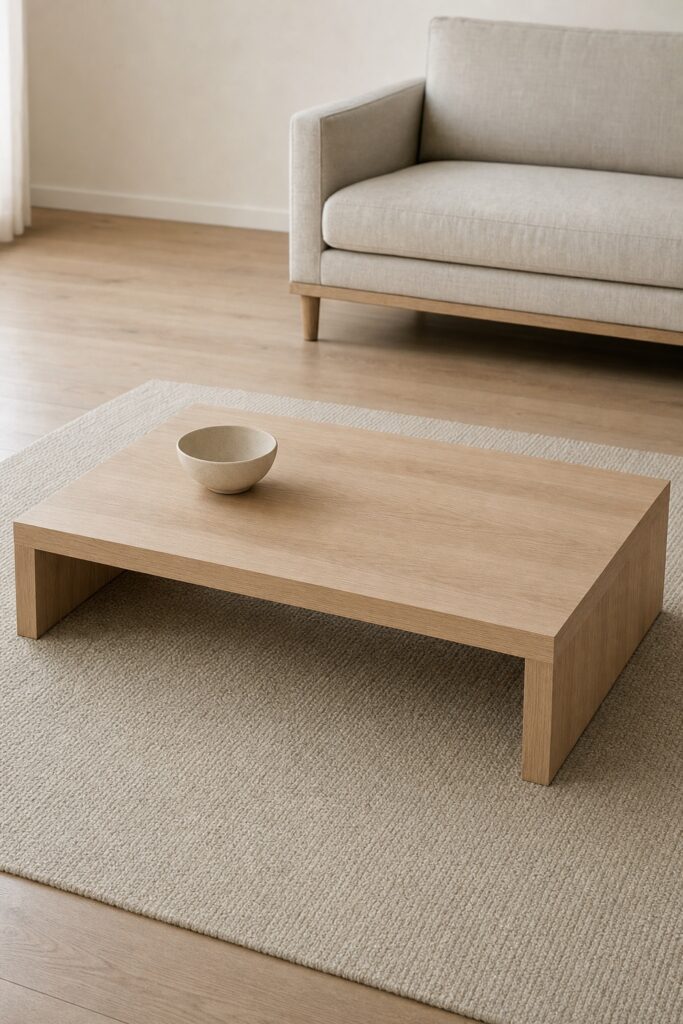
Japandi living rooms have a table problem in reverse: the temptation is nesting tables, a side table per seat, a plant stand — small wood objects multiplying because each one individually looks the part. Collectively they're clutter with good taste. The room wants one coffee table, wood, simple, sitting low relative to the sofa seat, and then it wants you to stop.
The tabletop is your empty surface candidate, and it's the hardest one to hold — so give the table a shelf below or a tray that migrates to the sideboard when someone needs the surface. One bowl or one small stack of books is the ceiling. If two seats genuinely need somewhere to set a cup, one small side table is earned by use, not by symmetry. The test for any additional table is the same as the five-dinners test for kitchen tools: name the specific daily moment that needs it, or it doesn't come in.
The television, honestly

Every japandi inspiration photo solves the TV by not having one. You have one, and pretending otherwise produces the worst outcome: a huge black rectangle floating over a styled console, surrounded by objects trying to distract from it. The calm answer is the opposite of camouflage — give it a low, quiet home and nothing to fight with.
A long, low media bench in wood — lower than feels normal at first — drops the TV's center of gravity and leaves real wall above it. That wall stays bare: no gallery around the screen, no shelf bridge over it, because a black rectangle next to busy decor is chaos, while a black rectangle alone on a calm wall is close to invisible when off. Cords disappear into one cable channel or behind the bench's back panel; a visible cord waterfall undoes the whole gesture. If the TV can live on the wall your sofa faces without taking your one reserved empty wall, that's the arrangement — the empty wall does more for the room than a hidden TV would.
Storage: one closed piece, waist-high or lower

Japandi's serenity is mostly hidden logistics. The room looks like it owns twelve objects because everything else lives inside one piece of closed storage — a long sideboard or low cabinet in wood, doors not open shelving, standing waist-high or lower so the wall above it stays quiet. This is the piece worth spending on if you spend anywhere: it's the infrastructure that makes every other section possible.
Inside it: the board games, the chargers, the spare throw, the router (with a drilled hole for airflow and cords), the things a living room genuinely needs and japandi photos pretend don't exist. On top of it: your second empty-surface candidate — one lamp or one ceramic piece, not a vignette. If you already own a bookcase you love, keep it, but let it be the one open storage in the room and style it at maybe a third full, spines and objects breathing — a packed bookcase next to japandi furniture reads as a storage unit having an identity crisis.
Where daily life goes: a home for the five nomads

Five objects destroy more japandi living rooms than any furniture mistake: the remote, the phone charger, the throw blanket, the current book, and mail. They're nomads — they belong nowhere, so they settle everywhere, and the empty surface you reserved in section two is their favorite campsite.
The fix is boring and it works: assign each nomad one specific home that is not a reserved empty. Remotes: a small tray or the sideboard's top drawer. Charger: one drawer with the cable routed through, so charging happens inside furniture. Throw: folded over the sofa arm — one throw, not a collection. Book: it may live on the coffee table; it counts as the table's one object. Mail: never enters the living room — it gets a landing spot by the door or in the kitchen. Thirty seconds of putting-away per evening is the actual maintenance cost of a japandi living room, and it's only thirty seconds because everything has exactly one place to go.
Palette and texture: warm, matte, and two woods maximum

The japandi surface recipe in one paragraph: warm neutrals — cream, oatmeal, greige, clay, one deep accent like charcoal or espresso used once or twice — on matte, textured materials: linen, wool, wood with visible grain, unglazed or softly glazed ceramic, paper. Nothing high-gloss, nothing chrome, nothing that glitters. Contrast comes from light-against-dark and rough-against-smooth, not from color.
The discipline that separates good rooms from muddy ones is the wood count: pick two — say, pale oak as the main and one darker walnut piece as the anchor — and repeat them, rather than collecting five near-miss wood tones that make the room feel like a secondhand store's staging area. Our japandi bedroom guide runs the same palette logic in more depth; the living room version just has more surfaces to hold consistent, which is exactly why the two-wood ceiling earns its strictness here.
Light in pools, not floods

A japandi living room at night runs on three or four small pools of warm light at different heights — a paper or linen floor lamp by the sofa, a small table lamp on the sideboard, maybe a picture light or a candle-height glow — and a ceiling fixture that stays off. Pools leave the corners soft and dim, and that dimness is doing design work: it's the evening version of your empty wall, the visual rest between lit moments.
Every bulb in the room should be warm — the amber end of the shelf, matched across lamps, because one cool-white bulb in a warm room reads like an office light left on. Paper lantern shades earn their cliché status honestly: they turn a bulb into a soft object and cost little. If you rent and the ceiling fixture is ugly, the answer is simply never turning it on — three plug-in pools of light make an overhead fixture irrelevant, no electrician involved.
One plant, chosen like sculpture

The japandi plant rule is the opposite of the jungle-apartment instinct: one plant, maybe two, chosen for the shape of its silhouette — a branching ficus, an olive tree, a sculptural snake plant — standing where its outline reads against a plain wall, ideally near your empty wall's edge where it becomes the exception that proves the emptiness. A simple clay or ceramic pot, no stand cluttered with trailing companions.
If you love plants and own many, this room isn't their home — concentrate the collection in the bedroom or kitchen and let the living room hold the single specimen. And if you keep plants alive badly, one branch of dried foliage or a bare sculptural branch in a floor vase gives the same line against the wall with zero maintenance, which is a very japandi trade: the honest version over the aspirational one.
Renting? The whole look without touching a wall

Almost everything above is renter-safe by construction: the empties are free, the sofa and bench and sideboard are furniture, the light pools are plug-in lamps, the plant is a pot on the floor. The usual rental obstacles have japandi-shaped answers, too. Ugly floor? One large flat-weave or wool rug in oatmeal covers it and adds the texture layer anyway. Harsh white walls? They're closer to right than you think — japandi walls are quiet by design, and warm lamplight against plain white lands within range. Nothing may be hung? The style barely hangs anything: one leaned artwork on the sideboard replaces the gallery wall outright.
The one renter move worth calling out is what not to buy: no peel-and-stick wood slat walls, no adhesive shoji-style film, no themed props. Japandi survives a rental precisely because it's a furniture-and-restraint style, not an installation — which also means it moves out with you intact, deposit included. For the broader deposit-safe toolbox, our rental decorating hacks sort every trick by move-out risk.
FAQ
What makes a living room japandi instead of just minimalist?
Warmth and intention. Minimalism subtracts until little remains; japandi subtracts until what remains can be seen — then warms it with wood grain, linen, clay tones, and low light. The reserved empty space is shared DNA, but a japandi room should feel inviting at 9 p.m., not gallery-cold. The two-parent test in our main japandi guide is the quickest diagnostic.
What colors should a japandi living room use?
Warm neutrals — cream, oatmeal, greige, clay — with one deep accent (charcoal, espresso, ink) appearing once or twice, all on matte textures. Contrast comes from tone and texture, not hue. If a color would look at home in a crayon box, it's fighting the room.
Can you have a TV in a japandi living room?
Yes — honestly, on a long low wooden media bench with a bare wall above it and cords fully hidden. What breaks the style isn't the TV; it's the decorating around the TV — shelves bridging it, galleries flanking it. Alone on a calm wall, a switched-off screen is nearly invisible.
How do I keep a japandi living room from getting cluttered?
Assign the five nomads — remote, charger, throw, book, mail — one home each inside furniture, and defend the three reserved empties (one wall, one surface, floor margin). The style's maintenance is thirty seconds of returning objects to their homes each evening; the design work is making sure each home exists.
Is japandi expensive?
The look leans on few, honest pieces, which rewards secondhand buying — solid-wood sideboards and simple low sofas are the used market's specialty. The most important elements are free: reserved empty space, lamps you already own with warmer bulbs, and the restraint not to buy the seventh small wood table.