
Boho Decor for a Living Room: Sort It by What You Touch

Boho decor works beautifully in a living room right up until someone sits down. The look depends on layers — woven, fringed, thrifted, handmade — and the living room is the one room where those layers get sat on, walked on, and spilled on every single day.
That is why so many boho living rooms look incredible for a month and tired by spring.
The fix is not less boho. It is sorting your boho by contact: how often a human body actually touches each layer. Touch decides what has to be washable, what can be delicate, and what you are allowed to buy secondhand for four dollars.
Jump to a section
- Sort every boho layer by how often you touch it
- The sofa decides whether the room reads boho or cluttered
- The rug: jute looks the most boho and survives the least
- Throws and pillow covers are the layer to buy washable
- The no-contact wall gets the delicate, the handmade and the thrifted
- Mix patterns by repeating the color and changing the texture
- Floor cushions: who actually sits on them
- Plants ranked by the light a living room really has
- The TV is boho's one unsolvable object
- The thrift map: what is cheap in each contact tier
- What makes a boho living room read as mess
- FAQ
Sort every boho layer by how often you touch it
Split your living room into three contact tiers, and let the tier decide what you buy.
- High contact — sat on, walked on, spilled on: the sofa fabric, the rug, floor cushions, the seat of any chair. Rule: washable or genuinely replaceable, no exceptions.
- Hand contact — touched daily but not sat on: throws, pillow covers, baskets you actually use, the coffee table surface. Rule: cleanable, and easy to swap when it wears.
- No contact — above about head height, or too far to reach from a seat: macramé, wall hangings, high-shelf pottery, dried stems. Rule: buy it delicate, buy it handmade, buy it thrifted.

Most boho advice ignores this completely, and that is the actual reason a room falls apart. Nobody's macramé wall hanging ever failed. Their jute rug did.
The tiers also tell you where the money belongs. Spend on the two or three high-contact things, because those are the ones that will look wrong first. Save on everything above head height, because nothing up there is under stress.
The sofa decides whether the room reads boho or cluttered
The biggest object in the room has to be the plainest one. Boho gets its character from many small patterned things, and many small patterned things need somewhere quiet to sit. If the sofa is patterned too, there is no quiet, and the room reads as noise rather than as a collection.
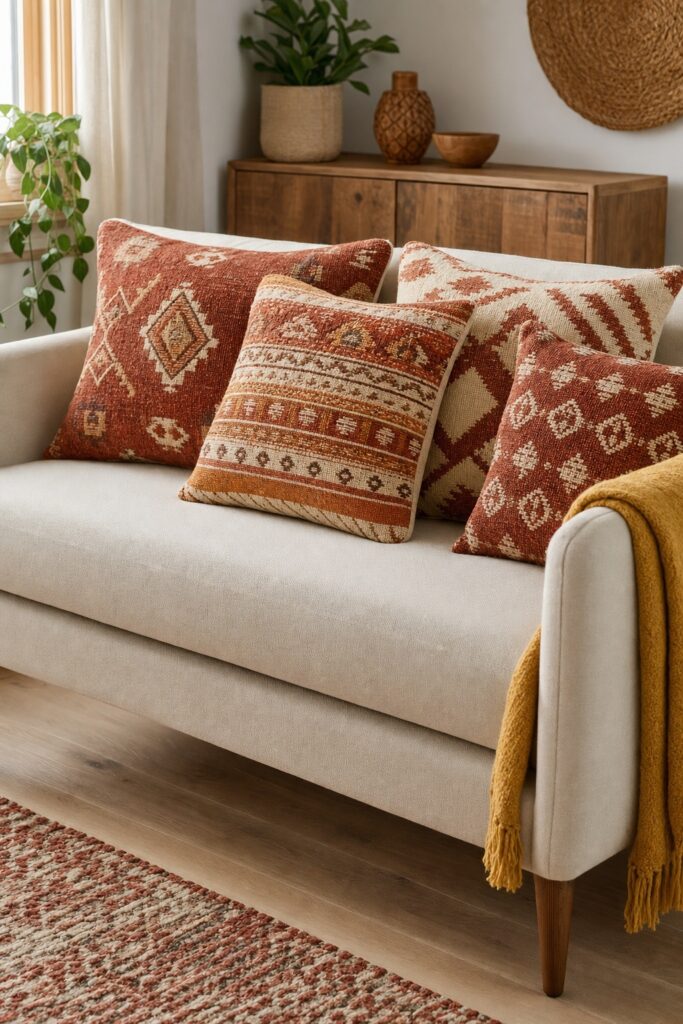
So: plain sofa, patterned everything-on-the-sofa. A flat cream, oatmeal, warm grey, or deep olive body carries rust and terracotta cushions without arguing with them.
For the fabric itself, there is a real number worth knowing. The Association for Contract Textiles rates woven upholstery for high-traffic use at 30,000 double rubs on the Wyzenbeek test (ASTM D4157), or 40,000 cycles on the Martindale test (ASTM D4966). Anything at or above that mark is built for hotel-lobby traffic and will shrug off your living room. Useful caveat from the same guidelines: "Abrasion test results exceeding ACT Performance Guidelines are not an indicator of product lifespan." A fabric advertised at 100,000 double rubs is not three times better than one at 30,000 — past the guideline, the number stops meaning much. Hit the mark and stop paying for it.
One more thing the sofa has to do: stand on legs you can see under. A visible strip of floor beneath the sofa keeps a heavy piece from swallowing a small room. A skirted sofa that meets the floor reads twice as bulky in a rental living room, and boho already brings plenty of visual weight.
The rug: jute looks the most boho and survives the least
Jute is the most photographed boho rug fiber and the worst choice for the middle of a living room. This is the section most boho guides will not write, because jute photographs so well.
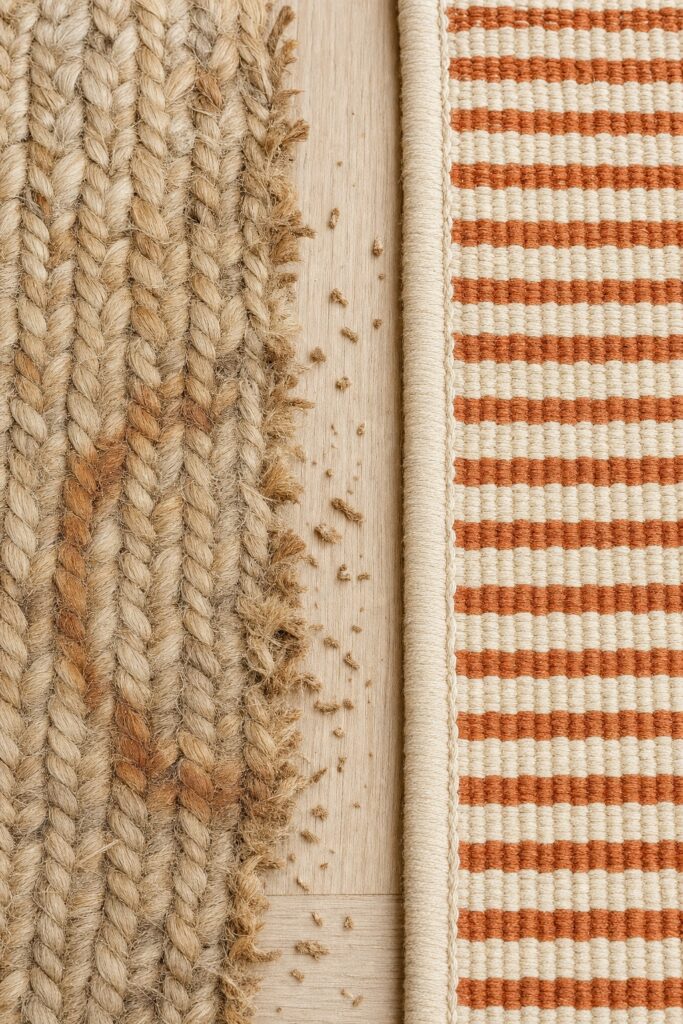
Here is what the professional rug-cleaning trade says about it. Cleanfax, the trade publication for cleaning contractors, is blunt: "Jute will turn brown when it's wet. It releases oils that brown the fibers." On durability: "the fibers easily break and split when under normal use." And on whether it is worth rescuing after a spill: "Most jute rugs end up becoming 'disposable rugs' if they are in heavy-use locations," and "Some rugs are worth saving. Jute rugs generally aren't."
Translate that into a living room. Your rug is the single highest-contact surface you own. It gets a dropped coffee at some point — that is not pessimism, that is arithmetic. A jute rug meets that coffee by absorbing it, browning around the edges, and being uncleanable, because the wet cleaning that would fix it is exactly the thing that ruins it.
What to do instead, without losing the look:
- Buy the flatweave. A tight cotton or wool flatweave in cream and rust gives you the same warm, worn, woven look and can be cleaned properly. Many cotton flatweaves go in a machine.
- Buy wool if you can stretch. Wool takes traffic better than any natural fiber here, hides crumbs, and cleans professionally — but budget for professional cleaning every year or so rather than shampooing it yourself.
- Keep the jute, move it. If you love the texture, put jute where feet do not turn and drinks do not travel: under a plant stand, beside a bookcase, in a bedroom, as the bottom layer of a layered pair with a washable rug on top where the seating is.
That last one is the honest compromise. You get the jute texture in the photo and the washable fiber under the actual coffee cup.
Throws and pillow covers are the layer to buy washable
One buying test: if it does not come off, it cannot be washed. Every cushion in a living room should be a plain insert inside a removable cover with a zip or an envelope back. Sewn-shut decorative pillows are a one-spill object.
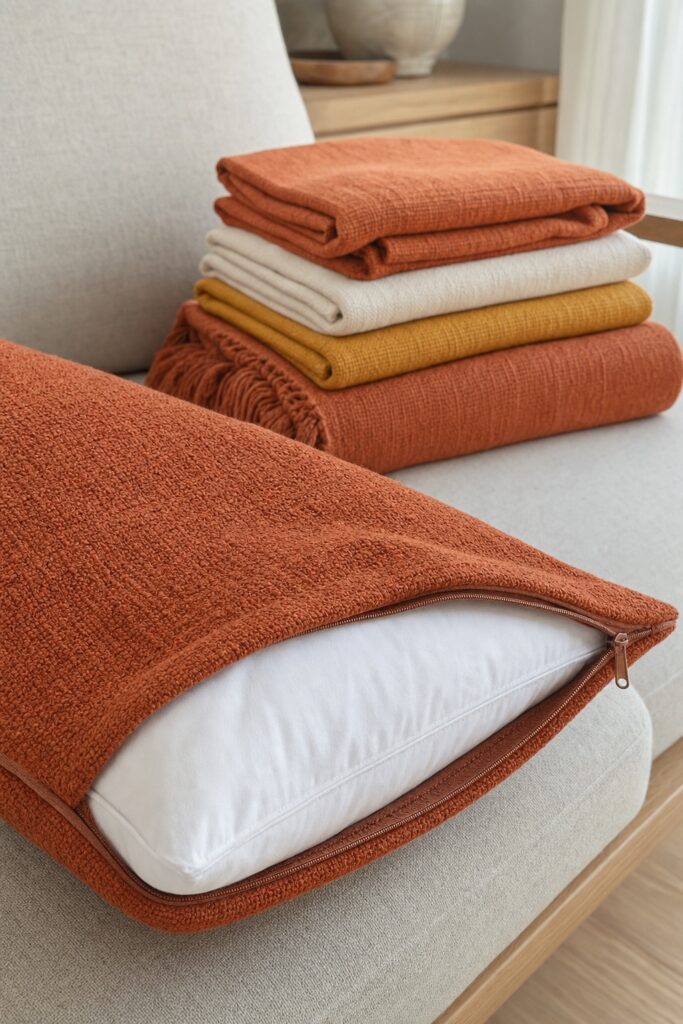
This is also the cheapest lever you own. Covers are the boho layer that changes the whole room for the least money, and because they are washable you can buy the pale cream one you actually want instead of the safe brown one.
A practical set for a three-seat sofa: four to six cushions, two of them a large square around 22 inches for leaning, the rest smaller and more patterned. Buy inserts one size larger than the cover — a 22-inch insert in a 20-inch cover gives you the full, hand-plumped look rather than a flat, sad corner.
Throws follow the same rule. Cotton and cotton blends wash and keep washing. A chunky wool throw belongs on the back of the sofa or over a chair arm, not as the thing that gets pulled onto a lap every night.
The no-contact wall gets the delicate, the handmade and the thrifted
Above roughly head height, nothing is at risk, so nothing has to be practical. This is where boho gets to be as fragile and as handmade as you like: macramé, woven flat baskets, a hanging with a two-foot fringe, dried pampas, a chipped thrifted plate.

Two placement rules keep it looking deliberate rather than scattered.
Leave a clear band of empty wall between the top of the sofa and the bottom of the arrangement. Six to ten inches of nothing does the work here. It separates the seating from the wall display, and it stops the fringe brushing anybody's head.
Group in odd numbers with uneven spacing. Three baskets in a loose vertical drift reads as collected. Four evenly spaced baskets reads as a product display.
If you rent and cannot drill, this tier is exactly where no-hole hanging methods are most likely to hold, because everything here is light. Our guide to decorating with adhesive hooks covers what each weight class can and cannot carry.
Mix patterns by repeating the color and changing the texture
Boho pattern mixing is not "no rules." The rule is: colors repeat, everything else varies. That single constraint is the whole difference between an eclectic room and a jumble sale, and almost no style guide says it out loud because "there are no rules" sounds more romantic.
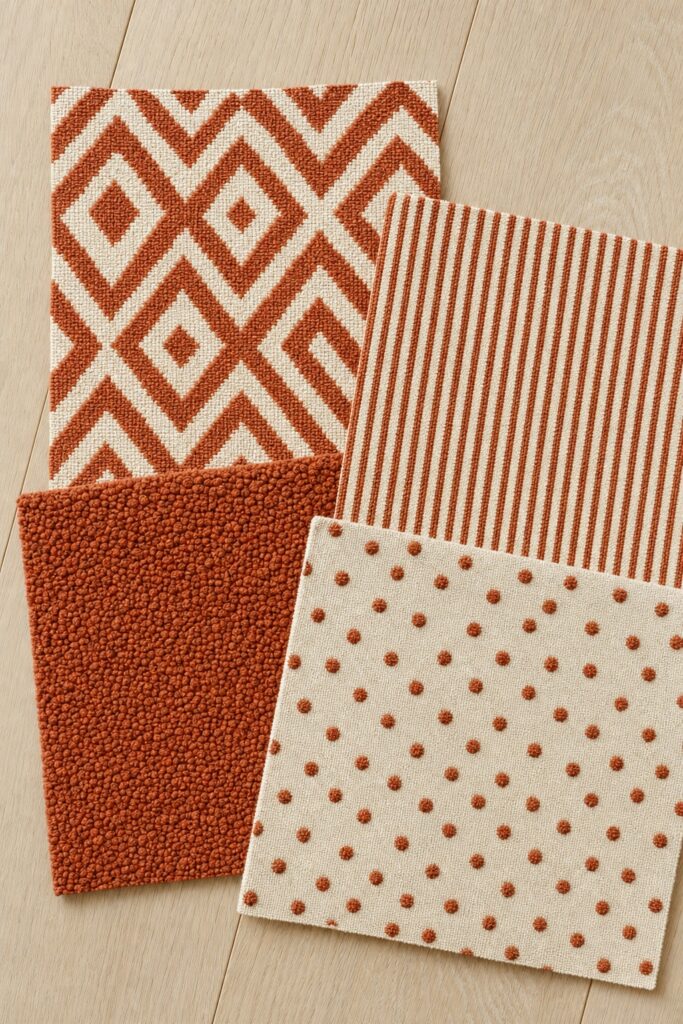
Pick two colors — say rust and cream — and make every patterned thing in the room use them. Then push everything else apart on purpose:
- Vary the scale. One large bold geometric, one fine stripe, one small scattered motif. If two patterns are the same size, they fight.
- Vary the texture. A flat woven, a chunky loop pile, a smooth cotton. Texture is what makes a two-color room feel rich instead of matchy.
- Include one plain. At least one large object in the color family with no pattern at all — usually the sofa. It gives the eye somewhere to rest.
You can add a third color, but make it the accent that appears three times and no more: on one cushion, one pot, one small piece of art. Three placements make it look chosen. Seven make it look like it happened.
Floor cushions: who actually sits on them
Buy floor cushions only if the people in your house already sit on the floor. They are the most-photographed boho object and the least-used one, and an unused floor cushion is a large soft obstacle you move to vacuum.
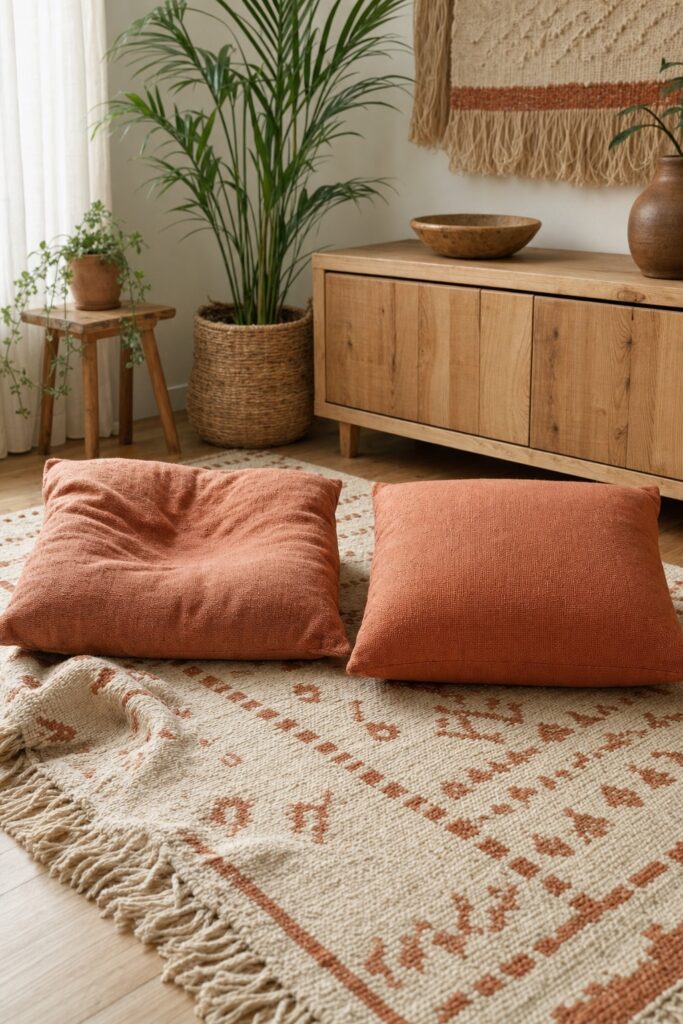
The honest test is a weekend: put a folded blanket where the cushion would go. If somebody sits on it twice, buy the cushion. If it stays untouched, you wanted the photo, not the seat.
When floor cushions genuinely do work, it is usually one of three situations: you have kids who already sprawl, you host more people than you have seats, or your living room is small enough that a fifth chair would block the walkway but a cushion that slides under the coffee table would not.
If you buy them, buy them high-contact: removable washable cover, dense fill that recovers, and a size around 24 to 26 inches square so an adult can actually sit rather than perch. Two is the useful number. Four is storage furniture.
Plants ranked by the light a living room really has
Match the plant to the light at the spot you want it, not to the room's brightest window. Indoor light falls off steeply, and a plant six feet back from a window is in a completely different world from one on the sill.

The University of Arkansas Cooperative Extension's indoor plant guide gives the ranges in foot-candles: low light is a minimum of 25 foot-candles with 75 to 200 preferred; medium light is a minimum of 75 to 100 with 200 to 500 preferred; high light is a minimum of 200 with 500 to 1,000 preferred. A free light-meter app on your phone gets you close enough to sort a room.
Practically, that means:
- On or beside the window: the fussy trailing things — string of hearts, most ferns, a fiddle leaf fig if you insist. Highest contact with light, highest maintenance.
- A few feet back: pothos in a hanging basket, philodendron, a rubber plant. Forgiving, and the trailing shapes are what make a room read boho.
- The dim corner: snake plant, ZZ plant, cast-iron plant. Stiff, upright, architectural, and they will outlive the lease.
Then apply the contact rule to the pots. Anything at floor level in the walking zone should be a pot you can knock without a disaster — terracotta, thick stoneware, or a basket over a plastic nursery pot. Save the delicate glazed piece for the shelf nobody brushes past.
The TV is boho's one unsolvable object
You cannot make a black rectangle boho, so stop trying to hide it and break up its outline instead. Cabinet doors that close over a TV, a motorized art frame, a curtain across the screen — these all cost real money to make one object slightly less visible, and you still watch it every night.

The approach that actually works: surround the screen so its hard edges stop being the only straight lines on the wall.
- Mount it off-center and low, at seated eye level rather than high above a mantel. High mounting makes the screen the room's monument.
- Cluster irregular shapes around it — flat woven baskets, two plain wooden frames, a trailing plant on a small shelf. The eye stops reading "screen on wall" and starts reading "wall of things, one of which is dark."
- Put something soft directly beneath it. A wooden console with a draped throw and a stoneware bowl breaks the line between the black rectangle and the wall.
What not to do: paint the wall behind the TV a dark color to "blend" it. In a rental it costs you paint and a deposit conversation, and in a boho room a large dark wall fights the warm neutral base the whole style depends on.
The thrift map: what is cheap in each contact tier
Buy secondhand in the no-contact tier and new in the high-contact tier. Thrifting is genuinely central to boho — the style is built on collected, mismatched, well-travelled objects — but the contact rule tells you exactly where secondhand is a bargain and where it is a false economy.
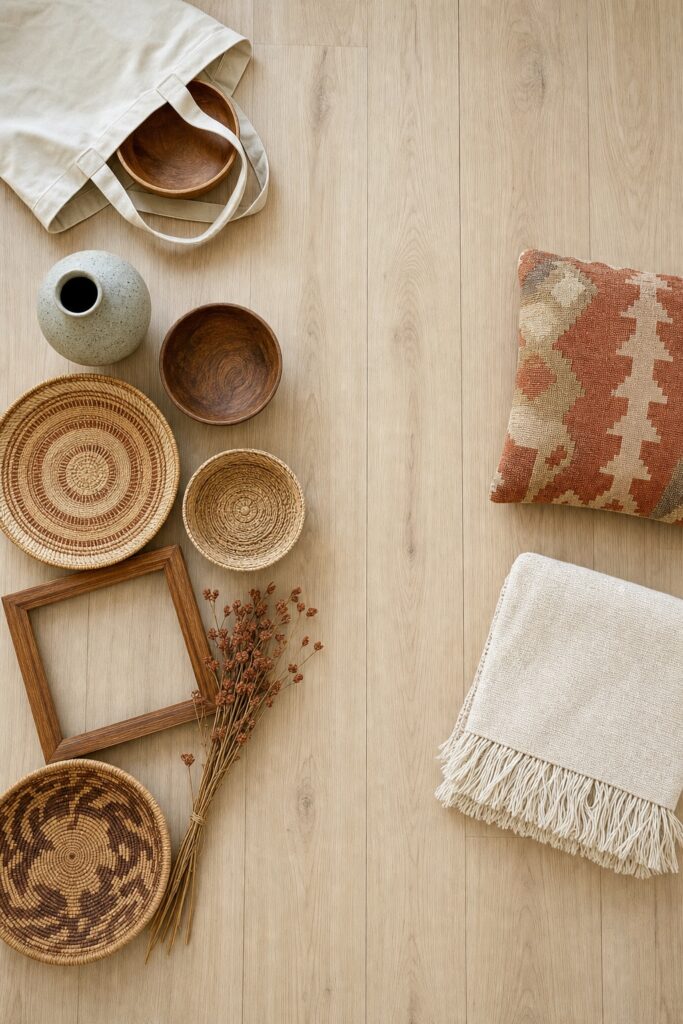
Worth buying used, almost always: wooden bowls, stoneware and ceramic vases, flat woven wall baskets, brass trays, wooden picture frames, mirrors, dried stems, small side tables, and anything made of solid wood. These live in the no-contact and light-hand-contact tiers, they are hard to damage, and they cost a fraction of new.
Worth buying used with a hard look first: rugs and baskets you will actually handle. Check a used rug's backing for stiffness and its pile for matted patches, and check that the price plus a professional cleaning is still cheaper than a new one. Often it is; sometimes it is not.
Buy new: cushion inserts, anything upholstered you will sit on, and floor cushions. Foam and fiber fill collapse with use, you cannot see how much life is left, and the covers are the part that gives you the look anyway. Buy the four-dollar thrifted cover and the new insert.
The other thrift advantage is time. Boho reads best when the objects clearly did not all arrive on the same Tuesday, and a collection built over six months of Saturday browsing looks like a collection. One cart checkout looks like a set.
What makes a boho living room read as mess
The failure is almost never too much color. It is too little empty space. Boho tolerates enormous amounts of pattern and texture, but it needs breathing room between groups of objects, and that is the first thing to disappear when a room is going well and you keep adding.
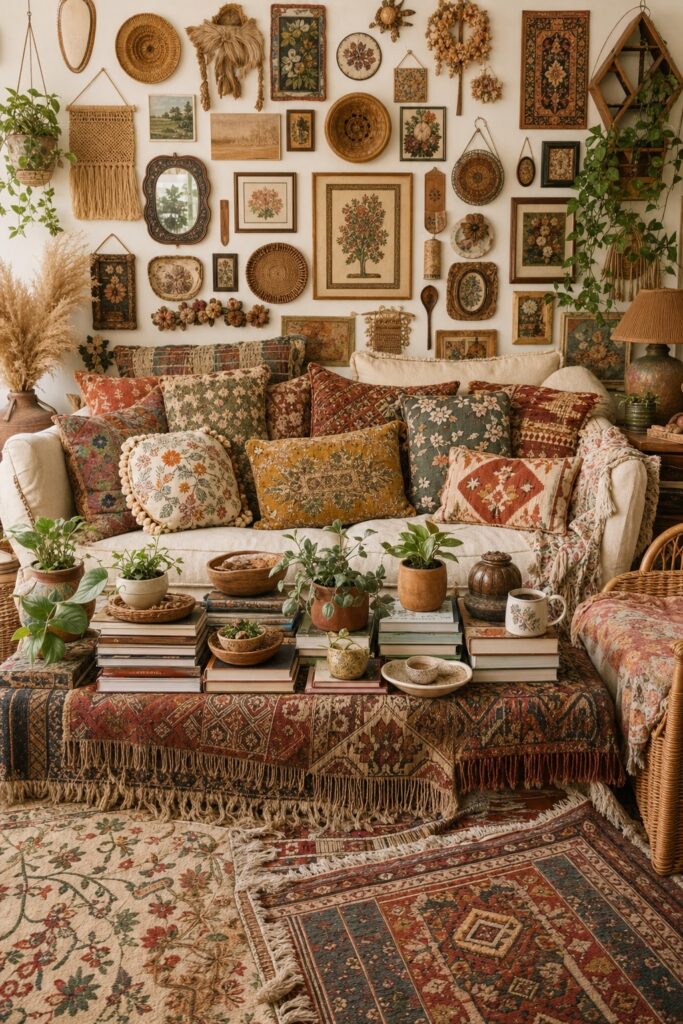
The specific signs, in the order they usually show up:
- The coffee table has no visible surface left. If there is nowhere flat to set a mug down, the table has stopped being furniture. Clear it to three objects at different heights and put the rest away.
- Cushions outnumber sitting spaces. More than six on a three-seat sofa and guests move cushions before they can sit. That is the moment decor became an obstacle.
- Every wall has something on it. At least one wall in the room should be empty, or nearly so. Empty wall is what makes the decorated walls read as decorated.
- Three rugs overlap with curling edges. Layering works with two, where the top one is flat, anchored by furniture, and the edges lie down. Beyond that it is a trip hazard with a nice pattern.
- Nothing is the biggest thing. A room needs one dominant object — the sofa, a large piece of art, a tall plant. When twelve things are all medium, the eye never lands.
The cure is subtraction, done in one pass: take everything off the surfaces, put back only what you would buy again today, and live with the empty spots for a week before you fill any of them. In most rooms, nothing gets added back.
FAQ
What actually makes a living room "boho" rather than just eclectic?
A narrow, warm color range plus a wide range of textures. Boho looks freeform but nearly every good example holds to a tight palette — warm neutrals with one or two saturated earth accents — while varying material constantly: woven, wooden, ceramic, fringed, plant. Eclectic rooms vary the color too; boho rooms mostly do not.
Can a small living room handle boho, or is it too much?
It can, with two adjustments. Keep the palette to two colors plus one accent rather than four or five, and keep furniture on visible legs so the floor reads continuous. The layering that makes boho work is mostly textiles and wall objects, and neither takes floor space. For more on the layout side, see our guide to small living room ideas.
What is the cheapest change that makes the biggest difference?
Cushion covers, by a wide margin. Four covers in a coordinated palette change the largest object in the room for the price of one small piece of furniture, and because they are washable they are a low-risk purchase. The second cheapest is subtraction, which is free.
Do I need a jute rug for the room to look boho?
No. The look people associate with jute is texture and a warm natural tone, and a cotton or wool flatweave in the same tone gives you both without the cleaning problem. Save jute for a low-traffic spot if you want the specific chunky braid.
How is a boho living room different from a boho bedroom?
Contact. A bedroom's boho layers are mostly touched by one or two people, gently, at the end of the day, so delicate and dry-clean-only things survive there. A living room's layers take guests, food, pets, and daily traffic. Our boho bedroom guide builds the look in layers; this one sorts it by wear.
How many plants is the right number?
Three to five real ones in a standard living room, placed at genuinely different heights — floor, table, and hanging or shelf. Height variation does more for the boho look than quantity, and five plants you keep alive beat twelve you replace.


