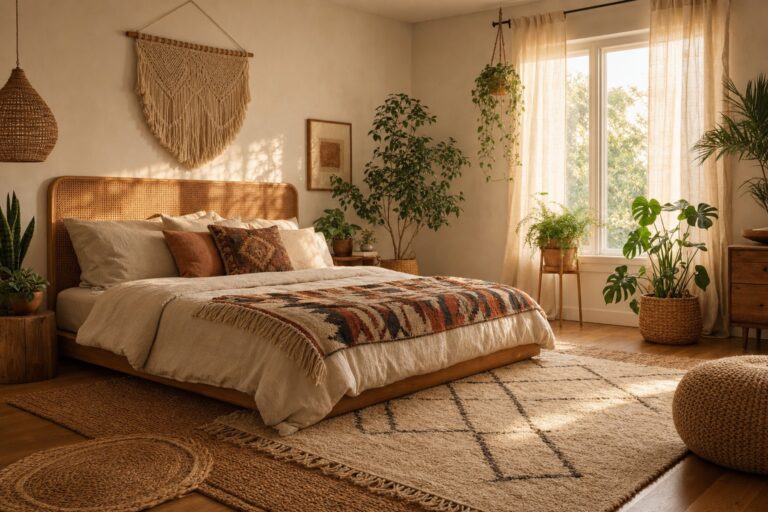
Boho Bedroom Decor: The Five-Layer Recipe That Never Tips Into Clutter

Boho bedroom decor has a reputation problem it doesn't deserve: attempt it without a plan and you land in one of two ditches — a beige room that's technically neutral and emotionally vacant, or a pileup of macrame and baskets that reads like a flea market closed on top of your bed.
The style itself isn't the problem. The missing piece is order.
Because boho is not a shopping list — it's a texture recipe, and it builds in layers: a warm neutral base, a stack of natural textures, one controlled pattern family, plants with real presence, and warm low light. Build them in that order and you can stop at any layer with a room that works. This article walks all five, then handles the headboard focal point, the airy-versus-maximal fork, the small-room version, and where the whole look gets cheap.
Jump to a section
- The boho formula: five layers
- Layer 1: the warm neutral base
- Layer 2: the texture stack
- Layer 3: patterns without chaos
- Layer 4: plants with presence
- Layer 5: warm, low light
- The headboard moment
- Airy boho or maximal boho
- Boho in a small bedroom
- The thrift map: where texture is cheap
- What breaks the look
- FAQ
The boho formula: five layers

Base, texture, pattern, plants, light — in that order, each layer sitting on the ones before it. The order matters because every boho failure is a layer skipped or jumped: pattern bought before the neutral base exists (chaos), plants added to a room with no texture (sad office), string lights strung over a flat unlayered bed (dorm).
The recipe also explains why boho suits real budgets: layers two through five are the cheapest materials in decor — jute, secondhand rattan, cuttings from a friend's pothos, warm bulbs. The expensive-looking version of this style is mostly patience, which is very on-brand for a look whose whole point is "collected over time."
Layer 1: the warm neutral base

Start with a room that would be boring on purpose: warm white walls, a low bed in plain linen, a flat jute rug, wood furniture — and resist decorating it yet. The base layer's job is warmth without incident. Warm white, not gallery white; oatmeal, not gray. Boho's coziness dies fastest on a cool-toned base, because every texture you add afterward reads against it like furniture in a dentist's office.
The bed goes low if you have the choice — platform frames and low profiles are the style's silhouette, and they make ordinary ceilings feel taller. This layer is also where the spending should happen, since it's the layer you replace least: decent linen-look bedding and a real jute rug outlast every trend the upper layers will cycle through.
Layer 2: the texture stack
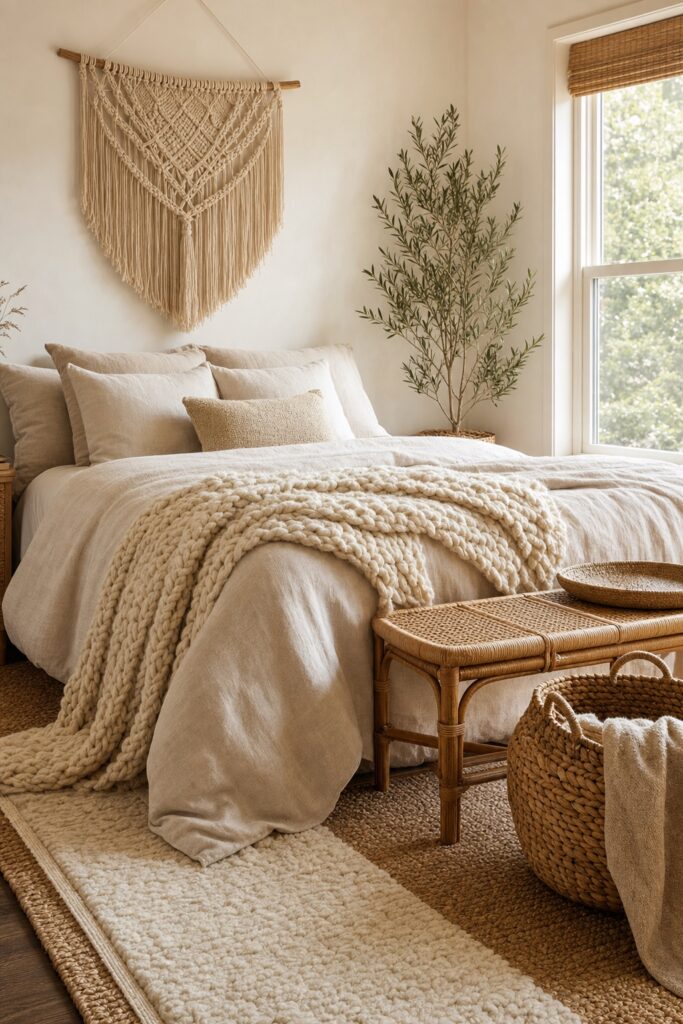
Texture is boho's color: where other styles add hues, this one adds weaves — and the room starts working when at least three natural textures share the frame. Chunky knit against smooth linen, macrame against flat paint, rattan against wood grain, wool rug over jute. Each texture catches light differently, which is why a boho room in a single beige palette still reads rich while a flat beige room reads unfinished.
The stack has a discipline: every texture earns its place by contrast with a neighbor. A macrame piece above a smooth headboard wall works; macrame next to three other fiber pieces on the same wall is a craft fair. If a new texture repeats one already touching it, it goes elsewhere or it goes back. That single rule is most of the difference between layered and cluttered.
Layer 3: patterns without chaos
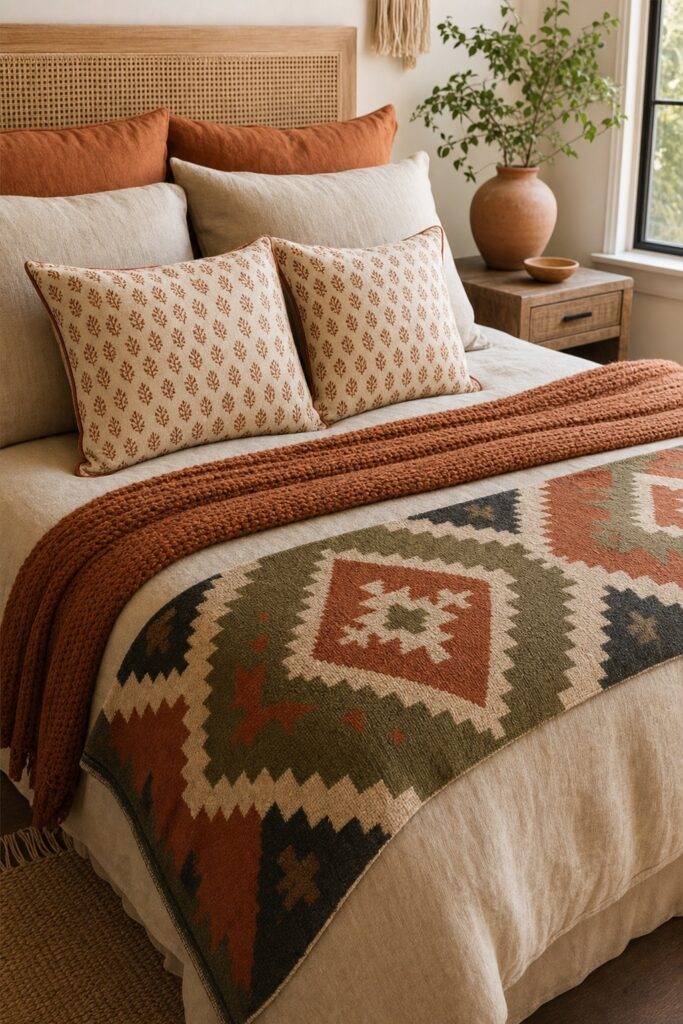
Cap it at two patterns: one large-scale (a kilim-style blanket, a bold rug), one small-scale (block-print pillows), and let every other piece be a textural solid. Pattern is where boho rooms most often tip over, because global patterns are the style's signature and the temptation is to collect all of them at once. The bed above holds the whole rule: one loud thing, one quiet print, everything else texture.
Keep the two patterns in the same color family as the room — terracotta, olive, charcoal on warm neutrals — and they'll read as related even from different continents' traditions, which is the collected effect you're actually after. When a third pattern shows up begging (it will; it's always a pillow), rotate: something patterned leaves before it enters. Seasonal rotation is free decorating, and boho absorbs it better than any other style.
Layer 4: plants with presence

One tall, one trailing, a few small — grouped, not scattered. Plants are boho's pulse; a single lonely pothos on a nightstand isn't a layer, it's an apology. Presence comes from height variation (a floor plant reaching up, a trailing plant spilling down, small pots in a cluster) and from grouping near the light, where they'd naturally crowd.
Match the plant to the room's reality, not the fantasy: a bright bedroom can host nearly anything, while darker rooms should lean on the famously tolerant trio — pothos, snake plant, ZZ plant — which are known for surviving low light and forgetful watering. Terracotta and woven-basket pots do double duty as another texture layer. And if a corner truly gets no light, a good dried arrangement — pampas, eucalyptus, branches — is a legitimate boho move, not a defeat.
Layer 5: warm, low light

The finished feeling arrives with the last layer: two or three warm light sources at different heights, and the overhead switch left alone after dark. A rattan or woven pendant throws patterned shadows that animate every texture below it; a floor lantern with a warm bulb pools light low; a short string of fairy lights along a shelf adds the glint. The room above contains nothing expensive — the light is doing the atmosphere.
Warm is non-negotiable here: cool-white bulbs flatten every fiber and undo layers two through four in one flip. Look for "warm white" on the bulb label, dimmable where possible. All of it plugs in, which means the entire lighting layer survives a move — worth knowing for a style this portable.
The headboard moment

Give the style one place to concentrate — the wall behind the bed — and the rest of the room earns the right to stay calm. An arched cane or rattan headboard is the strongest single boho purchase there is: it delivers texture, silhouette, and focal point in one object. Above it, one lightweight woven piece, centered. Done.
No headboard budget? A large macrame or woven hanging alone creates the moment on a plain wall, and a draped textile — hung from a simple rod or, in a no-holes situation, adhesive hooks rated for its weight — gives the arch-and-drape effect without furniture at all. The discipline stays the same either way: one statement at the head of the bed, not three competing ones.
Airy boho or maximal boho

The five layers have two honest destinations — airy (fewer objects, pale palette, one statement texture, generous space) and maximal (deeper colors, denser layering, more pattern rotation) — and choosing one on purpose beats drifting between them. The room above is the airy fork: linen, one pendant, one macrame, a mirror, air. Its opposite keeps the same recipe but doubles the texture stack, warms the palette toward rust and ochre, and lets the plant collection actually collect.
The choice is temperament, not correctness. Airy suits light sleepers, small rooms, and anyone who found the beige ditch comfortable but wants it alive. Maximal suits collectors and rooms with light to spare. The only wrong version is the drift — maximal shopping habits inside an airy intention is precisely how the clutter ditch gets dug.
Boho in a small bedroom

Small rooms don't disqualify the style; they just move it toward the airy fork with three scale rules: keep the bed low, hang one anchor instead of many, and let the plants share a single group. A low bed keeps wall space visible above it (small rooms live and die on visible wall), one macrame or headboard anchor concentrates the style without eating the room, and a windowsill plant cluster delivers the green pulse in a square foot.
Texture still does the heavy lifting — a small room takes the full knit-linen-jute stack without losing an inch of floor. What it can't absorb is the maximal fork's object count, so rotation becomes the strategy: own the collection, display a third of it. For the general small-bedroom toolkit underneath these rules — mirrors, curtain height, sightlines — our small bedroom guide carries the load.
The thrift map: where texture is cheap

Almost every raw material in this article is a thrift-store staple: baskets, rattan trays, wooden bowls and candlesticks, picture frames, and — the real finds — vintage textiles. The style's aesthetic is literally "collected and worn," which means patina isn't a defect at the thrift store; it's the point. The dresser above is one ordinary secondhand run, styled.
Hunt in this order: baskets first (always plentiful, instantly useful as plant pots and storage), wood objects second (candlesticks, bowls, frames — a shelf's whole styling for pocket change), textiles third with patience (kilim-style runners and woven blankets surface irregularly, but one real find outperforms a cart of new lookalikes). Buy natural materials only — wood, cane, fiber, ceramic — and the haul can't miss the palette. More damage-free and budget layering ideas live in our small apartment guide.
What breaks the look

Four things reliably kill a boho bedroom, and all four are avoidable on any budget:
- The matching set. A coordinated boho-collection-in-a-box reads as a costume. Mixed eras and one imperfect piece — like the corner above — read as a life.
- Shiny fake plants. Plastic gloss undoes the natural-materials argument instantly. Real, dried, or none.
- Beige-on-beige flatness. Neutral without texture contrast is the vacant ditch. If the room feels dead, the fix is almost never color — it's a rougher weave next to a smoother one.
- No air. Every layered object needs empty space beside it to register as chosen. When nothing has room, nothing reads.
Notice none of these are about money. The style's failure modes are all editing errors, which is the best news in this article: the fix is subtraction, and subtraction is free.
FAQ
What makes a bedroom "boho"?
Layered natural textures (rattan, macrame, linen, jute, chunky knits), plants with real presence, warm low lighting, and a collected-over-time mix rather than matching sets — all sitting on a warm neutral base. It's a texture recipe more than a color scheme.
How do I do boho without it looking cluttered?
Follow the layer order and the two editing rules: no texture repeats its touching neighbor, and no more than two patterns in the room (one large-scale, one small-scale). Then give every object breathing room — if nothing can be removed, something must be.
What's the difference between boho and coastal or cottage styles?
They share the relaxed-natural family but differ in materials and mood: coastal leans pale blues, white wood, and airy restraint; cottage leans florals, painted furniture, and sentiment. Boho is the texture-forward, global-pattern, plant-heavy member — warmer than coastal, earthier than cottage.
What are the best plants for a darker boho bedroom?
Pothos, snake plant, and ZZ plant are the famously low-light-tolerant trio, and all three happen to look right in the style — trailing, sculptural, and glossy-leafed respectively. In a truly lightless corner, use dried stems (pampas, eucalyptus) instead of fake plants.
Can I do a boho bedroom on a tiny budget?
More easily than almost any other style. The base layer (bedding, jute rug) is the only real spend; textures and vessels are thrift-store staples, plants propagate from cuttings, and warm bulbs cost pocket change. Build one layer at a time — the recipe works mid-build, which is the point of the order.