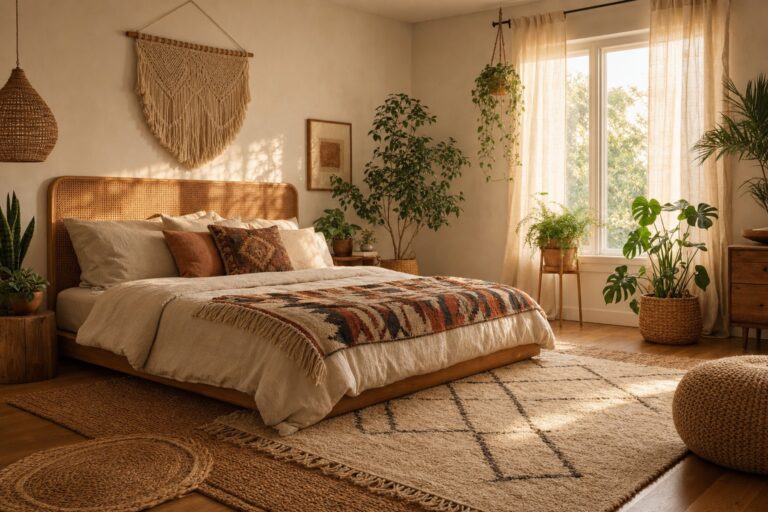
13 Small Bedroom Ideas That Feel Bigger and Cozier (Renter-Friendly)

Most small-bedroom advice quietly asks you to give up the good part. Paint it white, own less, keep the walls bare — and you end up with a room that photographs "bigger" and feels like nobody lives there.
You don't have to choose. The two goals run on different tracks. A room feels bigger because of what your eyes travel across: open floor, clear walls, light bouncing around. It feels cozy because of what your body meets: warm low light, soft layers, one corner that's clearly yours. Most of the ideas below are no-drill; anti-tip hardware for furniture and some mirrors is the safety exception worth making, even in a rental.
The short version: put the bed where it frees the most floor, get everything else up off the ground, use the walls to bounce light instead of store stuff, then concentrate all the warmth into lighting and textiles. Bigger is for the eyes; cozy is for the body.
Here are the ideas, in the order the decisions actually happen.
Jump to a section
Start with the bed — it's the biggest thing you own
Whatever else you change, the bed decides how the room feels. Move it first, while it's empty of consequences; every other idea gets easier or harder depending on where it lands.
1. Put the bed in the corner and create one useful walkway
Centering a bed splits the remaining floor into two side paths. Pushed into a corner, the same bed consolidates that space into one wider strip that may work better for a dresser, a narrow desk, or simply getting dressed without shuffling sideways. It does not create more square footage; it makes the open floor easier to use.
The trade-off is honest: the person on the wall side climbs over. If you share the bed, keep both long sides walkable and steal space at the foot instead — even a narrow path is better than a nightly climb.

2. Or place it under the window when access stays safe
A bed under the window can free the solid walls for a dresser or mirror. It works only when the window still opens safely and the layout does not block an emergency exit, a heater, a vent, curtains, or access you actually need. When those conditions are met, the window can become a built-in frame for the bed instead of a problem.

3. Do the full-versus-queen math before you upsize
A typical US queen is about 60 by 80 inches; a full or double is about 53–54 by 75. Exact mattresses and frames vary, so measure the model you own or plan to buy. In a 10-foot-wide room, the mattress alone leaves 60 inches total beside a queen versus about 66–67 beside a full, before subtracting the frame, trim, furniture, and real clearances. That 6–7 inches can rescue a tight door, drawer, or walkway.
For couples, the honest version: a full is snug for two adults, and only you know your sleep style. But if the queen makes the room difficult to use, the smaller bed may be the better trade. Measure the exact frame and the route around it before deciding.
Clear the floor next — this is where "bigger" comes from
Your eye reads the room by the floor it can see. Every square foot you uncover pays rent.
4. Choose furniture with legs you can see under
A dresser on 6-inch legs and a chair with an open base let the floor run visually wall to wall. Skirted, boxy, floor-hugging pieces chop the room into blocks. You don't need new furniture to use this — when you're choosing which existing pieces stay in the bedroom, promote the leggy ones and exile the slabs.
Legs do not make a dresser tip-safe. The US Consumer Product Safety Commission advises anchoring dressers and other storage furniture with drawers, doors, or shelves according to the manufacturer's instructions — including newer units that meet current stability rules.
5. Make the under-bed zone invisible storage
The space under the bed is the biggest closet you're not using — but only if it disappears. Open piles under a frame read as clutter and undo the leggy-furniture win. Measure the clearance under your frame first, buy low bins that actually fit (heights are on the label), and close the view with a bed skirt or a duvet that drops low. Off-season clothes and spare bedding go there; things you grab daily don't, or the system dies in a week.

6. Give one piece two jobs
A dresser at bed height can replace a separate nightstand. A narrow desk can do the same. A storage bench at the foot of the bed can hold shoes, support a suitcase, and provide a place to sit. Every double-duty piece is one whole object you do not need to add — and in a small room, the furniture you don't have is the most spacious-looking furniture of all.
For a teen whose bedroom also needs a homework spot and seating for friends, our small bedroom ideas for teens show how to plan those jobs around the bed.

7. Borrow storage from the door and the closet rod
The back of the door can hold shoes, bags, or accessories with zero floor cost. Low-profile over-door hooks may work, but check that the door closes freely and that the hardware does not mark the door or trim. Inside the closet, a hanging shelf organizer or a second tension rod can reduce the need for another dresser. The goal is blunt: fewer boxes standing on the floor.
Walls and light: borrow space you don't have
Most ideas in this section avoid permanent changes. Safety instructions still come first, and no product can guarantee that a particular paint finish will remain unmarked.
8. Place a stable full-length mirror where it catches the window
A large mirror opposite or beside a window can bounce daylight farther into the room and extend the view. A purpose-built freestanding mirror can do that without wall mounting.
Follow the mirror manufacturer's installation instructions. If a leanable floor mirror includes a tip restraint, install it. If your lease will not allow that, choose a purpose-built freestanding mirror with an integrated stable stand, or a smaller dresser-top mirror, instead of simply propping a mirror against the wall.

9. Hang art tall with adhesive strips — and pull the eye up
Small rooms usually have normal-height ceilings; the trick is making the eye use them. One large vertical piece — or a slim column of two or three frames climbing toward the ceiling — reads as height.
Adhesive-strip ratings depend on the exact product and number of pairs, so weigh the finished frame and follow that package rather than assuming every “large” strip is equal. For example, 3M currently rates one pair of Command Large 17206 strips for 4 pounds and four pairs for up to 15 pounds on a frame no larger than 24 by 36 inches. Its instructions also say never to use them over beds or on wallpaper, to wait seven days after painting, clean with rubbing alcohol, and wait one hour before rehanging. “Removable” is not a promise about your particular paint, so test discreetly and never use adhesive mounting for valuable or irreplaceable art.

10. Get the curtains high and wide — or work the no-drill fallback
Curtains mounted near the ceiling and wider than the window frame make the window read larger and the wall taller. If your lease allows small holes, this is one place where drilling may earn its keep.
If it truly doesn't: a tension rod inside the window frame, or brackets that hook over the top of the window trim, both work without a hole. The trade-off is that you lose the high-and-wide effect — so spend your effort on curtain color and length instead: floor-length, in a warm light color, hung as full as the rod allows.

The cozy layer: warmth without clutter
Here's where the room stops being an optical exercise and starts being yours. Most of the changes below concentrate comfort at touch height instead of scattering more decor around the room.
11. Switch the light, not the fixture
A bulb around 2700K gives a warm-white, relaxed residential look and is one of the simplest mood changes a rental allows. Then add lamps at two heights — a bedside lamp plus one across the room — and keep them dim during your evening wind-down. Two lower pools of warm light can feel more intimate than one bright overhead.
12. Layer texture where your body lands — bed, rug, one throw
Cozy is texture you can reach, not objects you display. Put the budget into the bed you touch nightly: soft washed sheets, a duvet with some loft, and one throw blanket with a texture you enjoy. Add a rug sized so the bed lands on it and it shows on your walking sides — a tiny rug floating beside the bed makes the floor look chopped up, the opposite of idea 4. Then stop. Three textures at touch height beat ten trinkets at eye level.
Want a name for this look? The warm-japandi recipe works unusually well in small rooms: a low bed, one or two warm wood tones, linen in cream or oatmeal, one deep contrast (espresso, charcoal), and walls kept quiet except for that single tall piece from idea 9. It's cozy because it's spare — which is exactly the trade this whole room is making.

13. Build a compact reading corner
A nook is not an architectural feature; it's a boundary plus a light. A slim chair or a floor cushion in the corner the bed doesn't own, the edge of the rug as its border, and a small warm lamp on a narrow, stable table — that's the whole build. In a room this size, one deliberately "slow" corner does more for coziness than decor spread evenly around.

The weekend order
If you do this in one pass, do it in this order — each step makes the next one easier to judge:
- Move the bed (corner, window, or right-sized) and live with it for a night.
- Clear the floor: under-bed bins in, double-duty furniture decided, door and closet doing their share.
- Position the mirror where it catches daylight, then secure or stand it exactly as its manufacturer directs.
- Go vertical: tall art up with strips, curtains as high as your lease allows.
- Warm it up: 2700K bulbs, second lamp, textiles, and your one slow corner.
Renter's caveat box, before you start: read the lease section on holes, adhesives, and fixtures — and ask in writing when it is vague. Photograph the walls before anything goes up. Follow adhesive-package instructions for the exact surface, weight, pair count, application, and cure time. Anchor storage furniture and follow mirror anti-tip instructions even when that means requesting a safety exception from a no-hole rule. Keep every screw and bracket you remove in one labeled container for move-out day.
Small bedroom FAQs
How can I make a small bedroom look bigger without painting or drilling?
Start with the layout and floor: choose a bed position that leaves one useful walkway, keep floor visible beneath furniture with open legs, hide under-bed storage, and use a stable freestanding mirror to reflect window light. Most of these changes require no drilling, but furniture and mirror anti-tip instructions still take priority.
What is the best bed placement in a small bedroom for one person or a couple?
There is no single best layout. For one sleeper, a corner bed can consolidate the remaining floor into one more useful strip. For two people, access from both long sides may be more practical. A bed under the window can free solid walls, provided the window, doors, closet, vents, and heaters remain safe and usable.
Is a full bed better than a queen in a small bedroom?
A typical US full or double mattress is about 53–54 by 75 inches, while a queen is about 60 by 80 inches. In a 10-foot-wide room, the mattress alone leaves roughly 6–7 more inches of total side space with a full. Measure the exact mattress and frame, then balance walkway space against your sleeping needs.
How can I add storage without making a small bedroom feel cluttered?
Use a few concealed storage zones instead of many visible containers: fitted bins beneath the bed, an organizer behind the door, hanging closet storage, and one double-duty furniture piece. Keep frequently used items easy to reach so the system stays tidy. Anchor storage furniture according to its manufacturer's instructions.
What light color makes a small bedroom feel cozy?
A bulb around 2700K produces a warm-white residential appearance. Two lower lamps can create a softer evening atmosphere than relying only on a bright ceiling light. Dimming bright artificial light during your wind-down is sensible, but 2700K is a mood choice—not a sleep treatment.
Can renters use adhesive picture-hanging strips without damaging walls?
They may be suitable, but “removable” cannot guarantee that every paint finish will remain unmarked. Check your lease and follow the exact product's surface, weight, pair-count, application, and cure-time instructions. For example, 3M's current picture-strip instructions prohibit use over beds and on wallpaper; recheck those instructions before acting on this guidance.
Bigger for the eyes, cozy for the body. Small rooms are actually the easiest place to get both — there's less room for the mistakes to hide, but less room for the budget to spread thin, too.