
Whale Topiary: How to Grow a Green Whale From Five Small Boxwoods

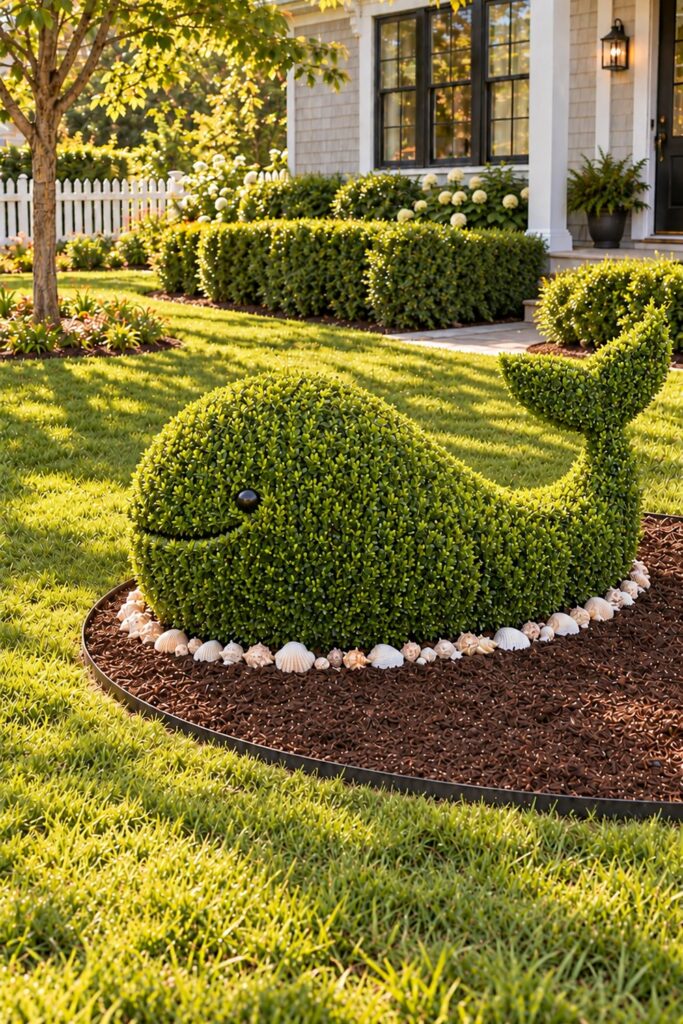
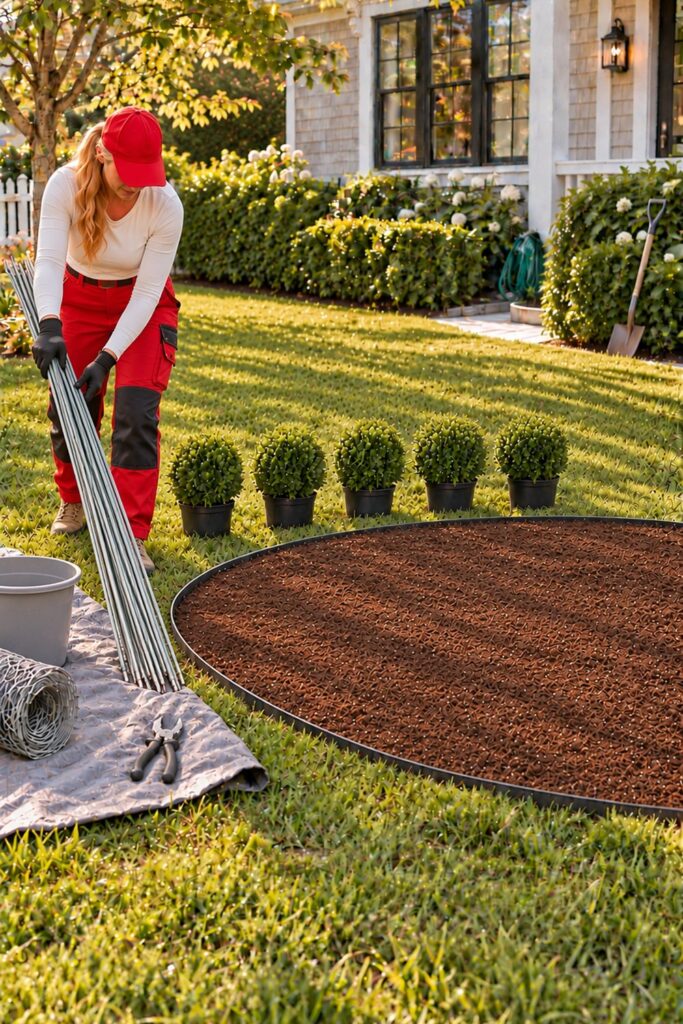
Picture a Saturday morning a few summers from now. A green whale smiles from the middle of your front lawn, its tail curling up toward the porch.
A neighbor walking a dog stops at the fence, and two kids on the sidewalk point at it. "How did you get a bush to do that?"
This guide contains Amazon affiliate links. As an Amazon Associate I earn from qualifying purchases, at no extra cost to you.
You grew it yourself, from five small boxwoods and a wire frame you bent at home. That's the whale topiary from our video. A wire whale, about 6 feet long, sits over a row of young shrubs. They grow up inside it, and you trim them to the wire. You can build the frame and plant in a weekend. The growing takes longer: plan on three summers or more. It costs about $230 to $300, and the shrubs are most of it.
When a topiary whale video goes around, the comments ask the same things. Where do you get the frame? Which bush is that? How many years does it really take? Every answer is below, with 8 steps and a picture for each, plus the five mistakes that make a topiary fail.
At a glance
- Time: a weekend to build and plant, then three summers or more to fill in
- Skill: beginner to intermediate. You bend wire, dig five holes and trim with shears.
- Cost: about $230 to $300, most of it for the shrubs
- Best time to build: now. Fall planting lets the roots settle in before winter. The shrubs grow from the first spring day, and your whale is one summer closer.
Jump to a section
- How the Whale Topiary Goes Together
- What You Need, and What It Costs
- Step 1: Bend the Arches Around a Bucket
- Step 2: Add the Spine and the Tail
- Step 3: Wrap the Frame in Netting
- Step 4: Plant Five Boxwoods in a Line
- Step 5: Set the Frame Over Them and Pin It
- Step 6: Water Deeply, Then Let It Grow
- Step 7: Trim Along the Wire
- Step 8: Add the Eye and the Shells
- The Mistakes That Make It Fail
- Keep It Smooth: Water, Trimming and Winter
- FAQ
If you buy one thing
Start with good hedge shears
A topiary is mostly trimming: a light pass every few weeks, and a real shaping each spring. Sharp, light shears with straight blades make clean cuts along the wire without tiring your hands.
How the Whale Topiary Goes Together

The video drops a ready-made frame over the shrubs. Big animal frames are hard to find and costly, so here you bend your own.
- Five arches of doubled wire make the body, from about 40 inches wide at the head down to 14 at the tail. A spine of three twisted strands ties their tops together, and a wire fluke curls up at the end.
- Netting with 2-inch holes covers the frame, open at the bottom. It's the line you trim to.
- Five boxwoods grow inside, about 14 inches apart, and U-shaped staples pin the frame to the ground.
Shrub topiaries take time. Iowa State University Extension says they can take 3 to 10 years to complete. Bigger starting plants get you there sooner.
What You Need, and What It Costs

- Boxwood shrubs, five in 2-gallon pots, all the same kind. Pick one that grows about 4 feet tall and wide.
- Galvanized steel wire, 9-gauge, about 100 feet, for the arches, spine and tail.
- Poultry netting with 2-inch holes, 3 feet wide and 25 feet long.
- Landscape staples, U-shaped, a pack of 25.
- Compost, two bags, for the planting holes.
- Hedge shears for the trimming.
- A flat black stone for the eye, plus white shells or pebbles for the edge.
- Tools: wire cutters, pliers, a round bucket, spade, hose, work gloves and safety glasses.
What it costs: about $230 to $300 in all, not counting tools. That's with prices we found at US stores on October 15, 2026. Five 2-gallon boxwoods are about $165 to $180. The wire, netting and staples are about $45 to $75, and the compost and shells about $20 to $40.
Two buying tips:
- Buy all five shrubs at once, from the same batch. Matching plants grow at the same speed, so the whale fills in evenly.
- Buy bigger plants if your budget allows. A larger shrub starts closer to the wire.
Step 1: Bend the Arches Around a Bucket

- Draw the five arches full size on cardboard: 40, 34, 28, 20 and 14 inches wide.
- Bend wire around a bucket to start each curve, then shape it to the drawing.
- Double each arch with a second strand, and twist the two together.
- Leave 6 inches straight at each end to push into the soil.
Watch out: wear gloves and safety glasses. Cut wire ends are sharp, and they spring back.
Step 2: Add the Spine and the Tail

- Stand the arches in a row on a tarp, biggest at the head end, about 14 inches apart.
- Twist three strands of wire into a spine, and lay it along the tops of the arches.
- Wire the spine to each arch with short pieces of wire, wrapped tight.
- Bend two loops for the tail fluke, and wire them to the end of the spine.
Watch out: check the shape from the side before you go on. A bend is easy to fix now and hard once the netting is on.
Step 3: Wrap the Frame in Netting
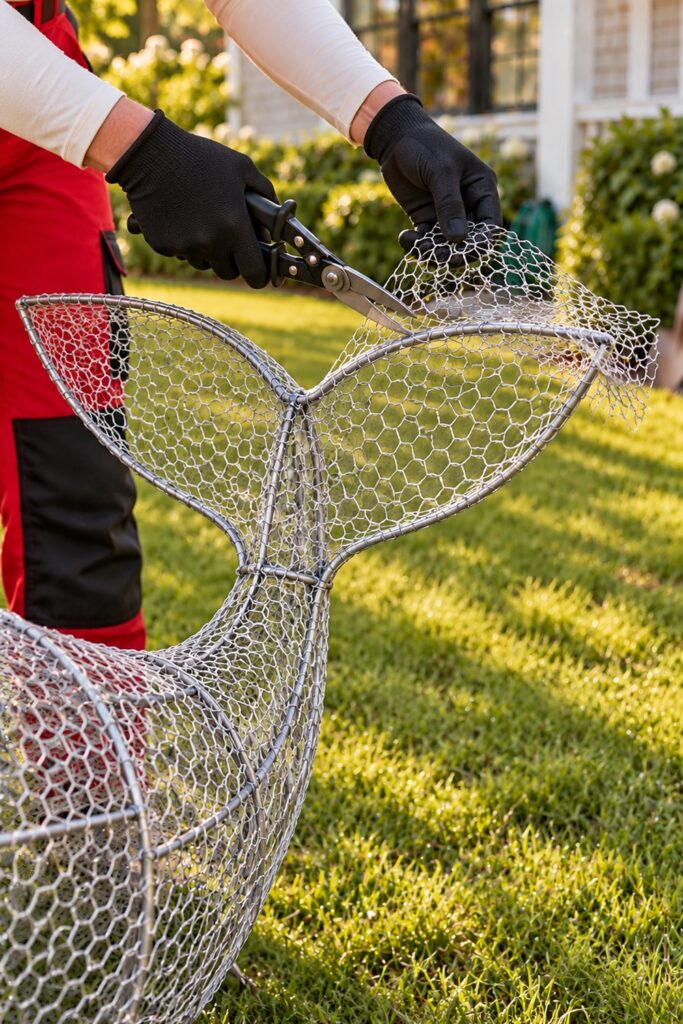
- Drape the netting over the frame, starting at the head.
- Fold and trim it to follow the curves, and twist the cut ends around the arches.
- Leave the bottom open.
Watch out: fold every sharp cut end inward, so it can't catch your hands or the hose later.
Step 4: Plant Five Boxwoods in a Line

- Dig five holes in a line, about 14 inches apart, each as deep as the pot and twice as wide.
- Mix compost into the dug soil.
- Set each shrub at the same depth it grew in its pot, the biggest one where the head will be, and backfill.
Watch out: call 811 a few days before you dig. 811 lists planting trees and shrubs among the jobs that need a call, at any depth.
Step 5: Set the Frame Over Them and Pin It

- Walk the frame over the shrubs, and line up the body with the row.
- Push the arch ends 6 inches into the soil.
- Pin the bottom edge with landscape staples about every foot.
Watch out: pin it well. A frame that rocks in the wind rubs the young stems.
Step 6: Water Deeply, Then Let It Grow

- Water each shrub slowly until the soil is soaked.
- Water once a week through the first summer whenever it doesn't rain.
- Spread mulch around the plants, but keep it off the stems.
Watch out: don't cut the shrubs back to the wire until they reach it. Every shoot you leave helps fill the whale.
Step 7: Trim Along the Wire
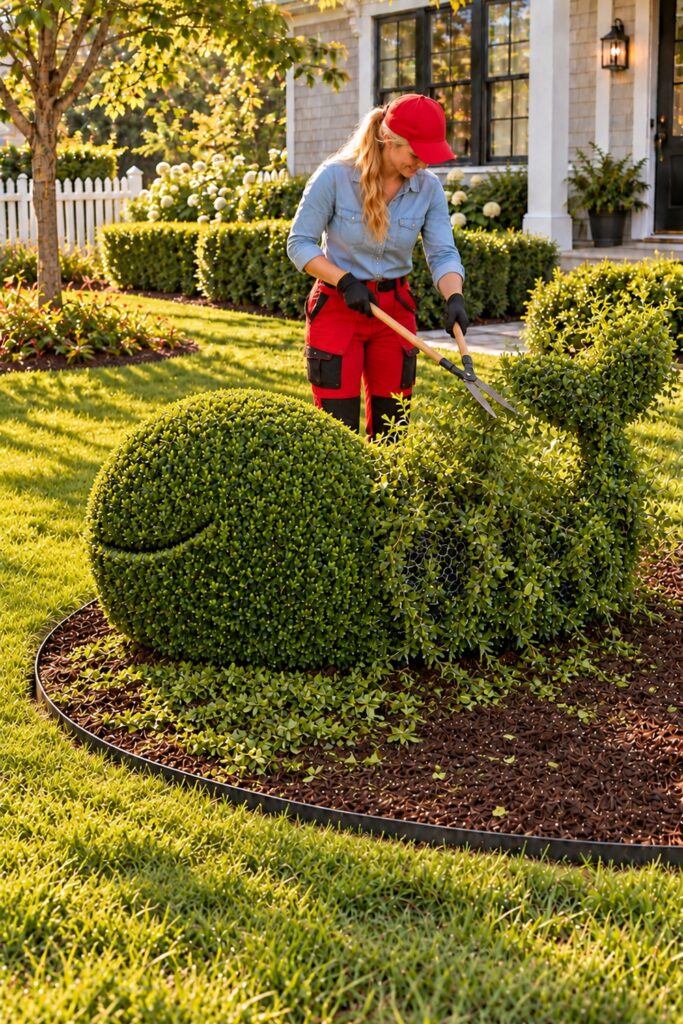
- Once shoots poke through the netting, trim them back to the wire with hedge shears.
- Do the main shaping in early spring, before new growth starts.
- Touch up lightly through the summer.
Watch out: stop trimming by mid-August. Clemson Cooperative Extension warns that shearing boxwood later can push out new growth that won't harden off before frost.
Step 8: Add the Eye and the Shells
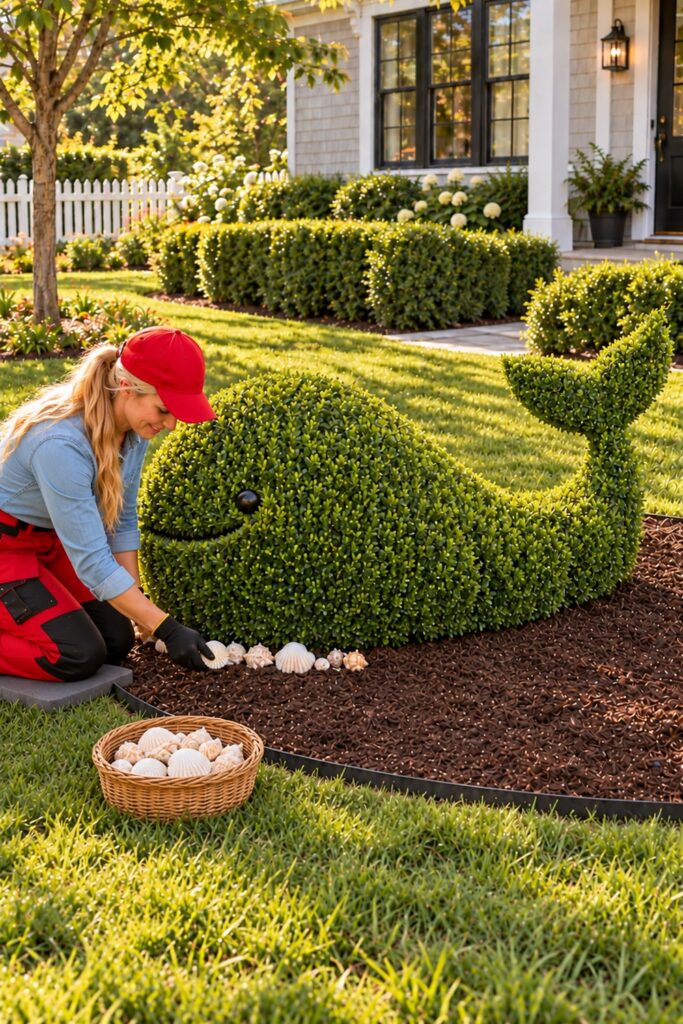
- Press a flat black stone into the head for the eye, and wire it to the netting.
- Rake up the clippings around the base.
- Set white shells or pebbles in a ring around the bed.
Watch out: add the shells after the trimming, not before. Shears and a rake scatter them.
Then step back to the sidewalk and look. The first time a stranger stops to smile at your whale, every summer of waiting pays off.
The Mistakes That Make It Fail
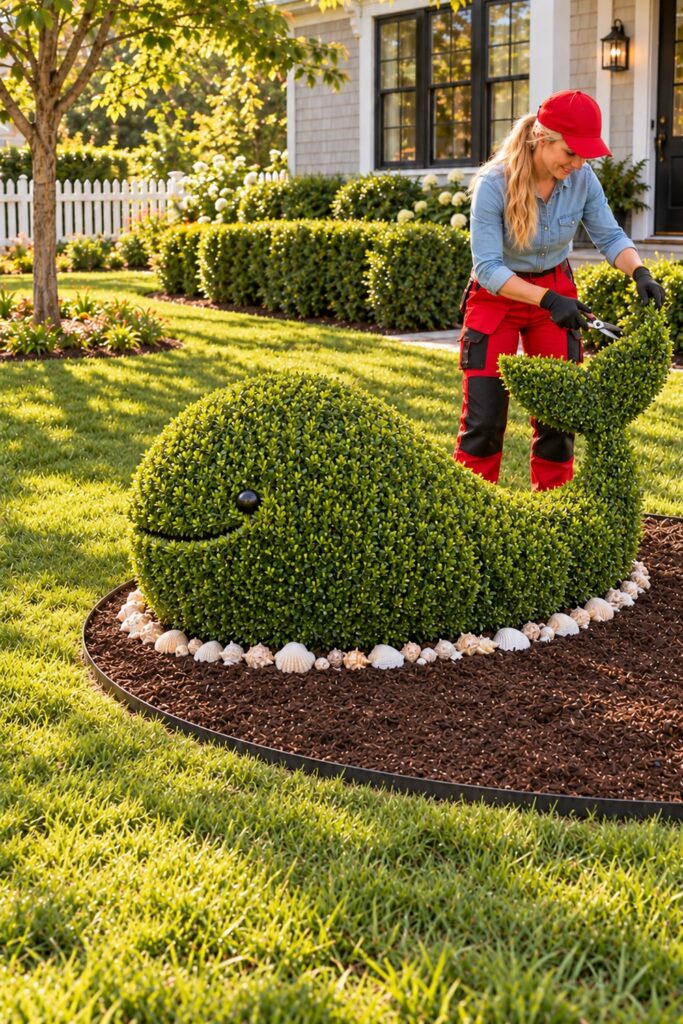
These five come up again and again under topiary videos, and each one has a simple fix:
- Expecting it in one summer. Shrub topiaries take years. Start with bigger plants, and enjoy the frame while it fills.
- Waiting to find a frame. Big animal frames are rare and costly. Bend your own from galvanized wire.
- Mismatched shrubs. They grow at different speeds, and the whale comes out lumpy. Buy five of one kind.
- A frame that isn't pinned. Wind rocks it and rubs the stems. Staple the bottom about every foot.
- Shearing in late summer. The new growth can die back in the first frost. Stop by mid-August.
Get those five right for the whale in the picture: a smooth green body, a curled tail and a smile.
Keep It Smooth: Water, Trimming and Winter
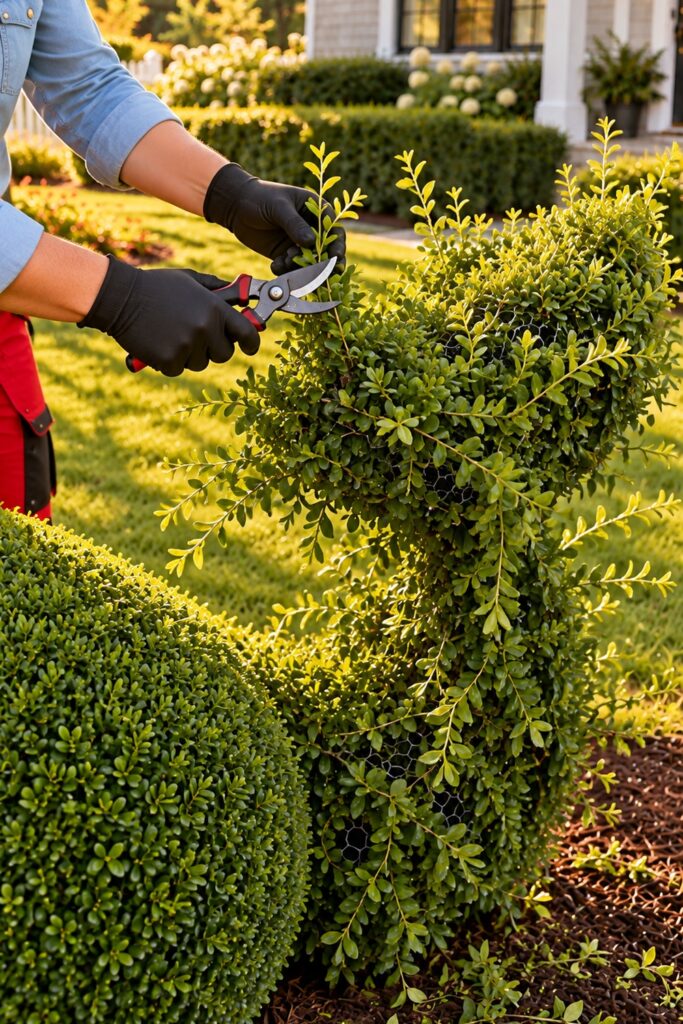
- Water: soak it once a week in dry spells, and more often in the first year.
- Trimming: shape it in spring, and touch it up through the summer until mid-August.
- Inside: every few years, thin a few branches inside, so light reaches the middle.
- Winter: brush heavy snow off the frame before it bends.
Then wait for the next neighbor who stops at the fence. For a front-yard flower bed to go with it, see our heart-shaped tulip bed.
Watch this build, and the next ones, on YouTube, Instagram and Facebook.
Start here
Want a whale smiling on your lawn in a few summers? Plant this fall, and get shears you'll enjoy using every year.
FAQ
How Long Does a Topiary Take to Grow?
Years, not months. Iowa State University Extension says shrub topiaries can take 3 to 10 years. Bigger starting plants get there sooner.
What Plant Is Best for Topiary?
A small-leaf evergreen that takes trimming well, like boxwood. Pick a kind that grows about as big as your frame.
Where Can You Buy a Whale Topiary Frame?
Big animal frames are sold online, but they're hard to find and costly. Bending your own from galvanized wire costs far less.
Should the Wire Frame Stay in the Shrubs?
Yes. The wire stays inside the shrubs as your trimming guide, year after year.
When Should You Trim a Boxwood Topiary?
Do the main shaping in early spring, then touch it up lightly until mid-August.


